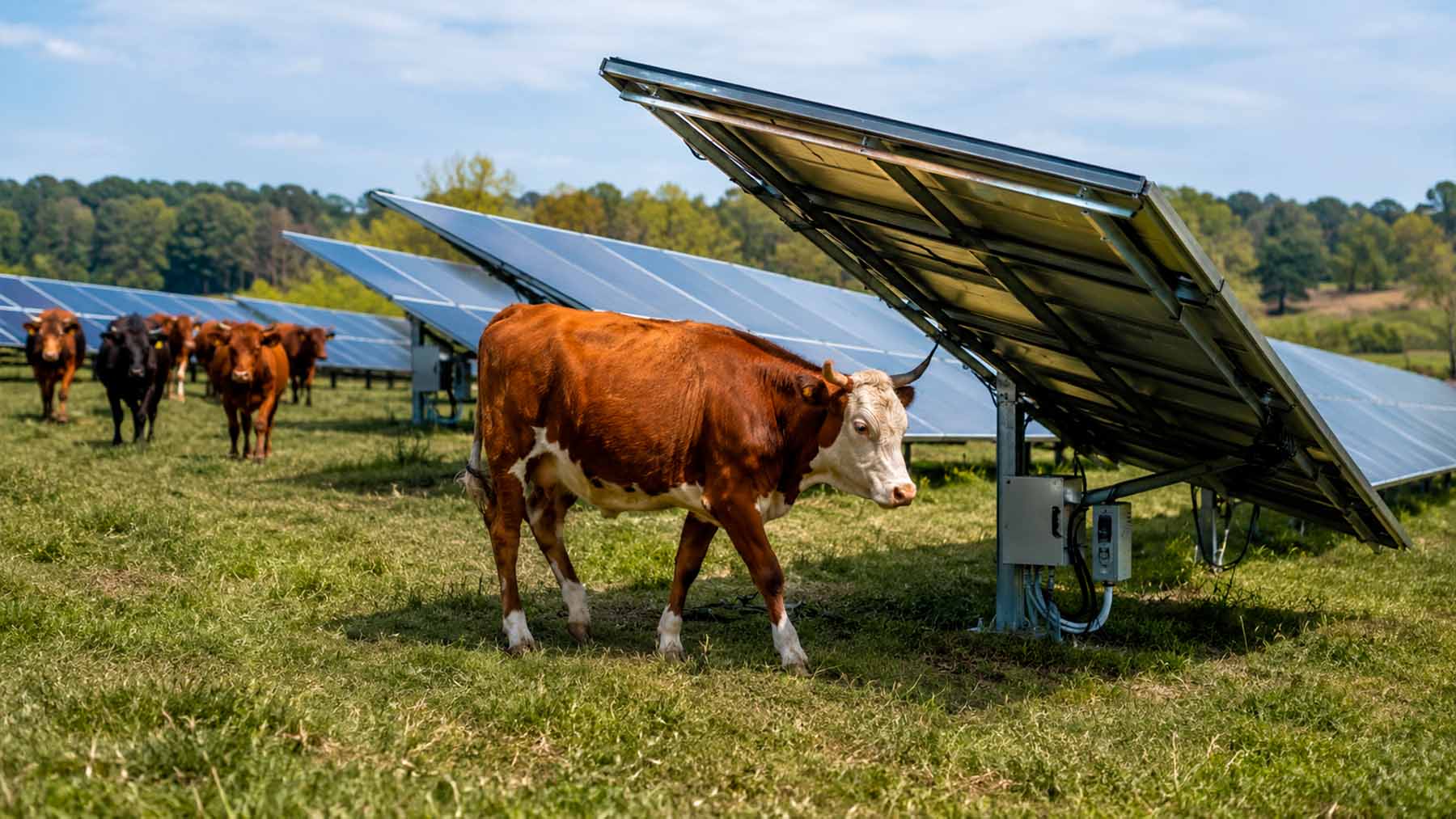
A commercial solar facility in Middle Tennessee is putting agrivoltaics in the spotlight. Operators recently launched a project that combines power with livestock. Solar infrastructure at the Christiana Solar Ranch operates alongside grazing cattle on a shared site.
Allowing heavy animals to come into contact with delicate electrical installations usually comes with risks.
How does the automated array system at this ranch manage to react and adjust when contact is imminent?
Agrivoltaics: How renewable power is combined with farming
There’s friction in the United States over solar developers taking up more and more agricultural land. The expansion of clean energy demands thousands of acres, and a lot of rural, established farming acreage has already been taken over by solar arrays.
Agrivoltaics now presents a middle ground. It is more than a compromise—it is a win all around. Two revenue streams can be generated on the same land, and the footprint is lighter, too.
Sheep have been the go-to choice for managing vegetation on solar sites for some time. They are small enough to move through the array support structures and electrical wiring without causing damage. Cattle, however, are a much bigger hazard—literally. They weigh more than 1,200 pounds. A mature cow having a scratch or bumping into a panel assembly can end up misaligning the panels, break cables, or even cause entire structural collapses.
These are major engineering concerns. But the potential economic benefits of combining cattle grazing with clean energy generation motivated solar developers to come up with a solution.
Under pressure due to farming displacement, regional utility provider Middle Tennessee Electric collaborated with solar operators on an experiment. They investigated whether utility-scale generation could successfully share land with a beef herd without compromising either.
Smart engineering means all stakeholders benefit
There were structural and financial hurdles to work out before agrivoltaics could be scaled to accommodate cattle. Conventional solar tracking arrays are single-axis systems designed to rotate to follow the path of the sun throughout the day. However, the physical drive mechanics are still left at heights that cattle can reach.
The logistics of raising the arrays so cattle could fit underneath were prohibitive. It’s more expensive due to more support structure materials, with thicker beams to withstand the cows’ weight. The height also meant that the arrays would be more vulnerable to strong winds.
Using fencing to surround just the arrays but leaving some gaps in between was considered. This undermines the advantage of shared land, and the cattle still could not manage the vegetation under the panels.
Engineers needed a flexible system that adjusted the solar panels in real time as the herd moved around the site.
Dual-use land and the role of automated tracking
Silicon Ranch in Tennessee designed CattleTracker, a platform so effective that it has been patented. The trackers go beyond following the sun. The single-axis system has a “grazing mode.”
When livestock approach, the motorized rows of panels are programmed to tilt vertically. This lowers the lowest edges of the panels completely out of the way of the roaming livestock, leaving the grazing zones clear and both the cattle and the infrastructure safe from damage.
Several benefits of grazing in the solar park
Their purpose is maintaining the vegetation, which they do brilliantly. But it also eliminates mechanical mowing, saves money, prevents noise pollution, eliminates the need for chemical herbicides, and reduces the use of fossil fuels.
The organic matter the cows leave behind is rich in nutrients and boosts soil health.
The successful rollout of Silicon Ranch’s technology at the Christiana Solar Ranch proves that renewable energy generation and agriculture can thrive on the same ground. By designing hardware around natural herd behavior, facility operators preserve farmland while generating clean power.
Understanding how livestock interact with clean energy technology highlights broader possibilities for sustainable land development across America. As solar installations expand, combining agriculture with electricity generation provides a practical option for energy independence and farmland conservation.
Read the whole thing?
Get the week's signal, not the noise
Our sharpest reporting on energy, climate and nature — free, once a week.