A man walking a Devon beach in 2015 spotted something small sticking out of a rock.
He had no idea what it was.
The exposed piece was so tiny that he almost stepped over it.
It took a decade of scanning, analysis and painstaking study before the world understood what that sliver of stone actually held inside it.
The answer, when it finally came, would rewrite a lineage stretching back further than the first dinosaur.
A beach that kept its secret for ten years
When the specimen was found on the Devon beach in 2015, there was so little of it exposed that nobody could tell what it was.
The rock was collected, catalogued and handed to researchers.
What followed was not a quick breakthrough.
Its minuscule size made it extremely difficult to study, so scientists turned to high resolution synchrotron scans that could reveal details invisible to the naked eye.
The machine they used fires X-rays millions of times more powerful than a hospital scanner.
Each scan took hours to process.
Slowly, a skull emerged from the data.
And it was unlike anything researchers had seen before.
What the skull told them about ancient life
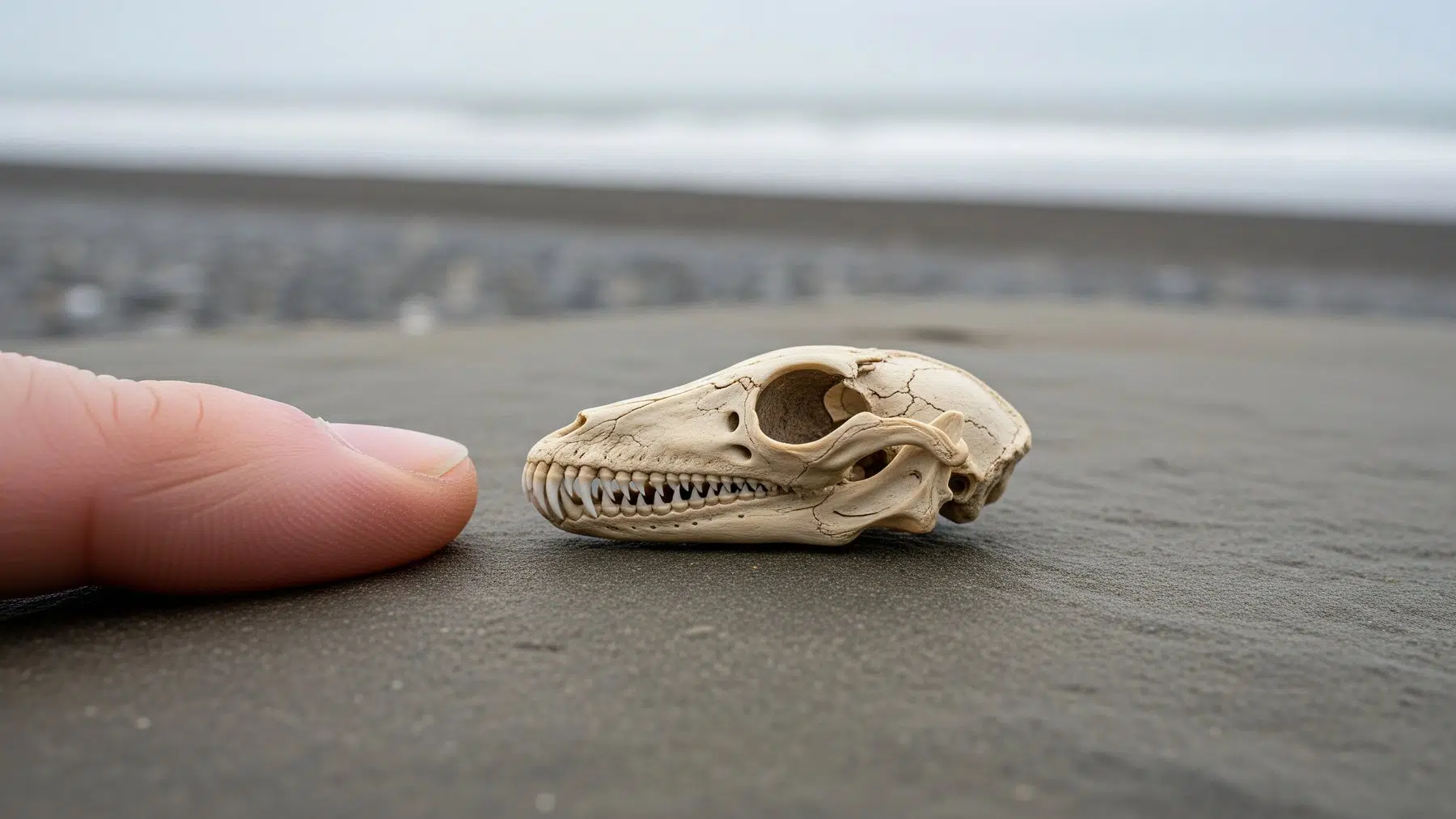
The ancient reptile was so small its entire body could fit in the palm of a human hand.
It used surprisingly large teeth to hunt cockroaches 242 million years ago.
That detail alone startled the team.
Instead of the expected skull hinges and palate teeth typical of modern lizards and snakes, this ancient creature showed a surprising mix of primitive and unusual traits, along with strikingly large, blade like teeth.
Scientists had long believed the earliest members of this lineage would carry three specific features in their skulls.
Shockingly, they found evidence of only one.
The fossil had no palate teeth and no sign of skull hinging at all.
The rules had just been rewritten.
The world it walked through before the dinosaurs
The fossil dates back 242 million years, to the Middle Triassic, just before the dinosaurs appeared.
Picture a warm, semi arid landscape crossed by slow rivers.
No grass yet, no flowering plants.
Just ferns, strange conifers and the sound of insects in the undergrowth.
A creature the size of a thumb darted through the leaf litter, snapping at cockroaches with narrow, precise jaws.
The fragile bones of the earliest lepidosaurs were vulnerable to being crushed or dissolved, which is why fossils like this one are extraordinarily rare.
This individual was buried fast and preserved almost perfectly.
Conditions on that ancient floodplain sealed it in stone and held it there for nearly a quarter of a billion years.
It waited in that Devon rock through every mass extinction and every ice age that followed.
The ancestor of every snake and lizard alive today
Researchers confirmed that this is a fossil of the oldest known lepidosaur, Agriodontosaurus helsbypetrae, offering fresh insights into the origins of modern lizards, snakes and the tuatara.
It is up to seven million years older than any other known lepidosaur fossil.
Today, lizards, snakes and the unique tuatara from New Zealand together form the most successful group of land vertebrates, with over 12,000 species, more than birds and more than mammals.
Every garden skink sunning itself on a patio, every garter snake slipping through the grass, every rattlesnake and gecko on Earth traces its family back to this one tiny Devon animal.
The ancient reptile is giving scientists new insights into why lizards became so dominant.
The study, published in Nature on September 10, 2025, forces a reevaluation of what we know about lepidosaur evolution.
What a coin sized fossil changes for science
The find matters far beyond the history of a single beach.
It shows that the lizard lineage was already branching and experimenting with body plans well before dinosaurs ruled the Earth.
Since the Middle Triassic, lepidosaurs have diversified in several stages, the early ones flitting through the undergrowth under the feet of the giants that came after them.
That resilience is exactly what allowed them to outlast the dinosaurs entirely.
Today, the descendants of that cockroach hunting speck keep doing what their ancestor did: adapting, spreading and finding paths through a world that keeps changing around them.
The lesson hiding inside a stone no bigger than a coin is that survival rarely looks impressive from the outside.
Scientists note that a single fossil cannot answer every question about how the lepidosaur family tree branched, and more specimens from the Middle Triassic are needed to fill the gaps.
But on a pebbled beach in Devon, the oldest chapter of the most successful reptile story on Earth is finally starting to be read.
Read the whole thing?
Get the week's signal, not the noise
Our sharpest reporting on energy, climate and nature — free, once a week.