Out in Val Verde County, far past the last gas station before the Texas Mexico border, the Devils River runs through canyon country most Americans have never seen.
The water is milky green, moving through a wilderness with no towns on its banks and no commerce along its shores.
Texans call it the last wild river in the state, and for three years its future has been fought over in filings and hearings rather than out there on the water.
Read those filings and you find grid rules, foreign ownership and fiduciary duty. What you barely find is the animal with the most to lose, hanging in a cave a few miles away, waiting for dark.
A wind farm that nobody could quite agree on
The fight centers on the Blue Hills wind farm, a 46 turbine project of roughly 276 megawatts planned near Comstock.
It was started by Houston based GH America Energy, a company controlled by the Chinese billionaire Sun Guangxin.
Between 2016 and 2018 that company bought over 130,000 acres across ten ranches in Val Verde County, then sought interconnection rights from ERCOT, the operator of the Texas grid.
From one angle this looked like a straightforward renewable project on private land. From another it looked like something a great many people in Texas were not going to accept without a fight.
The law that came too late, or maybe just in time
Val Verde landowners pushed to pass the Lone Star Infrastructure Protection Act of 2021, filed as Senate Bill 2116.
It prohibits entities from China, Russia, Iran and North Korea from owning critical infrastructure in Texas.
The company moved before the ink was dry. On 31 January 2022 GH America Energy signed an asset purchase agreement handing Blue Hills to Greenalia, a Spanish renewable developer.
That put a European name on a project that had begun under Chinese ownership, and it did not settle anything.
On 4 May 2023 attorney Dallas J. Barrington filed suit for Ward-Walker Seven Oaks Ranch and Cole Ranch, naming ERCOT, two GH America entities and Greenalia Wind Power Blue Hills.
The legal argument was about the grid. The living argument, the one that drew conservationists from across Texas, was about something else entirely.
The surprise buried inside the opposition
Each turbine would stand 700 feet tall, which would have made them the tallest onshore wind turbines ever built in the United States.
That is over 50 percent taller than the 430 foot machines at the nearby Rocksprings wind farm.
They would also cut into ecotourism from state and federal parks and threaten archeological sites, including historic cave paintings.
The area sits at the crossroads of three ecological regions, the Chihuahuan Desert, the Tamaulipan Brushlands and the Edwards Plateau.
Three ecosystems meeting in one place means three migration routes, nesting grounds and feeding corridors stacked on top of each other.
What lives in the rock beneath the proposed turbine site is one of the most remarkable wild gatherings in the region.
What Fern Cave holds, and why 700 feet changes everything
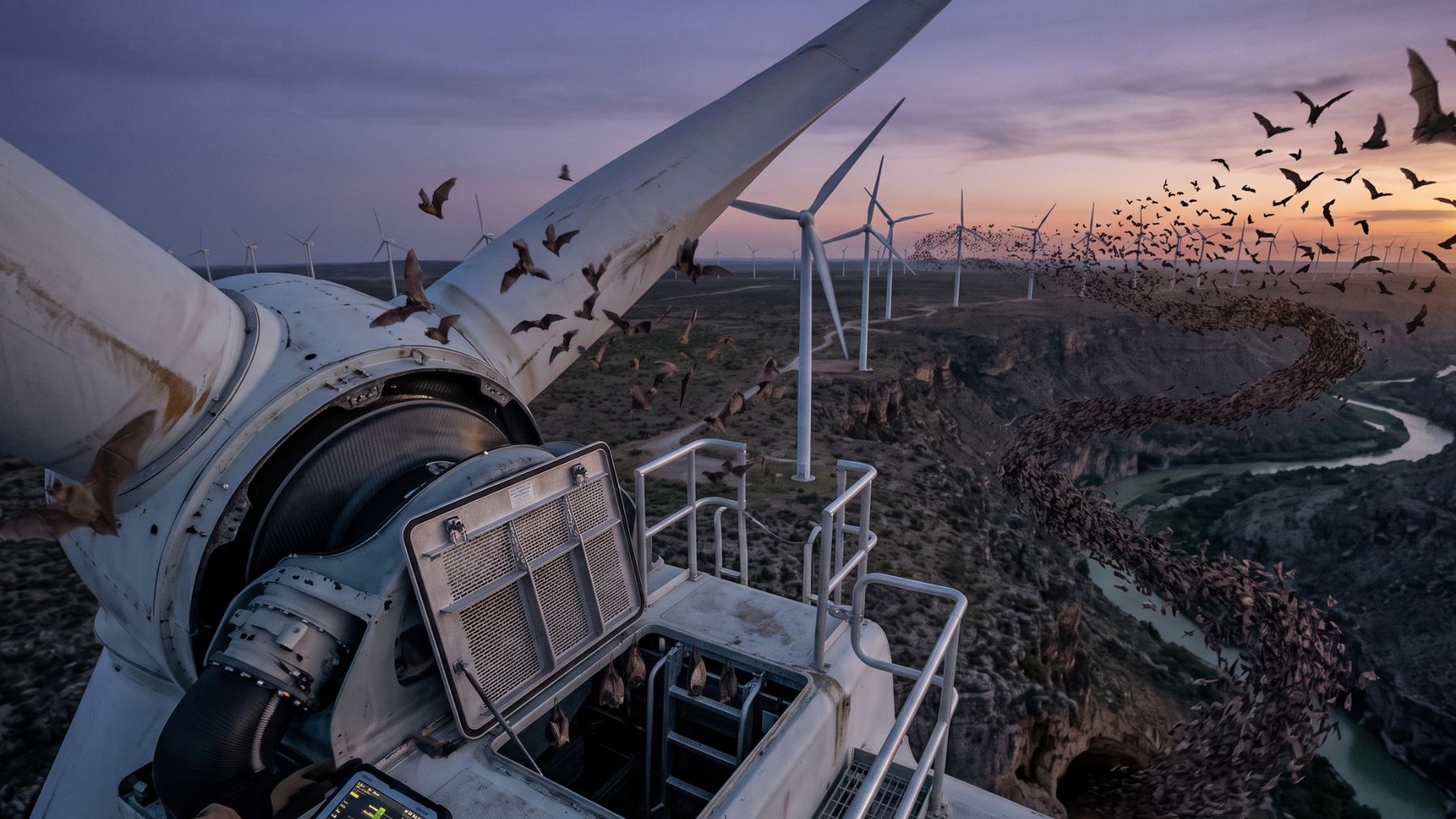
Millions of Mexican free tailed bats roost in nearby Fern Cave, and the proposed transmission lines and turbines sit directly across their nightly pathway.
Each evening they pour out in a living column that takes a long time to fully emerge.
Then they travel enormous distances eating insects, including the agricultural pests farmers across the region depend on them to control.
Put 46 turbines across that flight path and the math for the bats changes fast.
The Devils River Conservancy, The Nature Conservancy and local landowner groups all formally opposed the project, arguing that no energy argument changes what a spinning blade does to a bat at midnight.
The monarchs face the same problem, because the site also sits on a major flight path for migrating butterflies and birds.
What happened next, and why the cave matters beyond Texas
The project did not fall to the bats. It fell apart on paper.
GH America Energy sued Greenalia, claiming the Spanish buyer had withheld information and failed to execute the interconnection agreement with American Electric Power.
On 26 March 2025 a federal judge in New York dismissed that case for lack of jurisdiction and sent the parties to the Texas courts named in their own contract.
Pressure came from Washington too. In July 2024 Senator John Cornyn asked the Department of Defense to suspend the project’s environmental permit over the training mission at Laughlin Air Force Base, as national coverage reported.
The case is a reminder that clean energy projects on paper can carry complicated costs on the ground, especially when that ground is already doing extraordinary ecological work.
Texas caves shelter tens of millions of Mexican free tailed bats each season, and their nightly flights reach crops and ecosystems hundreds of miles away.
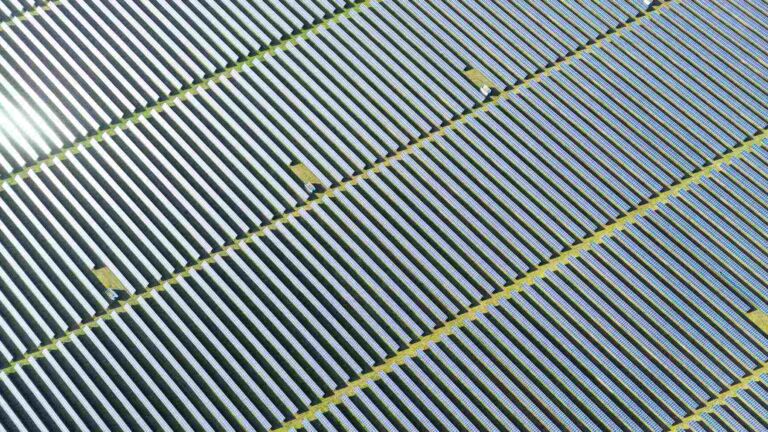
Engineers are finding ways to adapt, and pronghorn in the American West have been tracked threading their own paths between solar arrays rather than abandoning ancient routes.
Researchers have also found that solar farms can become unexpected refuges for species nobody planned for.
Val Verde County still has no settled answer, but the river keeps running and the bats keep flying out each evening into a darkening Texas sky.
Whatever any court decides, the cave will still be there, and so will everything that depends on what comes out of it.
Read the whole thing?
Get the week's signal, not the noise
Our sharpest reporting on energy, climate and nature — free, once a week.