It sounds like a power station.
Row after row of dark glass panels, angled at the sky, bolted into what used to be a meadow or a crop field.
For years, that picture has been the whole story of a solar farm.
But something tucked in between the panels that nobody planned for is changing how the energy industry thinks about the land beneath its feet, and it starts with all 1,042 solar farms in Great Britain.
A creature that was losing ground long before the panels arrived
Bumblebees were already in serious trouble before the solar boom began.
One major study projected that between 38 and 76 percent of European bumblebee species could lose at least 30 percent of their suitable territory by the 2060s.
In Britain, 2024 was the worst year for bumblebees on record, according to the Bumblebee Conservation Trust.
The reasons pile up fast.
Land use change, intensive agriculture, invasive species and infectious diseases are all bearing down on pollinators at once.
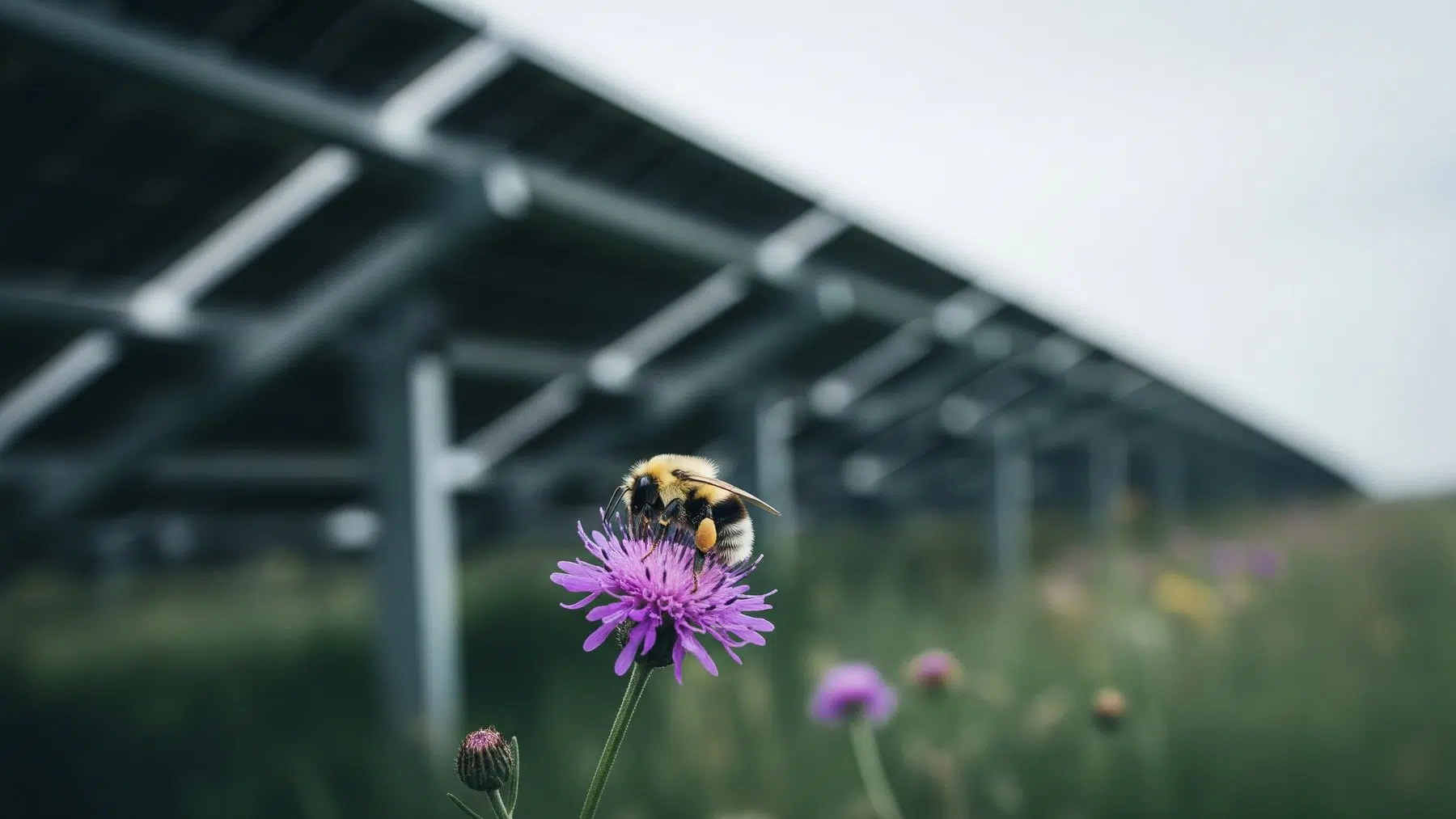
Bumblebees need two things above almost everything else: flowers to feed on and undisturbed ground to nest in.
Intensive farming strips both away in a single season.
What happens when the mowers stop
When a solar farm goes up on former cropland, something shifts almost immediately.
The mowing schedules slow down and the herbicide stops.
Solar panels add structural complexity to a landscape, creating pockets of shade and shelter that open farmland simply does not offer.
Wildflowers begin pushing through the gaps between panels wherever the ground is left alone.
Raised panels allow native grasses and plants to thrive alongside them in a way solid pavement never could.
Ecologists started noticing insects moving in on their own, without anyone seeding a single plant or laying a single nest box.
The land was not being restored in any formal sense.
It was simply being left alone, and that turned out to be enough of an invitation.
The numbers that made researchers look twice
Evidence from the United States sharpened the picture considerably.
In a study on two solar farms in Minnesota, researchers found that insect populations had tripled over five years, with native bee populations increasing twentyfold.
That figure alone stopped a lot of people mid sentence.
The research team found increases across every habitat and biodiversity measure they tracked.
They also found positive effects of proximity to solar habitat on bee visitation to nearby soybean fields.
The benefit was leaking out through the fence line.
Farmers growing crops next door were getting more pollination services than before, not from a conscious conservation effort, but from a power plant sitting beside their field.
Mapping every farm to find out how far the effect could go
That is what drove scientists at Lancaster University, the UK Centre for Ecology and Hydrology and the University of Reading to map all 1,042 operational solar farms in Great Britain.
They modelled each farm’s ability to support bumblebee populations, inside and outside the boundary, under three different futures running to 2050.
The key variable was not the panels.
It was what grew underneath and around them.
Their modelling suggests bumblebee numbers could more than double, a 120 percent increase, if farms swap turf grass for wildflower margins.
That gain is largely contained within the solar farm itself.
In the foraging zones immediately surrounding the boundary, wider landscape changes had a greater impact on bumblebee densities than management inside the fence.
Well managed farms can nonetheless act as local refuges, protecting bumblebee populations against landscape changes beyond their boundaries.
Even so, a single farm in isolation cannot reverse the effects of large scale land use change across an entire region.
A power plant that feeds more than the grid
The honest caveat matters here.
Wildflower margins cost money to establish, and not every solar developer chooses to plant them.
Bumblebee density was significantly greater inside farms managed with floral rich margins compared to those managed as turf grass.
The benefit is real, but it is not automatic.
Solar farms managed with native habitat require less mowing and less maintenance, which can more than offset the upfront cost of richer plantings.
Meanwhile, native bees in the United States are in decline, with nearly a quarter of assessed species now at risk of extinction.
Solar farms, it turns out, offer a chance to feed nature recovery and the grid at the same time, as researchers who tracked wildlife colonizing energy infrastructure have now found repeatedly.
A solar panel field seeded with wildflower margins is not a wildlife sanctuary by any grand design.
It is simply a power plant that remembered what the land used to be, and left a little room for the creatures that were there first.
That turns out to be a surprisingly powerful thing.
Read the whole thing?
Get the week's signal, not the noise
Our sharpest reporting on energy, climate and nature — free, once a week.