
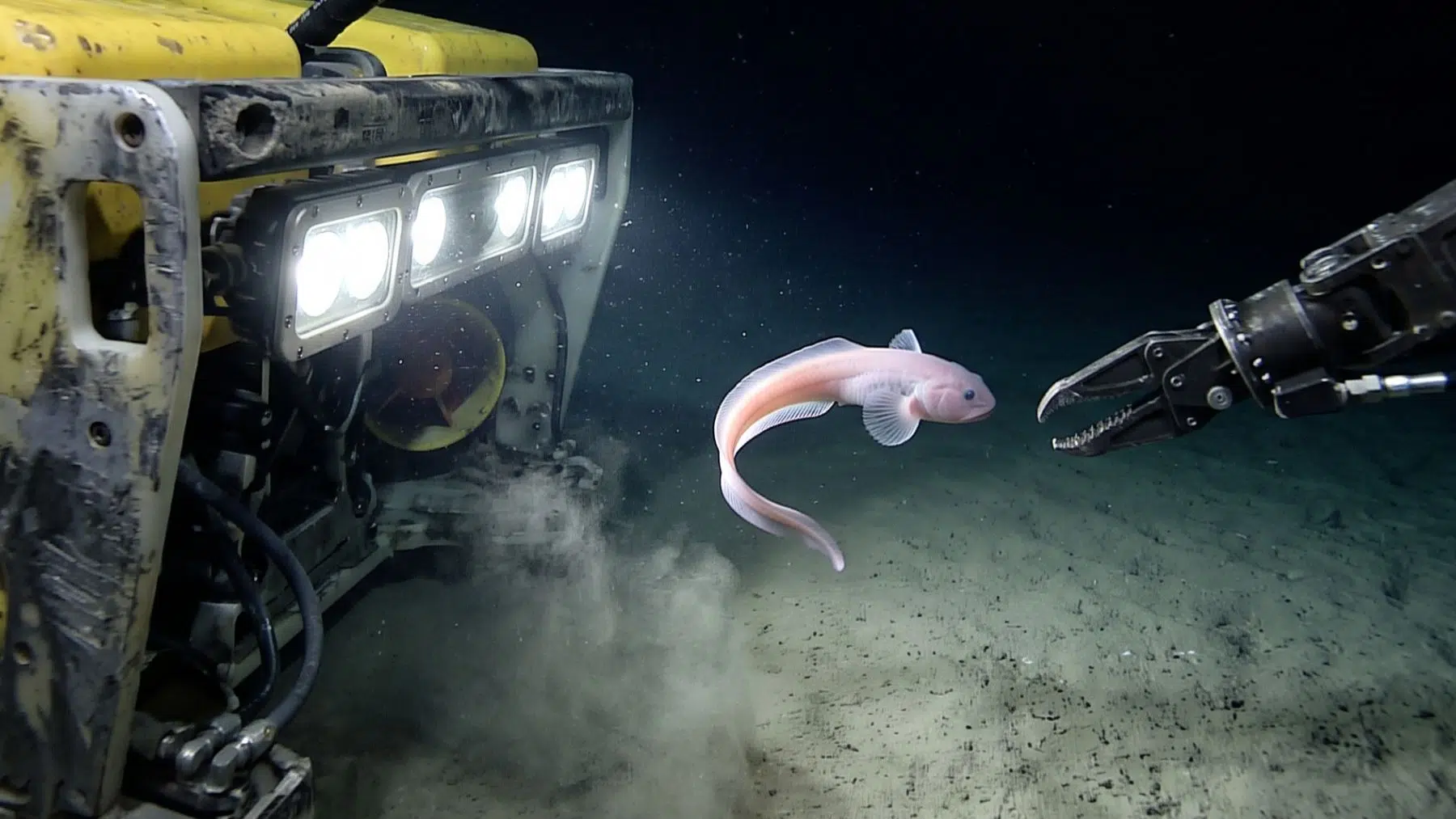
An underwater robot dropped into the water about 60 miles off the central California coast.
It sank for hours, past the last of the light, until the depth gauge read 10,722 feet.
And there, holding station a few inches above the sediment, was a small pink fish nobody on the ship could identify.
So the pilots filmed it, logged it, and the vehicle carried on with the dive it had come down there to do.
Then it took six more years before that animal had a name.
A canyon the size of the Grand Canyon, starting at the beach
The dive happened in Monterey Canyon, which is the reason any of this is possible.
Because the canyon head sits almost at the shoreline near Moss Landing, deep water begins absurdly close to a California parking lot.
From there it runs 290 miles out to sea and reaches 7.5 miles across at its widest point.
Its walls climb about 5,580 feet, which puts them close to the depth of the Grand Canyon itself.
The comparison is the one the researchers themselves use, similar in scale and shape rather than bigger.
But the two were built by opposite forces. A river cut one over millions of years, while underwater avalanches of sediment carved the other.
And the canyon floor keeps dropping past 13,000 feet where it finally spills onto the abyssal plain.
What the robot saw down there
The vehicle was Doc Ricketts, a remotely operated robot flown on a cable from a ship at the surface.
Which matters, because at that depth a human submersible has to carry people, and a robot does not.
The fish it found was a snailfish, part of a family built for pressure rather than for speed.
They have no swim bladder, almost no scales, and a body of loose gelatinous tissue that does not care how hard the water squeezes.
This one was pale pink, with skin covered in a rash of bumps, and it hung above the seafloor rather than resting on it.
None of that matched anything in the catalogue of fish already known from these depths.
So it went into the archive as an unknown, which is where most deep sea footage usually ends up.
Why naming a fish takes six years
Yet a video alone cannot name a species, and that is the whole delay.
Describing an animal formally means proving it is not something else, and video cannot do that.
So the work runs through microscopy, then a micro CT scan that maps the skeleton without cutting the specimen open, then DNA sequencing.
Each of those steps sits in a queue behind other work, in labs that are not funded to move quickly.
Then the results have to be written up, reviewed by other specialists, and published.
The formal description finally appeared in September 2025, in the journal Ichthyology and Herpetology.
Six years, in other words, is not slow. It is roughly how long it takes.
Three species, and only one from this dive
Because the paper did not describe one fish. It described three at once.
Only the bumpy snailfish, Careproctus colliculi, came from the robot’s dive in the canyon.
The other two were collected somewhere else entirely, at a long term research site called Station M, roughly 13,100 feet down.
And they were not found by a robot at all. The dark snailfish and the sleek snailfish were brought up by Alvin, the crewed submersible, as the institute laid out.
All three were described together by a team led by Mackenzie Gerringer at SUNY Geneseo, working with colleagues in Montana and Hawaii.
Which is the ordinary shape of deep sea work, where one dataset borrows from another the way a solar site or an offshore project borrows its monitoring from whoever already has a vessel out there.
One sighting, and what that says
Here is the part of all this that is worth sitting with for a moment.
That single encounter in the canyon is still the only confirmed sighting of the bumpy snailfish anywhere, as the coverage of the paper noted.
One animal, seen once, on one afternoon, in one canyon, and now it has a scientific name.
Which tells you a good deal less about the fish itself than it does about the ocean it lives in.
Because this canyon is among the most heavily surveyed pieces of deep seafloor on the planet, sitting an hour from a major research institute.
And it still handed over an animal nobody had ever recorded.
The lead author put it simply enough. The deep sea holds an incredible diversity of organisms and a beautiful array of adaptations.
So the honest headline is not that a robot found a new fish. It is that the best studied deep canyon in America is still full of strangers.
Read the whole thing?
Get the week's signal, not the noise
Our sharpest reporting on energy, climate and nature — free, once a week.




