On a property near Theodore, in central Queensland, a farmer named Nick Freeman picked up a slab of rock.
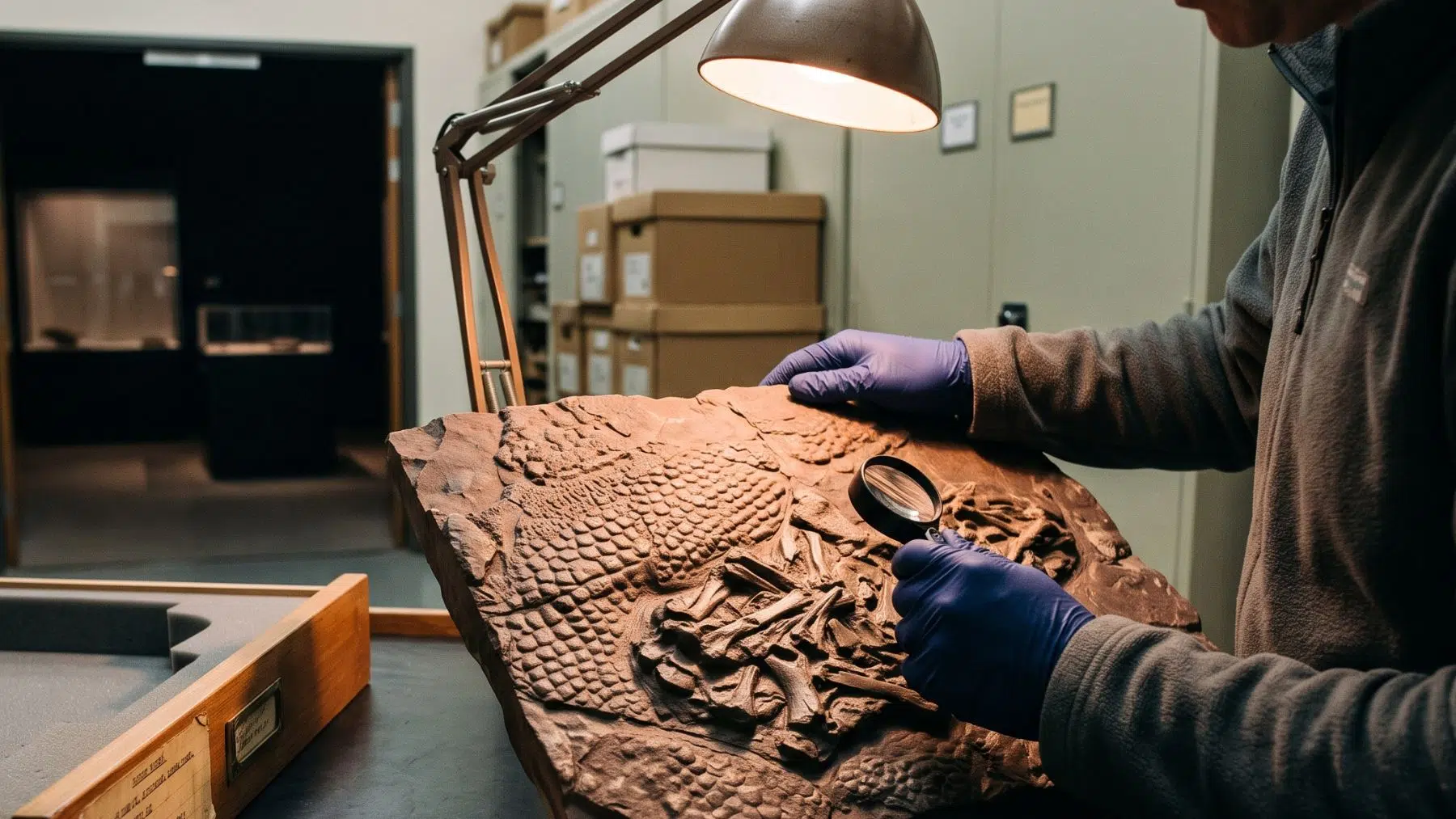
Something was printed across the surface of it, a dense pattern of raised scales and ridges.
So he did the right thing with it and handed the slab over to the Queensland Museum.
Where it went into a drawer, and stayed there for three decades.
The label it earned, in the curator’s own words, was the too hard basket.
What the farmer actually picked up
The problem was that the fossil is a fragment rather than an animal.
It is a piece of cuticle, the tough outer shell of something that moulted and grew, and it carries no head, no legs and no tail.
Which leaves ornamentation, the pattern on the shell, as almost the only clue available.
Andrew Rozefelds, the curator who kept coming back to it, worked out early that it had to be an arthropod of some kind, something with a jointed shell.
And the size of it, the ornamentation across the shell and the place it turned up all pointed the same way.
They pointed at a eurypterid, the group most people know as the sea scorpions, a name that has caused confusion ever since it was coined.
But pointing at a group is not the same as naming a species, and there the trail went cold for years.
The animal on the other end of that fragment
Because a eurypterid is not a small thing to have living in your river.
This one ran to more than three feet, which made it among the largest predators in the freshwater system it hunted.
And that is the first correction worth making. Despite the name, this animal was not in the sea at all, but in lakes and rivers inland.
The group as a whole lasted more than 200 million years, which is longer than the dinosaurs managed.
Some of them were monsters. The largest known, from Germany, reached about eight feet and remains the biggest arthropod that has ever lived.
They were already ancient when the first dinosaur appeared, and by then most of them were gone.
Why a lockdown solved it
Then the world closed, and a museum with no visitors coming through the door is a museum with time on its hands.
During the closures of 2020 and 2021, Rozefelds pulled the Theodore slab back out and worked the problem properly.
He also brought in Markus Poschmann, a specialist in Germany who works on exactly these animals.
Between them the fragment finally resolved into something genuinely new, and it was given a name that honours the family who found it and handed it in.
The date is what made everyone sit up. The rock it came from is about 252 million years old.
That puts the animal at least 11 million years younger than any other eurypterid ever recorded, anywhere.
The last one, and what happened next
Which makes this fragment the final entry in a ledger that had been running for 200 million years.
Because 252 million years ago is the doorstep of the end Permian extinction, the worst event in the history of animal life, as the museum set out when it announced the work.
Something like four out of five marine species disappeared inside a geological blink, and the eurypterids went with them.
They had come through every earlier crisis in that long run. They did not come through this one.
The description was published in the journal Historical Biology at the end of 2021, as the coverage of the paper reported.
So a single unlabelled slab from a Queensland paddock now marks the last known moment of an entire order of animals, in the same way a solar site or an offshore project ends up documenting far more than it was built to measure.
What is actually left of them
People usually reach for the horseshoe crab at this point, and that is not quite right either.
Horseshoe crabs are cousins, in the same broad family of animals, but they are not the closest living link.
The nearest surviving relatives of a sea scorpion are the ones already living in your garden shed and under your porch.
Scorpions and spiders sit closer on the tree than anything crawling up an Atlantic beach in spring.
Which is a strange thing to hold in your head, that the animal in the slab has no direct descendants at all.
Its whole lineage stops at that one rock face in central Queensland, and everything that came afterwards belongs to some other branch entirely.
And it took a farmer, a full lockdown and a specialist in Germany to work out that the ledger closed there.
Read the whole thing?
Get the week's signal, not the noise
Our sharpest reporting on energy, climate and nature — free, once a week.