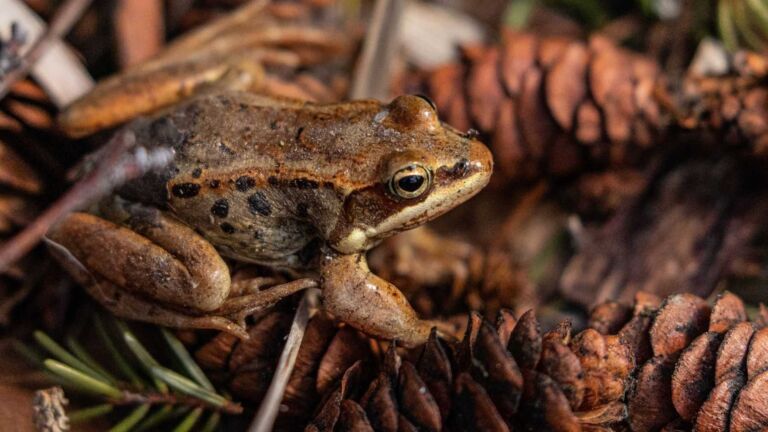
Around 7 a.m., fog still hanging in the trees, a biologist driving through Brazil’s Atlantic Forest spotted a small primate dead on the pavement — a buffy-headed marmoset, one of the world’s most threatened primates, with only an estimated 2,500 individuals left in the wild. It wasn’t an unusual morning. Nearly 9 million mammals die on Brazil’s roads every year, in the country that holds the greatest diversity of primates on Earth.
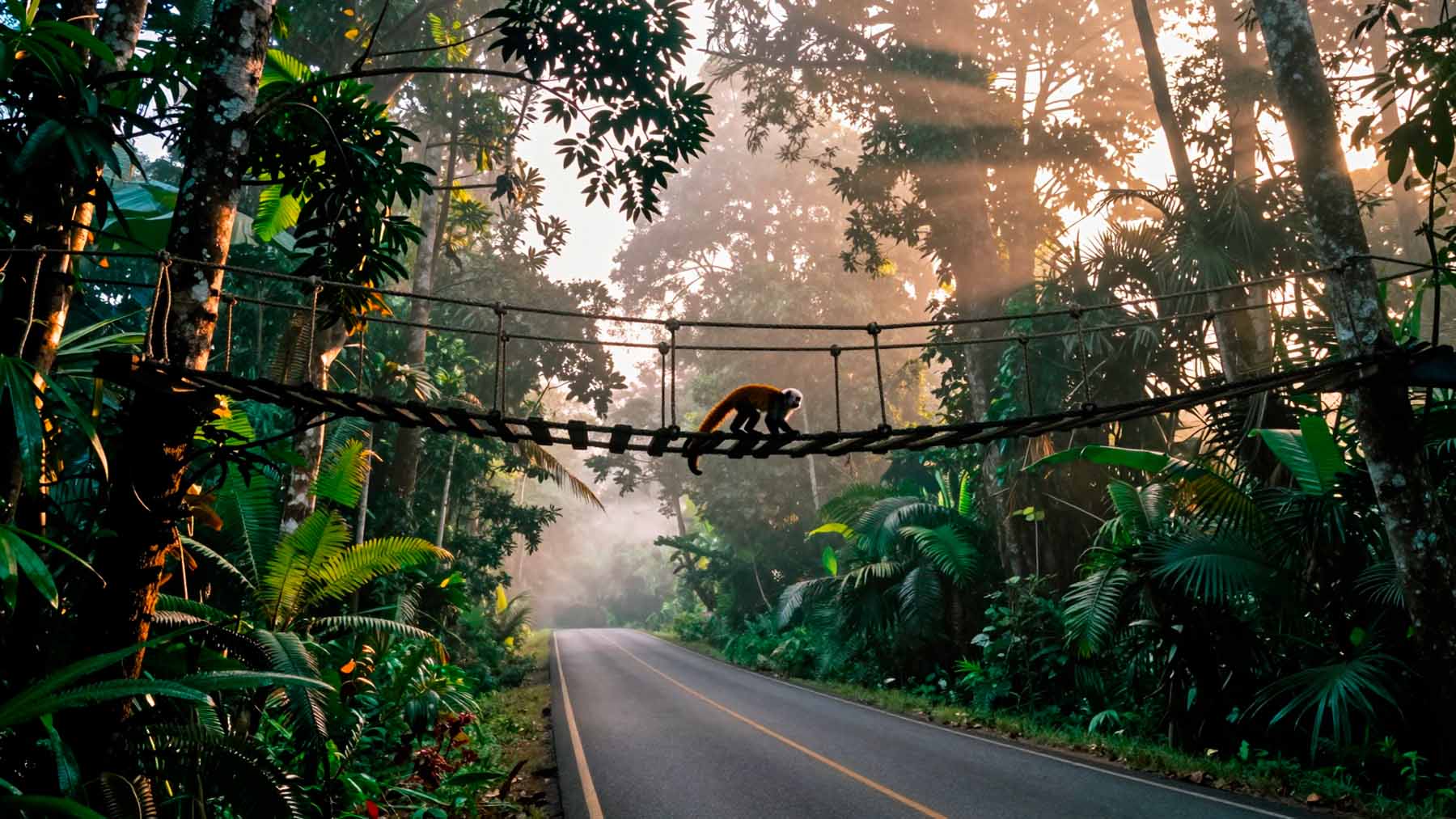
About 1,800 miles away, on the road into Alta Floresta — a small Amazon town in Mato Grosso — that story hasn’t repeated itself once since 2024. The reason hangs quietly above the highway, strung between the treetops.
A deadly divide running through the world’s most biodiverse nation
Brazil carries a paradox at its core. It’s home to more primate species than any other country on Earth — and also the fourth-largest road network. For animals living along fragmented forest edges, that combination is lethal.
Nearly 9 million mammals are killed on Brazilian roads every year, according to a 2022 study. A 2025 data compilation published in Nature ranks Brazil among the countries with the highest mortality rates for terrestrial vertebrates from roadkill. The numbers are large enough to feel abstract — until you’re standing over a dead marmoset at dawn.
“From our human perspective, roads mean connection and development,” Abra has said. “But for wildlife, they represent disconnection, barriers, and a threat to survival.”
When a highway splits a forest, it isolates the populations on either side. Smaller, confined groups become more vulnerable to inbreeding. Primatologist Fabiano Rodrigues de Melo, a professor at the Federal University of Viçosa, describes it as a domino effect: lose the fruit-eating primates, and you lose the seed dispersers — and once they’re gone, the forest composition begins to shift in ways that are difficult to reverse.
“The impact of roadkill is still greatly underestimated,” Melo told Mongabay.
Eight bridges, 15,000 crossings, zero roadkill
In 2024, Projeto Reconecta installed eight rope canopy bridges near Alta Floresta, connecting fragmented forest patches over a local highway. The results, documented over 15 months of camera-trap monitoring, were unambiguous: 15,000 safe crossings by arboreal animals, and not a single roadkill event recorded.
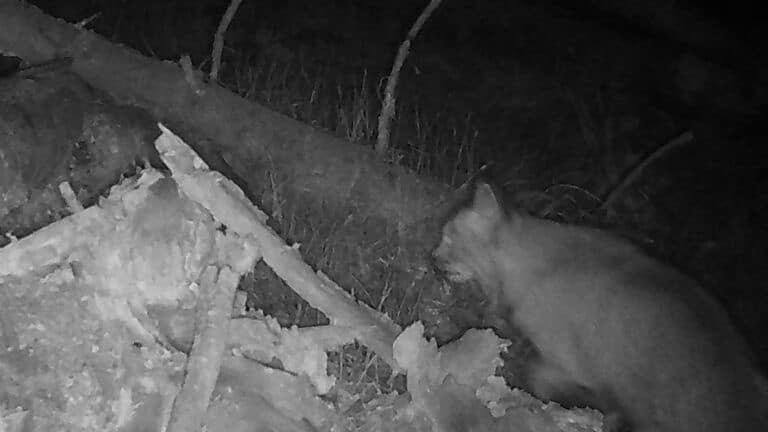
Camera traps captured the black-faced black spider monkey, the Purus red howler monkey, the northern night monkey, the tufted capuchin, and Schneider’s marmoset. Most notably, the bridges drew the Alta Floresta titi monkey — a species described by science only in 2019 and almost immediately classified as critically endangered. Sloths, opossums, and mouse opossums were also recorded crossing, animals not typically expected to climb a rope structure.
Each bridge carries two camera traps. One faces the crossing itself; the other faces the forest edge, recording animals that arrive but hesitate — capturing behavior, not just outcomes.
Fernanda Abra: the biologist who redesigned a highway from above
Abra, an associate researcher at the Smithsonian National Zoo and Conservation Biology Institute, founded Reconecta after years of searching for a solution that was simple, low-cost, and built to last. Her rope bridge uses a multilayer design — a network of crossed ropes accommodating multiple movement styles. Spider monkeys brachiate arm over arm; others rely on prehensile tails; some simply walk across. The bridge works for all of them.
The design was refined on BR-174, a highway cutting through the Amazon between Amazonas and Roraima states. Working alongside the Waimiri-Atroari Indigenous community in 2021, Reconecta installed 32 bridges along that road. Over five years, cameras logged roughly 1,250 primate crossings, including the golden-handed tamarin.
Abra received the Future For Nature Award in 2019, the Whitley Award in 2024, and was named a recipient of the 2026 National Geographic Wayfinder Award.
Why patience is part of the science
One counterintuitive finding from Reconecta’s monitoring is how long animals take to trust a new structure. In Alta Floresta, tufted capuchins waited seven months before using a bridge for the first time — seven months of cameras recording hesitation before a single crossing appeared.
BR-174 was built in the 1970s. Decades of learned avoidance don’t dissolve overnight. Reconecta’s data consistently show that bridge usage climbs over time, but that pattern only becomes visible if you’re still watching. Conservation funding tends to reward fast results. Rope bridges produce slow ones — and then, eventually, thousands of them.
“Very often, our sense of urgency in conservation doesn’t take into account the timing of the impact,” Abra has said.
From a local experiment to a national — and international — standard
Brazil’s federal transport department has officially adopted Reconecta’s rope bridge design as the recommended national standard for highways. A bill establishing a National Road Safety Plan for Wildlife — requiring warning signs, speed-reduction devices, and aerial crossings — has passed Brazil’s Chamber of Deputies and is awaiting a Senate vote.
Reconecta is now expanding to Suriname and to Lucas do Rio Verde, where 10 new bridges are planned. Abra also has her eye on BR-262, which cuts across the Pantanal and kills approximately 2,000 animals per year, and on the Atlantic Forest, home to muriquis and howler monkeys.
“I envision a future with Reconecta Biomes,” Abra has said. “We already have Reconecta Amazon, and we’ll soon launch Reconecta Pantanal.” Central to that vision is co-ownership between researchers, local governments, Indigenous communities, and private partners. “When everyone is involved,” Abra said, “everyone values the initiative and works harder to make it succeed.”
Read the whole thing?
Get the week's signal, not the noise
Our sharpest reporting on energy, climate and nature — free, once a week.