
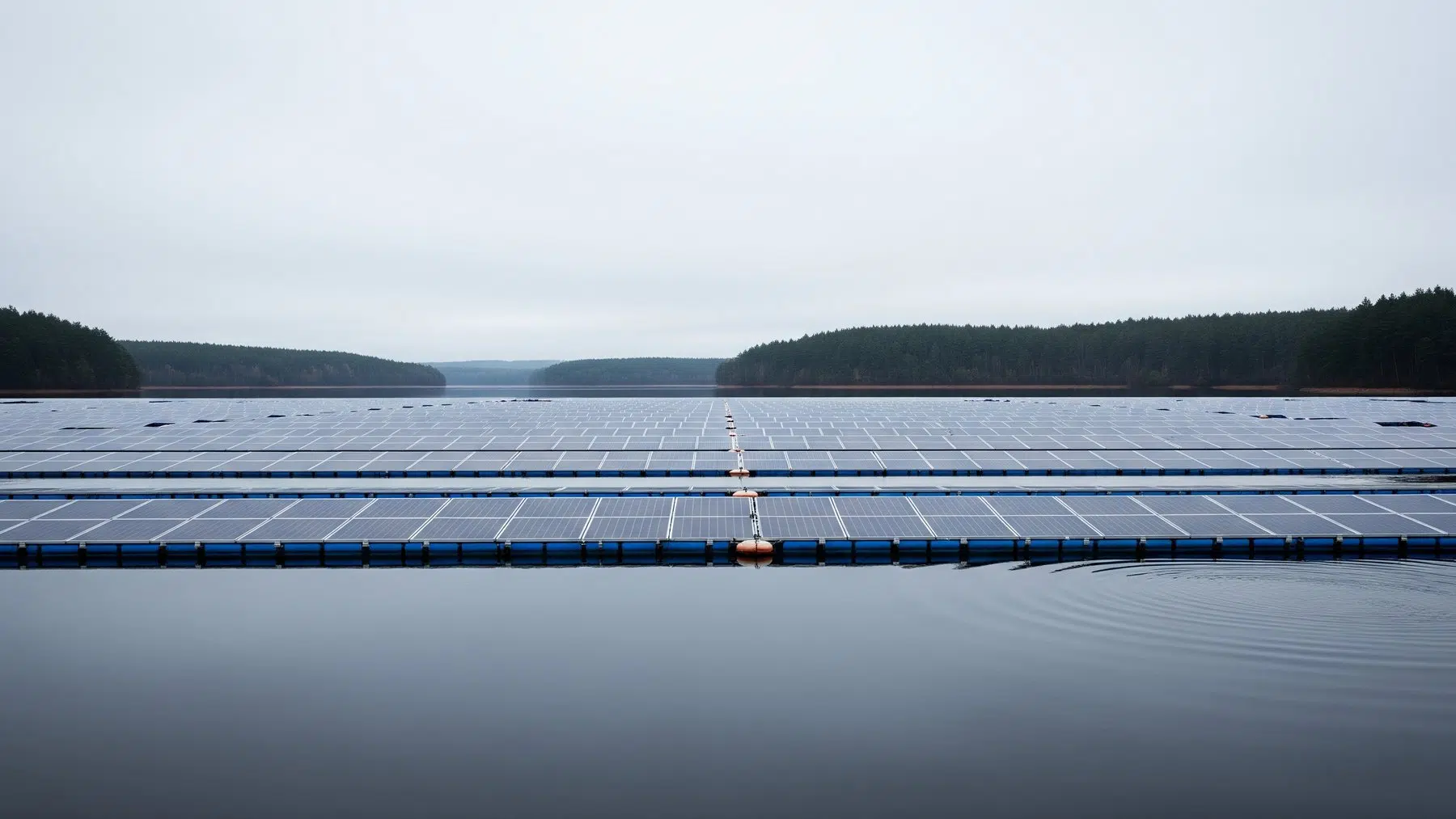
There is no floating solar on any of the eleven reservoirs in this study.
Not one panel. The whole thing was run on a computer.
Researchers took 11 real lakes across 6 states and simulated what would happen if a skin of modules covered them.
The shade cooled the surface in every single case.
What it did to the fish underneath changed lake by lake.
Which is a less tidy headline than the industry would like, and a more useful one.
Why a reservoir is attractive to build on
Because the appeal of putting solar on water has very little to do with the water itself.
A reservoir is already flat, usually already public, and there is no clearing to do and nobody farming it.
Many of them sit behind hydro dams, which means a substation and a transmission line are already on site.
The water underneath also holds the modules cooler than bare ground does, and a cooler panel produces more power.
Estimates put that gain somewhere between 5 and 15 percent, and shading the surface cuts evaporation on top of it.
In a drought state that second effect can matter as much as the electricity does.
Federal figures put the technical potential of American reservoirs at 1,476 terawatt hours a year, which lands on the order of a third of national demand.
What a reservoir looks like in July
And to see why shade matters at all, you have to picture the lake in cross section rather than from the shore.
By midsummer the water has separated into layers, with a warm lid floating on top and a cold mass sitting underneath it.
The band between the two is the thermocline, and it is a far sharper boundary than most people imagine.
Bass and catfish work the warm upper water. Trout and salmon drop below that line and stay down there.
Every fish in the lake is reading that boundary, and it moves up and down through the season.
But cold is not the whole story at depth, and this is the part usually left out of the retelling.
Deep water in a productive reservoir often runs short on oxygen by late summer, which can leave the coldest layer unusable anyway.
What the model actually did
Which is precisely the complication the team had to build into the simulation.
They ran 11 reservoirs across six named states, Oregon, Ohio, Washington, Idaho, Tennessee and Arkansas.
Each was modeled over two month stretches in summer and again in winter, rather than as a single snapshot.
The runs tracked temperature and oxygen together through the whole water column, then translated both into habitat suitability.
Two seasons matter because a lake that gains in July can lose the advantage entirely by January.
Panel coverage was varied as well, because a strip across one corner is a different object from a sheet over half the lake.
What comes out is a map of where a fish could live, not a count of fish.
What came out of it
Then the results split into one clean finding and one distinctly messy one.
The clean part is that the panels lowered surface temperature in all of them and shifted the layering underneath, as the university reported.
The messy part is that habitat suitability did not simply improve. It became more variable.
Some reservoirs looked clearly better for cold water species afterward. Others returned a result nobody could call good or bad.
That spread is the actual finding, and it is the part that gets dropped when this gets summarized.
Cold water fish gained most where coverage passed 50 percent of the surface, and that is a very large array.
Warm water species did not read the same way, since a cooler lid takes something away from them, as the trade press covered.
Why the answer has to be per lake
And the lead author is unusually direct about that in the coverage of his own paper.
Different reservoirs respond differently based on depth, circulation and which fish matter for management, he said, and there is no single formula for designing these systems.
It is ecology, he added, and it is messy.
Which is not the sentence a developer wants at the top of a permitting file, and it is the honest one.
He also pointed at the precedent nobody in the industry enjoys citing, which is the dam holding the reservoir in place.
Large changes to freshwater systems carry lasting consequences that were not foreseen at the time, and hydro is the standing example of that.
The same caution belongs around an offshore project or a ground mounted solar site, where the structure changes the place it sits in.
Monitoring real installations is what the team asks for, since a model is a hypothesis and not a measurement.
None of that is an argument against floating solar. It is an argument against copying one design onto every lake.
Read the whole thing?
Get the week's signal, not the noise
Our sharpest reporting on energy, climate and nature — free, once a week.


