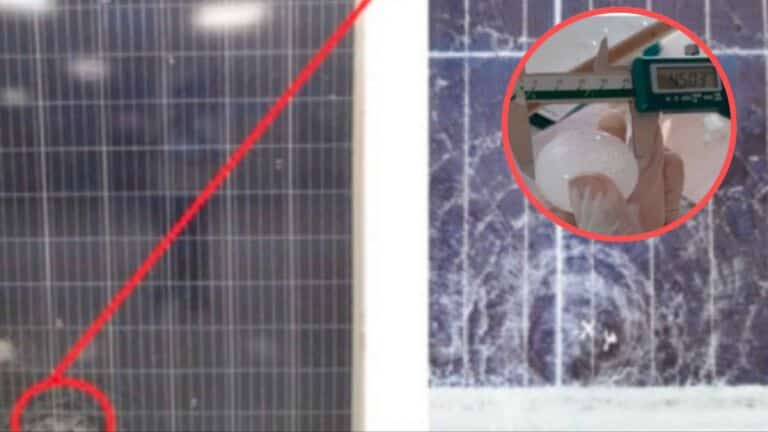
A retired rooftop panel sits on a warehouse scale, cracked at one corner, its aluminum frame gone chalky with age.
Scrap buyers price it as glass.
By weight, that is fair.
Roughly three quarters of the module really is glass, easy to melt down and easy to sell.
But weight was never the point of this panel.
Buried in the thin metallic threads across each cell is a figure that changes what this scrap pile actually is.
What the panel is really carrying
The silver grid lines that carry current off a solar cell are a sliver of the module’s mass, but concentration is not the same as abundance. End of life panels can carry silver at 300 to 500 parts per million, a fine mesh of conductive fingers printed onto the silicon and sealed under glass.
That number means more once it is set beside a mine. Researchers at the University of Newcastle describe those concentrations as comparable to, and in some cases exceeding, the cutoff grade of primary silver mines, the threshold below which rock is not worth processing at all.
So recyclability figures quoted by weight describe mass, not worth. Glass and aluminum make up almost all of a module’s weight and little of its value, while the silver, copper and silicon packed into a thin fraction of that weight carry most of it.
The scene inside a retired panel
Picture the module coming apart. Crews peel the aluminum frame first, then work the laminated glass away from the cell layer underneath, a sandwich bonded so tightly that a clean, fast split remains the industry’s sticking point, one engineers have chased for years without a cheap fix.
Somewhere inside that sandwich the silver lines sit intact. Because the bond is stubborn, tearing a panel apart has generally cost more than the recovered scrap returns, and the share of US panels that reach a recycler has been estimated at under ten percent, with landfills taking the rest.
Price the pile by its silver instead, and it stops looking like trash. It starts looking like a stockpile of untapped ore, already broken up, waiting on a buyer rather than a truck.
The evidence, and an unexpected comparison
Bench work suggests the gap can close. In a rougher flotation test run in ordinary tap water, using air, bubbles and small amounts of reagent rather than acid, researchers recovered about 97.6 percent of the silver from ground solar cells and upgraded it roughly thirtyfold over the feed in a single pass. A later continuous pilot run pushed the idea further, processing cell material from roughly 1,000 pounds of retired panels and concentrating nearly all of the silver into a product amounting to about 1.25 percent of the feed.
“Our earlier small scale batch research proved flotation could recover silver from solar panels,” said Mahshid Firouzi, deputy director of the university’s Centre for Critical Minerals and Urban Mining, framing the remaining question as one of scale and cost rather than chemistry.
The comparison that makes such a grade legible comes from ocean geology rather than from panels at all. Massive sulfide deposits at seafloor hydrothermal vents have been sampled with silver reaching about 1,000 parts per million at mid ocean ridges, and above 1 percent by weight in some immature back arc rifts. A dead panel in a parking lot bin falls inside that same broad range.
Where the gap still bites
None of this makes recycling simple. Splitting the glass from the cell without shattering it, then separating silicon from silver without acid baths or heavy energy use, is the step still holding the industry back, and costs for high recovery processing run above what scrap glass and aluminum alone can cover.
Even so, the direction is shifting. Plants built around recovering silver, copper and silicon together are moving from pilot scale toward commercial throughput, including a Dallas area facility that We Recycle Solar says will open in 2027, designed to process one panel per minute and recover up to 96 percent of a panel’s materials. That figure is a company target, not a measured result.
A lab testing solvents on that stubborn laminate bond points at one version of the fix, peeling the glass free without destroying what sits beneath it.
What a buried panel is actually worth
None of this rewrites the physics of mining. Ocean floor silver still sits thousands of feet down, guarded by pressure, cost and ecological risk that keeps most deep sea mineral projects stalled in debate. The comparison is about concentration, not convenience.
But it does change what a landfill full of old panels represents. The silver is not a rounding error on a glass recycling operation, it is a parallel ore body sitting on dry land, already mined once and sitting above the surface, waiting for a cheaper way in.
A geothermal operator chasing heat recovery from an idle well faces a similar lesson, that the resource was there all along, just not where anyone thought to look.
Scale still matters more than grade. A single panel holds well under an ounce of silver, and it takes millions of them to approach what one mine produces in a year. Still, as more panels retire together, that buried mesh looks less like waste and more like a deposit waiting for the right process to open it.
Read the whole thing?
Get the week's signal, not the noise
Our sharpest reporting on energy, climate and nature — free, once a week.