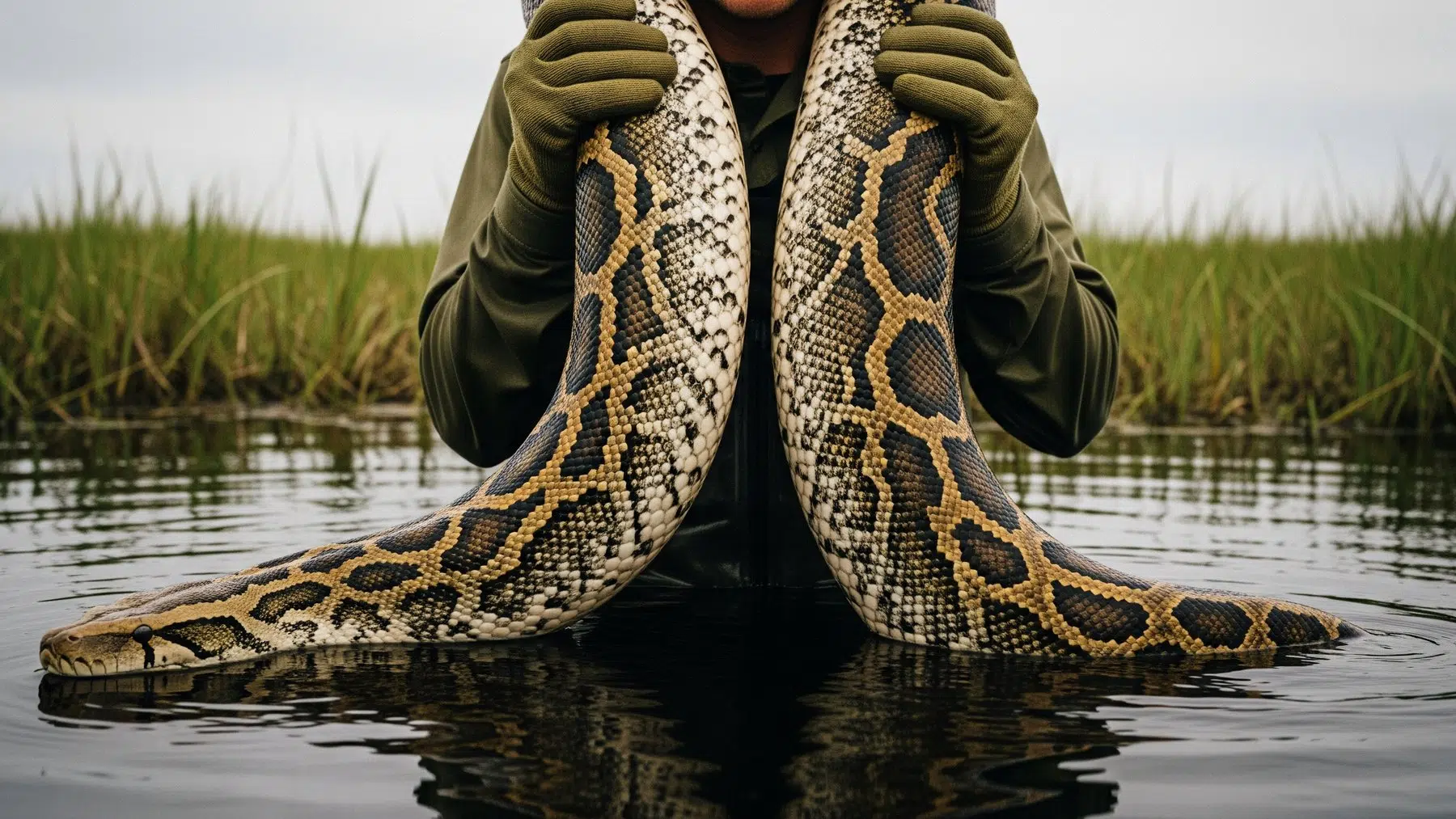
Somewhere in the deep swampy sprawl of Collier County, Florida, a team just set a grim record.
Biologists pulled 8,080 pounds of Burmese pythons from 200 square miles of Everglades in one season.
That is more than four tons of snake, hauled out by hand.
It is the heaviest single season the program has ever logged.
They also removed roughly 4,100 eggs before a single one could hatch.
Those eggs are the real reason the work matters so much right now.
What used to be an Everglades problem is creeping toward the islands.
Because the same snake is already breeding farther south.
A record that took 13 years to build
The Conservancy of Southwest Florida has run its python program since 2013.
Each winter its team tracks and removes the big constrictors during mating season.
The goal is to catch the animals before they can lay another clutch.
This season the crew logged 177 pythons in all.
Together they weighed 8,080 pounds, the program’s heaviest haul yet.
It was the first time the effort ever crossed the four ton mark in a season.
The old record stood at about 6,300 pounds, set just a year earlier.
All of it came from a single 200 square mile patch of Collier County.
That one stretch now yields more python each year than anyone once thought possible.
The snake that helps catch snakes
The method behind the record is one of the most cunning tools in wildlife work.
Every winter the biologists radio tag 40 male scout snakes.
They set the males loose and simply follow their signals.
A male on the move in spring is looking for exactly one thing.
During mating season those males lead straight to the breeding females.
That is where the real weight sits, coiled and waiting.
The largest female this year tipped 153 pounds at 17 feet long.
The removed females averaged around 95 pounds apiece.
And in a grim detail, one in four of them held the remains of a white tailed deer.
A snake that can eat a deer can eat almost anything smaller.
What disappears when the pythons arrive
Before the pythons, the Everglades ran thick with small mammals.
Then the snakes spread, and a landmark 2012 study measured the collapse.
Researchers drove the park at night for years and counted what crossed their headlights.
Raccoon numbers fell by 99.3 percent in the worst hit areas.
Opossums dropped 98.9 percent, and bobcats fell 87.5 percent.
Marsh rabbits, cottontail rabbits, and foxes were not seen at all.
The work came from biologist Michael Dorcas and his team at Davidson College.
A single adult python can swallow an animal as large as a full grown deer.
Each female removed today is a breeding engine taken off the board.
Every clutch stopped now is a small piece of the marsh given a chance.
The 4,100 eggs and Key Largo
Which brings the story back to those 4,100 eggs.
Removing them is not tidy bookkeeping so much as a race against the map.
In 2016, wildlife officials confirmed the first python hatchlings ever found on Key Largo.
The tiny snakes hinted that the species had begun breeding on or near the island.
No nest has turned up there yet, but the hatchlings speak for themselves.
That pushed the invasion out of the Everglades and toward the fragile Florida Keys.
A record season on the mainland buys the Keys a little time.
Salt water will not save them either, as a 2012 study showed.
Hatchling pythons survived long saltwater exposure in the lab.
That means the open sea is no reliable wall against their spread.
A snake that shrugs off saltwater can island hop down the whole chain.
What the numbers mean going forward
Step back, and the totals are staggering.
Since 2013 the program has pulled more than 20 tons of python from Southwest Florida.
That is a small city of snakes, taken one clutch at a time.
Yet even this record barely dents the wider population.
Scientists still cannot say how many pythons hide across the Everglades.
Estimates of the total run from the tens of thousands into the hundreds of thousands.
The scout snake method works because it targets breeding females directly.
Kill the mothers, and thousands of future hatchlings never arrive.
One large female taken in winter can erase a whole nest before it exists.
Like the wind that powers an offshore wind farm, the fix works out of sight.
It is the same hidden math as a fox pushed off its den by solar panels, one change rippling outward.
The greenest win here is the clutch that never hatches.
Read the whole thing?
Get the week's signal, not the noise
Our sharpest reporting on energy, climate and nature — free, once a week.