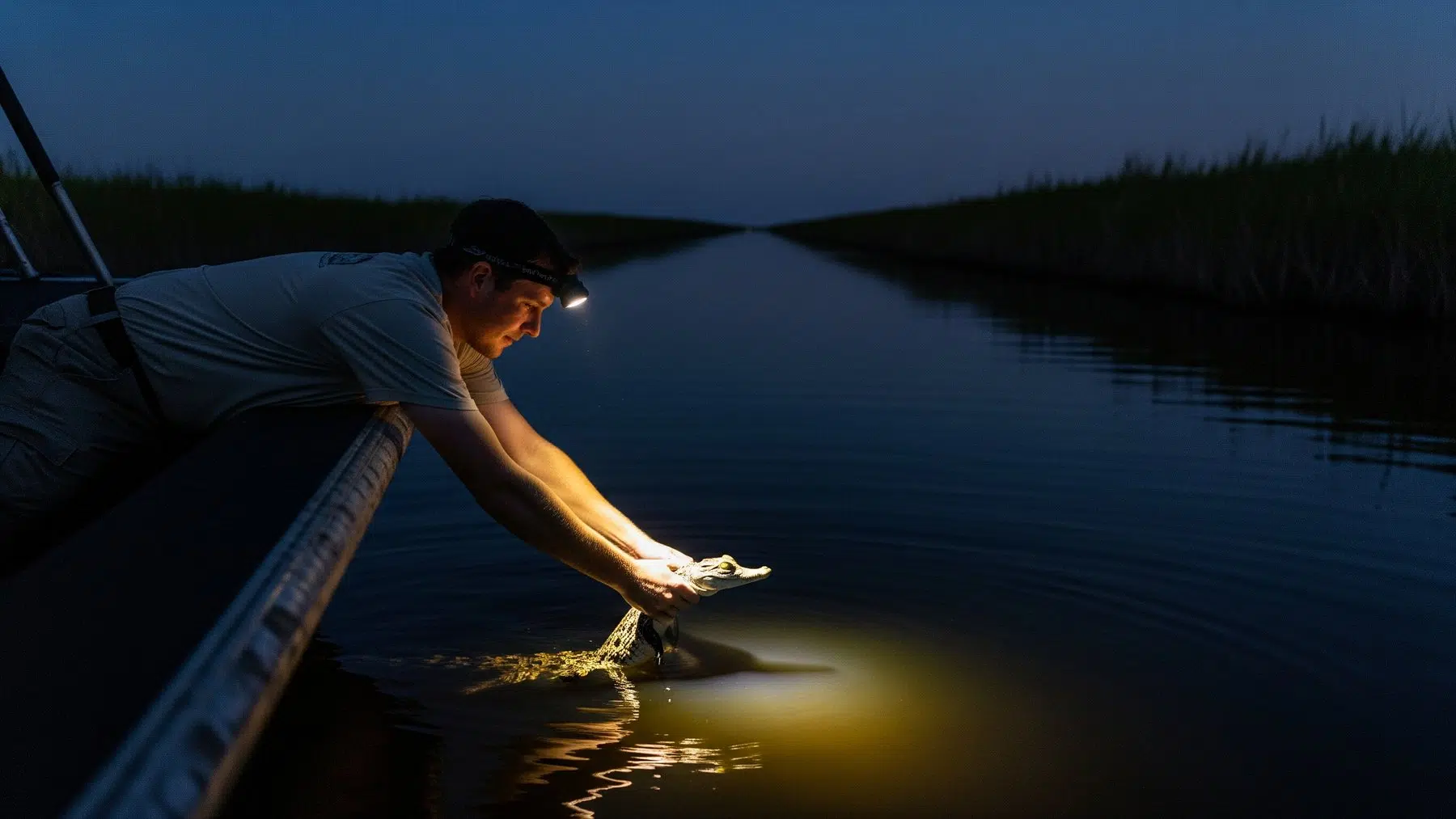
Crews at a nuclear plant south of Miami spend summer nights walking gravel berms with headlamps and mesh bags.
They are picking up newborn crocodiles, weighing them, clipping a tag and putting them back in the water.
This past season they handled 606 hatchlings, out of roughly thirty nests.
In 47 years of doing this, the count had never passed 600.
And the habitat producing them was designed for cooling water, by engineers who were not thinking about reptiles.
Six hundred and six in one summer
The work is unglamorous and it happens in the dark, because that is when hatchlings move.
A staff biologist at the plant leads the collection, and the animals are measured, marked and released back into the same canal system.
Roughly thirty nests produced the total, which works out to about twenty surviving hatchlings apiece at collection.
The program has run without a break since the first clutch was found on the property in 1978.
Nothing about the method has changed much either, because a hatchling still has to be picked up by hand to be counted.
Across those decades it has tagged more than 10,000 young animals, which is the number that makes the record legible.
Without the earlier counts, 606 is just a figure. With them, it is the first time the site has cleared six hundred in almost half a century.
How low the number got
The American crocodile in the United States came close to disappearing entirely.
By the middle of the 1970s the estimate was around 200 animals, squeezed into the Florida Keys and the southern end of Biscayne Bay.
It went onto the federal endangered list in 1975, at a point when nobody was confident the species had a future in the country at all.
Shoreline building had taken most of the nesting ground, and what was left sat in exactly the places people wanted to be.
The recovery took three decades and it was slow the whole way.
The status was lowered from endangered to threatened in 2007, which is the formal marker that the trend had reversed.
State biologists now put the Florida population at at least 2,000, and that figure is a floor rather than a ceiling.
Why a cooling system works as a nursery
The canals were approved in 1971 and running by 1973, and the reason was heat.
Rather than send warm water out into the bay, the plant sends it into a closed loop that runs two miles wide and five miles long.
That is 32 canals flowing south, seven flowing back north, and about 5,900 acres of ground given over to the arrangement.
Digging them produced long berms of dry raised fill running for miles, which is exactly what a female crocodile looks for when she needs somewhere to nest.
She needs ground that stays above the water line through the whole incubation, and that is harder to find in south Florida than it sounds.
The water beside those berms is warm and salty, which is exactly what the hatchlings want.
And the whole site is fenced, patrolled and closed to boats, which removes the pressure that kept the numbers down everywhere else.
What share actually lives there
This is where the story usually gets stretched, so it is worth being exact.
The operator puts 300 to 400 crocodiles in and around the canal system on an average day, as the utility states.
Against a statewide floor of two thousand, that is roughly one animal in six, not the quarter that gets repeated.
What is genuinely exceptional is the concentration. The site holds the highest density of crocodiles anywhere in North America, as the account of this season describes.
It is also one of only three primary nesting populations left in the country, which makes the site structurally important rather than simply crowded.
The same accidental logic shows up at an offshore array and a fenced solar site, where the fence itself does most of the conservation work.
What the canals do not solve
None of this makes the canal system a nature reserve, and nobody involved describes it that way.
Water that sits and evaporates in a loop gets saltier than the sea, so salinity there is monitored continuously and has been for years.
The habitat is a byproduct. It was not planned, it is not permanent, and it depends on the plant continuing to operate.
What the record does prove is narrower and rather more useful than a feel good story about nature bouncing back.
An animal down to two hundred individuals did not need pristine wilderness to come back.
It needed warm water, dry ground to dig in, and nobody bothering it for fifty years.
Read the whole thing?
Get the week's signal, not the noise
Our sharpest reporting on energy, climate and nature — free, once a week.