About 35 miles off Montauk, twelve steel towers rise straight out of the Atlantic.
They belong to a new offshore wind farm, spinning power toward Long Island.
From the surface, they look like a lonely row of white giants.
Far below the waves, their foundations plunge into a flat sandy floor.
That seabed is mostly a featureless underwater desert.
But the bare sand is not staying empty.
Fish are already being drawn to the fresh steel below.
The same thing has happened at every wind farm before it.
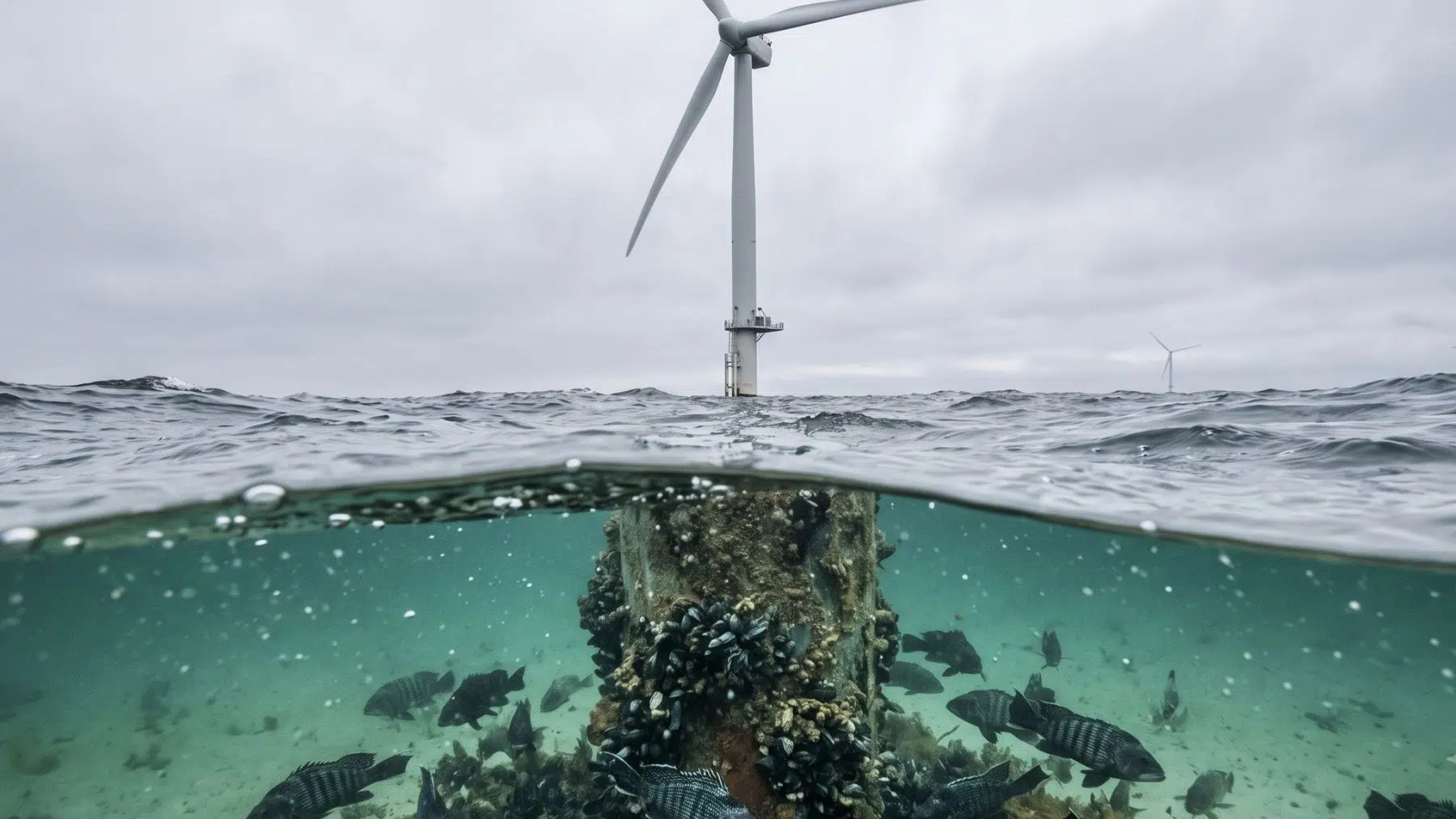
Slowly, a power station is turning into a living reef.
The turbines make clean power above and new habitat below.
Twelve towers in a sandy desert
The wind farm is called South Fork Wind, off the eastern tip of Long Island.
It stands about 35 miles east of Montauk Point, New York.
Twelve turbines there make a combined 132 megawatts of power.
Each one rides on a single steel monopile hammered into the seabed.
Those legs are wider than a bus and driven deep into the mud.
The water around the legs runs up to 135 feet deep.
Power first flowed in late 2023, and the whole farm was finished in early 2024.
It counts as the first utility scale offshore wind farm in the country.
Together the turbines can light around 70,000 homes.
It was a landmark for a country long slow to build at sea.
Why bare sand is an underwater desert
Out on that part of the shelf, the seabed is mostly open sand.
There is almost nothing solid for sea life to cling to and hide in.
With no shelter, very little can gain a foothold there.
Marine biologists often call this flat bottom an underwater desert.
Then a hard structure drops in and changes everything.
It hands mussels and barnacles a surface to grab.
Those small filter feeders pull food straight from the passing current.
They coat the steel in a thick, crunchy carpet of shells.
Little fish arrive to graze, and bigger fish follow them in.
One steel leg can seed a whole food web.
Structure, not sand, is what this stretch of ocean was missing.
How steel becomes a reef
The change begins within weeks of the steel going in.
A fuzz of algae, barnacles, and blue mussels spreads across the surface.
Soon the smooth monopile vanishes under living crust.
Crabs and small fish move in to feed and hide.
Every new layer of life pulls a hungrier one in behind it.
Then come the structure lovers, above all the hungry black sea bass.
These fish adore anything solid on an otherwise empty bottom.
A lone rock or wreck can hold dozens of them at once.
They pack around wrecks, rocks, and now steel wind foundations.
Within a season, the tower foot hums like a reef.
What was empty sand becomes one of the busiest spots around.
The wind farm that proved it
This is not just a hopeful guess or a bit of marketing.
America had already run this exact experiment once before.
Off Rhode Island stands the tiny Block Island wind farm, built in 2016.
It was the first offshore wind farm in the country.
Scientists have watched its five legs closely ever since.
It gave the first real look at what US wind farms do to the seabed.
They found blue mussels, juvenile crabs, and black sea bass swarming the steel.
Researchers called it a magnet effect for local fish.
A later study found the farm had not harmed the fishery.
Like the same steel now off Montauk, it turned sand into habitat.
The pattern was clear long before Montauk ever got its towers.
What South Fork will become
South Fork’s foundations are only starting down the same path.
In a few years its legs should teem with the very same life.
Divers and scientists are already lining up to track the change.
But a reef effect is not all pure good news.
The change reshapes the seabed in ways that are still being studied.
The new structure favors some species over the ones that liked bare sand.
Fish that need open sand may quietly lose ground.
It can also give footholds to unwanted invasive species.
And it tangles with where boats are allowed to fish.
Still, turning dead sand into busy living habitat is a real bonus.
Like the turbines of an offshore wind farm, the payoff hides underwater.
It is the same quiet trade as a fox pushed from its den by solar panels, a gain that carries a cost.
For now, out under the new towers, the black sea bass are simply moving in.
Read the whole thing?
Get the week's signal, not the noise
Our sharpest reporting on energy, climate and nature — free, once a week.