Miles below the ocean’s surface, where sunlight vanishes, pressure reaches crushing extremes, and temperatures hover just above freezing, life has found a way — and then kept going. Evolution, working in total darkness across millions of years, has produced creatures that bear almost no resemblance to anything most people would recognize as an animal.
An estimated one million deep-sea species remain undiscovered. Many that are known have been observed only a handful of times. The deep ocean is Earth’s largest habitat — and its least explored. What little we’ve managed to glimpse is already stranger than most science fiction.
Masters of darkness: creatures that make their own light
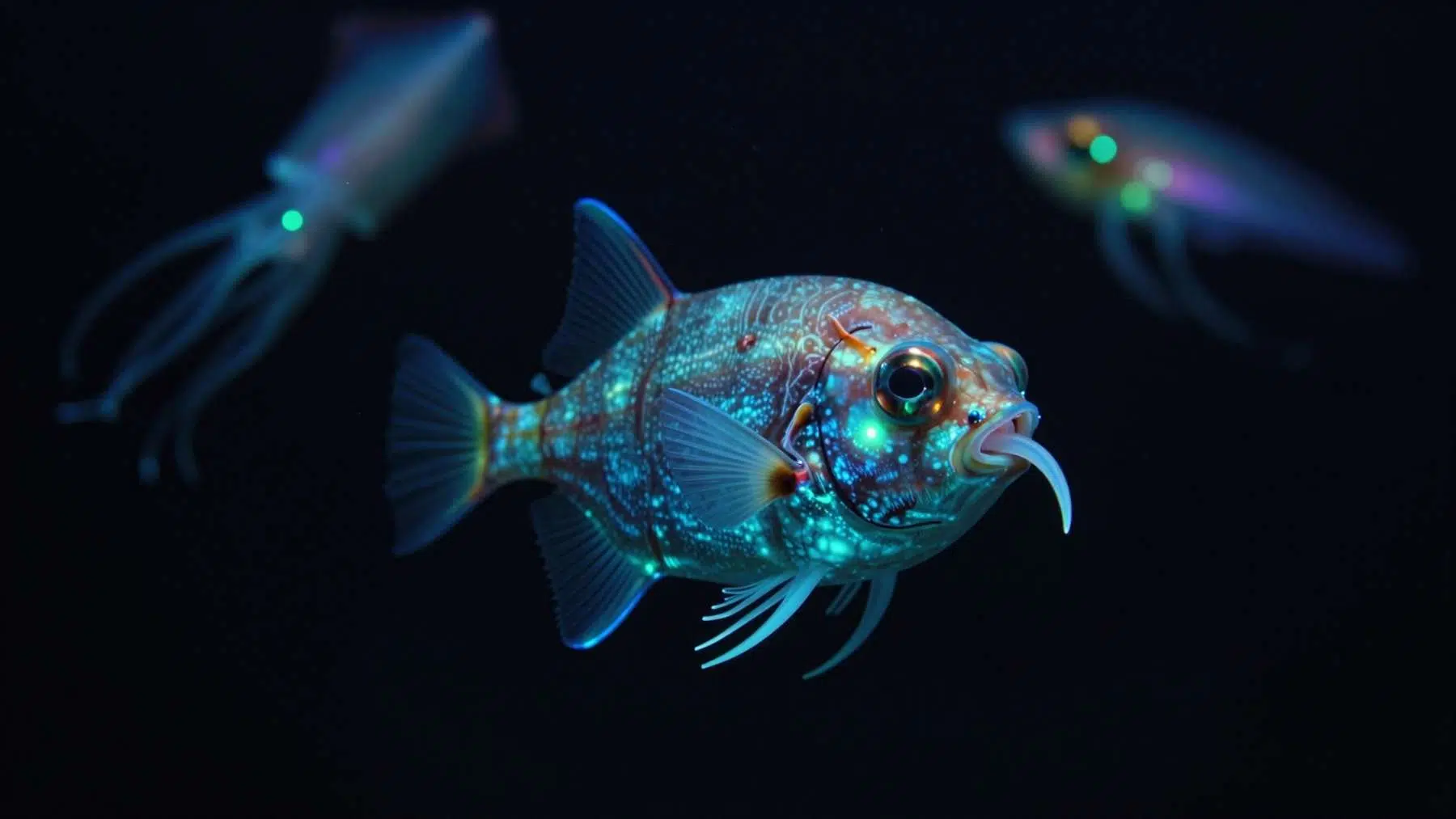
In the deep ocean, light doesn’t come from above — it comes from the animals themselves. The vampire squid, despite its name, has no interest in blood. What it does have is a network of light-producing organs called photophores, concentrated near its arm tips. When threatened, it releases bursts of bioluminescent light that may confuse or distract predators — buying just enough time to drift away into the dark.
The vampire squid doesn’t hunt. It hangs suspended in the water column, matching the density of the surrounding seawater, and uses long filament-like appendages to collect “marine snow” — tiny drifting particles of organic matter. It’s a passive, almost meditative existence, worlds apart from the active-hunting image most people associate with squid.
The anglerfish takes the opposite approach entirely. A bioluminescent lure dangles from its head like a fishing rod, drawing prey directly into a mouth lined with needle-like teeth. No sunlight ever reaches these depths, which means producing your own light isn’t a trick — it’s the difference between eating and starving.
Seeing the unseen: animals with extraordinary sensory adaptations
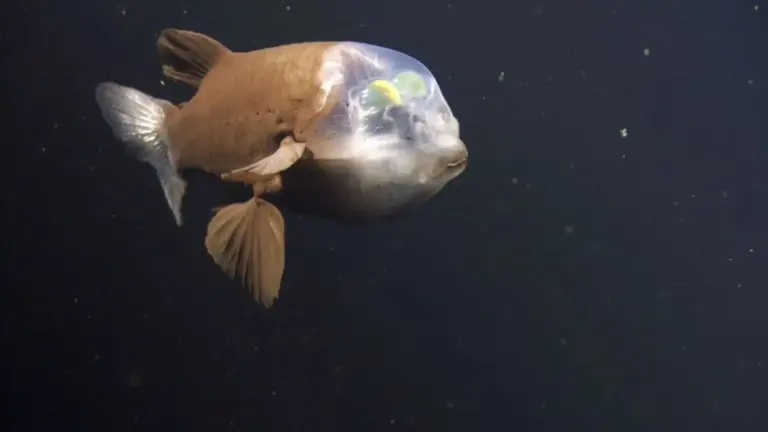
Few deep-sea animals are as visually striking as the barreleye fish. Its head is entirely transparent, filled with fluid, and through it you can see two bright green eyes that rotate freely inside the skull. Those eyes can point upward to detect prey silhouetted against faint light filtering down from above, then swivel forward when it’s time to feed.
For decades, scientists didn’t know this. Preserved specimens lost their transparent tissue during collection, leaving researchers with a distorted picture of what the fish actually looked like — and it wasn’t until the Monterey Bay Aquarium Research Institute observed a live barreleye that its true form was confirmed. A species we thought we understood turned out to be something else entirely.
The goblin shark presents a different kind of strangeness. Its skin is semi-translucent, with visible blood vessels that shift the coloration from pale white to pink depending on the angle. The long, flattened snout and protruding jaws are already unusual. But the jaw mechanism is what sets it apart: it can shoot forward rapidly to snatch prey, then retract. No other shark alive today does anything quite like it.
Built to endure: survivors of the extreme deep
Giant isopods look like something out of a nightmare — or a natural history museum. Essentially roly-polies scaled up to the size of a housecat, they live as deep as 7,000 feet and can survive for years without food, scavenging whatever drifts down to the ocean floor. Their segmented armor and multi-legged body plan have changed remarkably little since first appearing in the fossil record more than 300 million years ago.
That kind of evolutionary stability isn’t stagnation. It’s proof that a design can be so well-suited to its environment that there’s simply no pressure to change.
The dumbo octopus — named, genuinely, after the Disney character — lives between 1,000 and 13,000 feet beneath the surface, making it one of the deepest-known octopus species. It flaps ear-like fins to move through the darkness. Unlike its shallower relatives, it carries no ink sac; at those depths, predator pressure is low enough that the defense simply became unnecessary. Extreme environments don’t just shape life — they pare it down to what’s essential.
Almost not there: the gelatinous animals that blur the definition of life
Some deep-sea creatures are barely solid. Gelatinous animals — including sea jellies and other drifting organisms — are composed of at least 95% water, with no blood, no heart, no brain. Underwater, some pulse with neon bioluminescent color. Others trail tentacles of extraordinary length, creating an appearance that looks more like a digital rendering than anything alive.
Sea jellies have existed for at least 500 million years, predating most complex animal life on Earth. Their structural simplicity isn’t a flaw — it’s an ancient, proven survival strategy that has outlasted countless more complex organisms. In evolutionary terms, simpler sometimes just means more durable.
Why the deep ocean still matters — and why so little of it is known
The deep ocean regulates climate, stores carbon, and supports biodiversity at a scale that affects the entire planet. Yet an estimated one million species living there remain undiscovered. The goblin shark, for instance, is so rarely photographed that basic details about its behavior remain unclear — and it’s a species we’ve at least named.
Ocean Conservancy argues that protecting the deep sea requires first acknowledging how much of it we don’t understand. That’s not a comfortable starting point for policy — but it’s an honest one.
The barreleye fish is a useful reminder of what’s at stake. Observed, catalogued, filed away — until a live encounter revealed that everything scientists thought they knew was incomplete. If that can happen with a fish we’d already named, it’s worth asking how many other assumptions are waiting to be overturned somewhere in the dark water below.
Read the whole thing?
Get the week's signal, not the noise
Our sharpest reporting on energy, climate and nature — free, once a week.