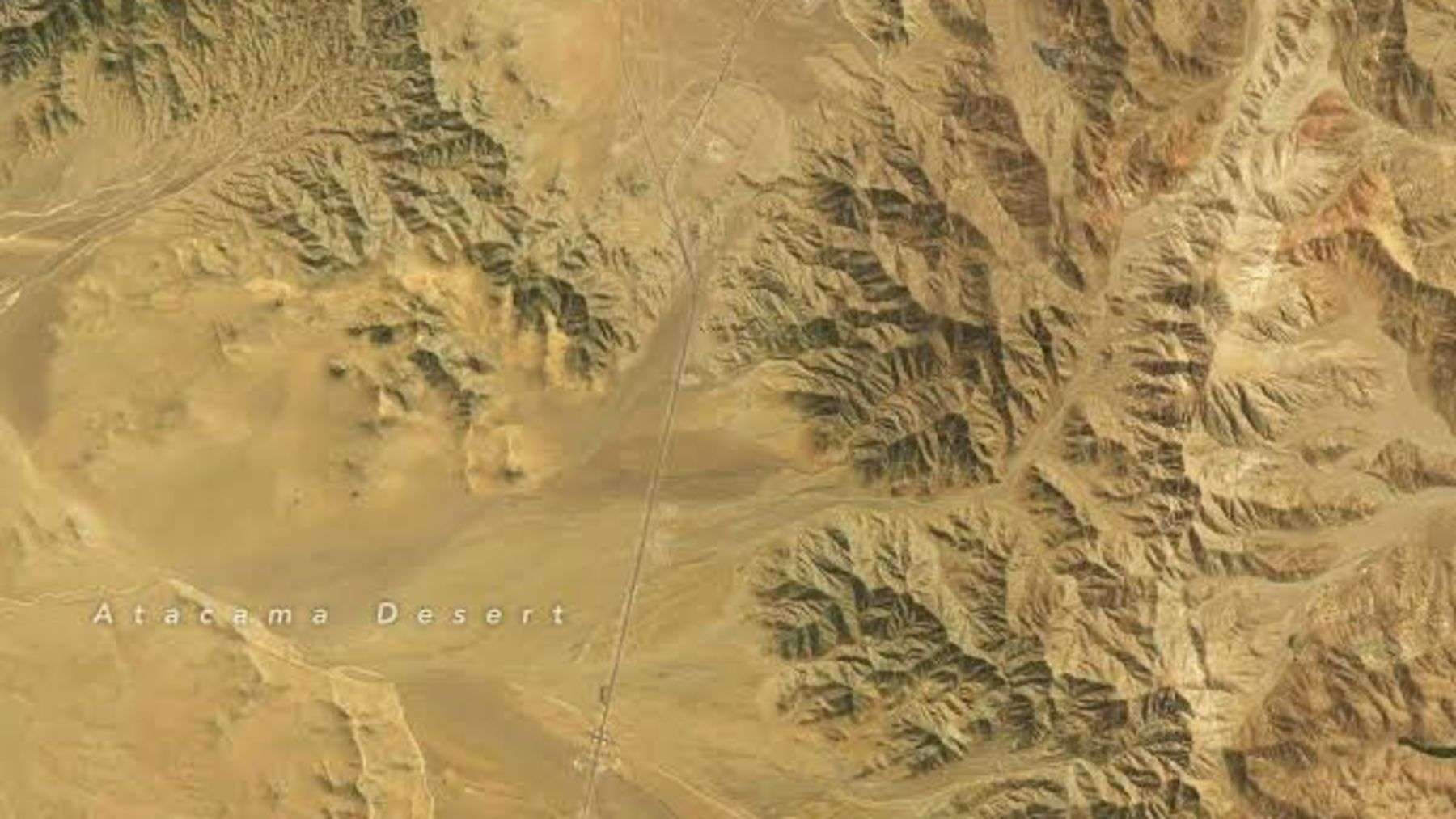
A desert that almost never sees rain woke up this spring blanketed in red, purple, and white — on a scale scientists say has never been recorded
The Atacama Desert is one of the driest places on Earth — somewhere weather stations have gone years, even decades, without recording measurable rainfall. Life there survives on the margins, and blooms are rare enough to feel like rumors.
Then came austral spring 2026. Satellite images started showing something hard to reconcile with everything the Atacama is supposed to be: vast stretches of red-purple, green, and white spreading across a landscape that’s almost never this alive. Scientists looking at the data had a harder time explaining it away.
A desert that almost never blooms
The Atacama’s reputation is well-earned. In its driest zones, rainfall is measured not in inches per year but in millimeters per decade. Some corners go so long without rain that the concept of a “wet season” is almost meaningless there.
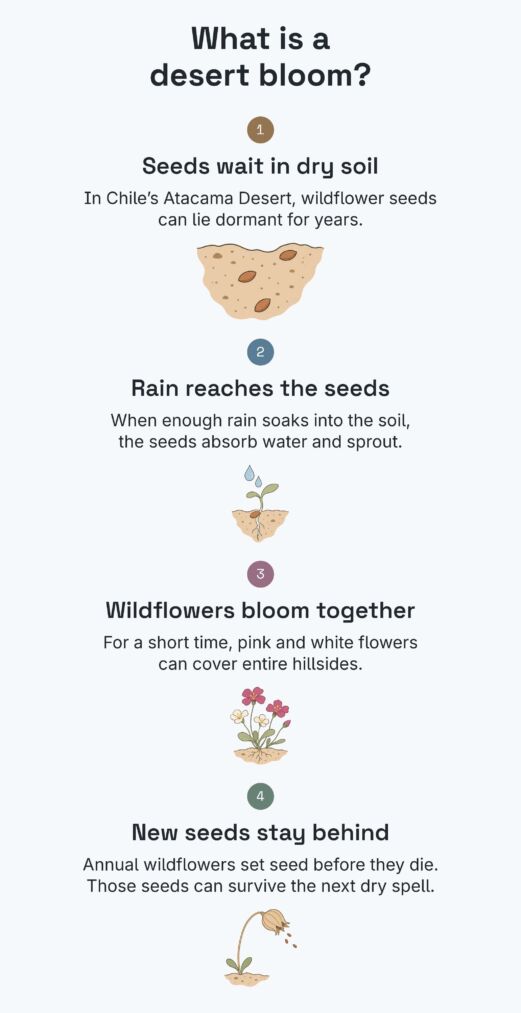
The desert holds a secret, though. Dormant seeds can survive in the soil for years — sometimes decades — waiting for the right conditions. When unusual rainfall finally arrives, those seeds wake up in a phenomenon Chileans call the desierto florido, or “flowering desert.” Rare, brief, and striking.
Scientists have tracked these blooms via satellite since the 1980s. A 2019 study using NASA’s long-term vegetation record identified just 13 bloom events across the Atacama between 1981 and 2015 — roughly one every two to three years, and many were modest. The 2026 event, by contrast, is described as the most extensive since satellite monitoring began.
How El Niño unlocked the rain
To understand why 2026 was different, you have to start in the tropical Pacific. El Niño was strengthening there, and that shift set off a chain reaction in the atmosphere above South America.
Normally, a subtropical Pacific high-pressure system acts as a lid over the Atacama, blocking moisture from reaching the region. During El Niño, that lid weakens. A blocking high also tends to form near the southern tip of South America, nudging the Southern Hemisphere storm track northward — toward the desert.
Beginning in mid-July, a series of storm fronts fed by an atmospheric river delivered one of the heaviest July rain events in decades, with impacts stretching from the Atacama region south to Los Lagos, according to Chile’s national weather service. Then August brought something even rarer: back-to-back winter storms, snow across parts of the Atacama, and soil that absorbed more moisture than it had in a very long time.
What the satellites revealed
When spring arrived, the satellites were watching. Landsat 8 and Landsat 9 captured before-and-after image pairs on September 14 and October 24, showing the desert at different stages of flowering. The transformation was stark.
About 30 kilometers southwest of Copiapó, near the eastern sector of Desierto Florido National Park, the October images showed vast sweeps of red-purple — blooms of pata de guanaco, most likely Cistanthe longiscapa, carpeting the landscape. A second area, roughly 50 kilometers southwest of Copiapó, sits within a priority biological conservation zone. September images there revealed hillsides covered in suspiros, or Nolana baccata, their green foliage topped with white flowers.
Researcher Andres Moreira-Muñoz of Pontificia Universidad Católica de Valparaíso described the 2026 event as “the most significant to date — in terms of its extent, intensity, and duration,” adding: “at least since we began using remote sensing.”
Scientists on the ground with drones and cameras
Satellite images tell part of the story. The rest required boots on the ground — and drones in the air.
Roberto Chávez and colleagues at Pontificia Universidad Católica de Valparaíso led field research during the bloom, combining satellite data with drone flights and digital cameras to document what was happening at a finer scale. They photographed the Cistanthe blooms on October 24 and the Nolana-covered hillsides on September 24, building a detailed visual record as the event unfolded.
By mapping how the bloom’s biodiversity shifts across space and changes over time, the team aims to give land-use planners and conservation managers reliable, high-resolution data about a landscape of recognized biological significance.
What this record bloom means for the future
Thirteen blooms in 34 years. That historical baseline is worth sitting with. Even in a region where El Niño events periodically deliver unusual moisture, major flowering events remain genuinely rare — and 2026 doesn’t change that. It does raise questions about what comes next.
Hyper-arid ecosystems like the Atacama appear acutely sensitive to episodic climate variability. A single wet season, delivered by the right atmospheric conditions, can transform a near-lifeless landscape into something biologically rich. If El Niño events intensify under climate change — a possibility researchers are actively debating — these blooms could become more frequent, more intense, or different in species composition than anything the historical record shows.
No one can answer those questions yet. The satellites will keep watching, and the seeds will keep waiting. The Atacama has always operated on a timescale longer than a single season, and 2026 is a reminder of how much can change when the rain finally comes.
Read the whole thing?
Get the week's signal, not the noise
Our sharpest reporting on energy, climate and nature — free, once a week.