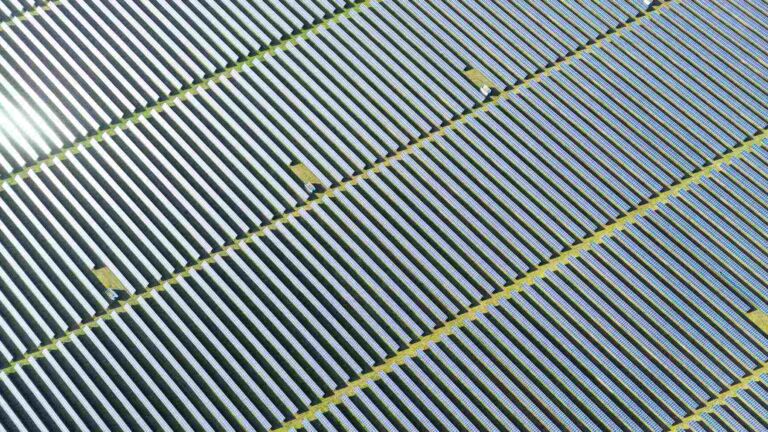
In mid-March 2024, extreme hailstorms struck Fort Bend County, Texas, home to more than 1.2 GW of solar capacity. The storms damaged the Fighting Jays Solar Project and renewed questions about solar performance during severe weather.
Industry attention quickly followed because several major solar facilities operated in the area.
Other utility-scale solar projects across the area were also affected. Yet the damage was not consistent.
Some panel fields were heavily damaged, while nearby solar facilities exposed to similar hailstorms were virtually unaffected.
If neighboring solar facilities were exposed to similar hailstorms, why were their outcomes so different?
The radar data revealed something unusual
There were reportedly three consecutive days with hail-producing storms moving through Fort Bend County during the middle of March 2024. VDE Americas reviewed National Oceanic and Atmospheric Administration (NOAA) weather radar data to better understand what happened. Three hail-producing storms occurred in Fort Bend County during an approximately 12-hour period.
Each storm was determined to be an event expected less than once every 500 years in this area.
The hail was not limited to a single geographic area; rather, the storm system affected a wide area of the county.
Multiple utility-scale solar projects across the county were affected by the same weather systems. Reports of significant damage at the 350 MW Fighting Jays facility attracted the most attention.
Investors, insurers, and developers have closely watched what a major hail event at an operational solar facility could reveal about solar-weather risk.
Notably, the Fighting Jays project was not the only solar facility in the path of the hail-producing storms.
Fort Bend County hosts a large concentration of utility-scale solar installations, making comparisons between projects possible. Several were exposed to the same hail-producing storm cells identified through weather radar analysis.
The damage at Fighting Jays did not tell the whole story
This led to a very basic question for local investigators. If two or more neighboring solar projects were subject to the exact same storm conditions, why did their respective damages differ so drastically?
To answer this question, VDE Americas conducted forensic investigations alongside weather analyses.
Investigators found that storm severity was not the only factor influencing which solar arrays suffered less damage. As the investigation expanded beyond Fighting Jays, a different picture of the hail event began to emerge. Specifically, investigators found that some nearby utility-scale solar projects responded differently as the storms approached.
VDE’s forensic investigations indicated that some facilities avoided widespread physical damage.
Those facilities had been exposed to the same extreme hail events as Fighting Jays, despite experiencing far less damage.
The difference appeared before the hail arrived
While not explicitly stated by VDE Americas, the evidence suggests that panel positioning contributed to the success of these “hail stow” protocols. Solar panels placed in a nearly vertical stow position presented a much smaller target to incoming hail.
By placing their modules upright, developers greatly reduced the surface area exposed to falling hail.
VDE Americas’ investigations indicated that these operational “hail stow” procedures remained effective even during hail events expected less than once every 500 years.
Panels left in more horizontal positions presented a much larger surface area exposed to direct hail impacts.
The findings changed how the damage was viewed
In short, the findings indicated that storm severity alone did not determine how much damage a solar project sustained.
More importantly, decisions made before a storm arrives can significantly affect overall performance during severe hail events.
Those decisions can also influence how much damage a solar facility ultimately sustains.
The Fighting Jays event will likely serve as a benchmark for future decisions about solar risk assessments and insurance premiums. But hail is not the only challenge forcing developers to rethink how solar projects are built and operated.
Read the whole thing?
Get the week's signal, not the noise
Our sharpest reporting on energy, climate and nature — free, once a week.