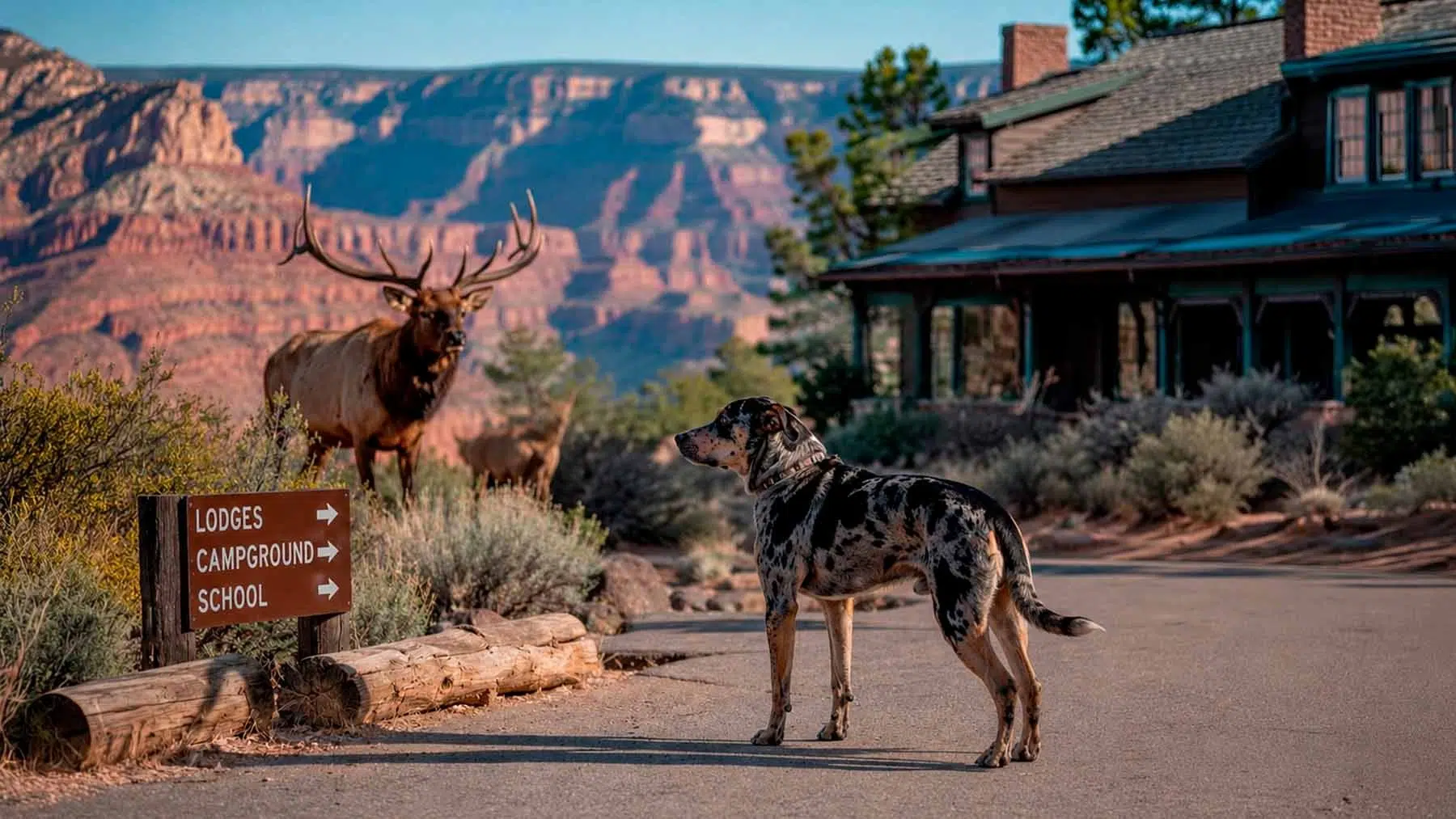
For nearly 20 years, the elk and bighorn sheep at the Grand Canyon have learned that humans do not pose a threat to them.
They have begun to walk through the busy sections of the South Rim of the Grand Canyon.
Some are walking through hotel courtyards. Others are on roads and even in schoolyards.
This is called habituation.
Traditional methods that have been used to haze wildlife out of developed areas have failed to prevent wildlife from entering these areas. The park tested a new approach this past May, using a leashed dog named Blue.
The animals stopped fearing humans over two decades
Animals that once avoided people now spend increasing amounts of time around buildings, roads, and crowds.
The park has accumulated extensive wildlife behavior monitoring and human-wildlife interaction data for more than 15 years.
Wildlife that once avoided buildings and crowds now views those same places as part of its territory. That change has made it more difficult for park managers to keep wildlife and visitors safely separated.
While there are many examples of conflict, park officials say they want a non-lethal way to prevent the animals from becoming a problem.
The Grand Canyon looked to one of them for ideas.
A leashed hound arrived with a specific job
Blue is a Catahoula Leopard Hound trained specifically for use in moving wildlife away from developed areas. The National Park Service approved the three-year pilot to test whether a leashed dog can reverse 20 years of habituation.
She works by barking at wildlife and pressuring it with her body to move away from areas where people are present.
However, when Blue is working, she remains on a leash at all times under the full control of her handler.
She does not make physical contact with wildlife. Her presence taps into natural predator-prey instincts and leads wildlife away from human-dominated areas.
Blue began testing her skills in the field on May 18, 2026.
Most of Blue’s work takes place around the most heavily populated areas in Grand Canyon Village. These include the El Tovar Complex, Grand Canyon Visitor Center, Maswik Lodge, Mather Campground Services Area, and Grand Canyon School.
Much of her work occurs during calving season in the spring and rut season in late summer and early fall. When Blue is working in an area where people or vehicles are present, foot or vehicle traffic may be stopped temporarily.
The Grand Canyon Conservancy covers Blue’s training, kennel, veterinary care, and travel expenses.
What the three-year pilot is designed to measure
Grand Canyon National Park has initiated the Conservation K-9 Pilot Project. It will begin a three-year study of Blue’s effectiveness in influencing wildlife movement patterns, herd behavior, and human interactions with wildlife.
The project was modeled after a highly successful conservation project at Glacier National Park.
Beginning in 2026, GPS collars will be placed on elk and bighorn sheep.
Researchers will collect pre- and post-project data regarding how blue influences movement patterns, herd behavior, and human interaction with wildlife. The results from this study will be instrumental in determining how best to coexist with wildlife within national parks.
Long-term goals include encouraging elk and bighorn sheep to spend less time in areas dominated by humans.
Park managers want them to continue to graze, bed down, and calve in more natural habitats.
They want to reduce roadway closures caused by wildlife activity. Park managers also hope to eliminate the need for lethal wildlife management actions. The project is funded primarily through Grand Canyon Conservancy.
Blue is not the only predator working at a human site.
In Illinois, two orphaned owls were hired as pest control at a solar farm after rodents kept invading the panels, eating up to a thousand rodents a year between them.
Read the whole thing?
Get the week's signal, not the noise
Our sharpest reporting on energy, climate and nature — free, once a week.