75 Florida sea turtle hatchlings followed their inner compass toward a road instead of the ocean
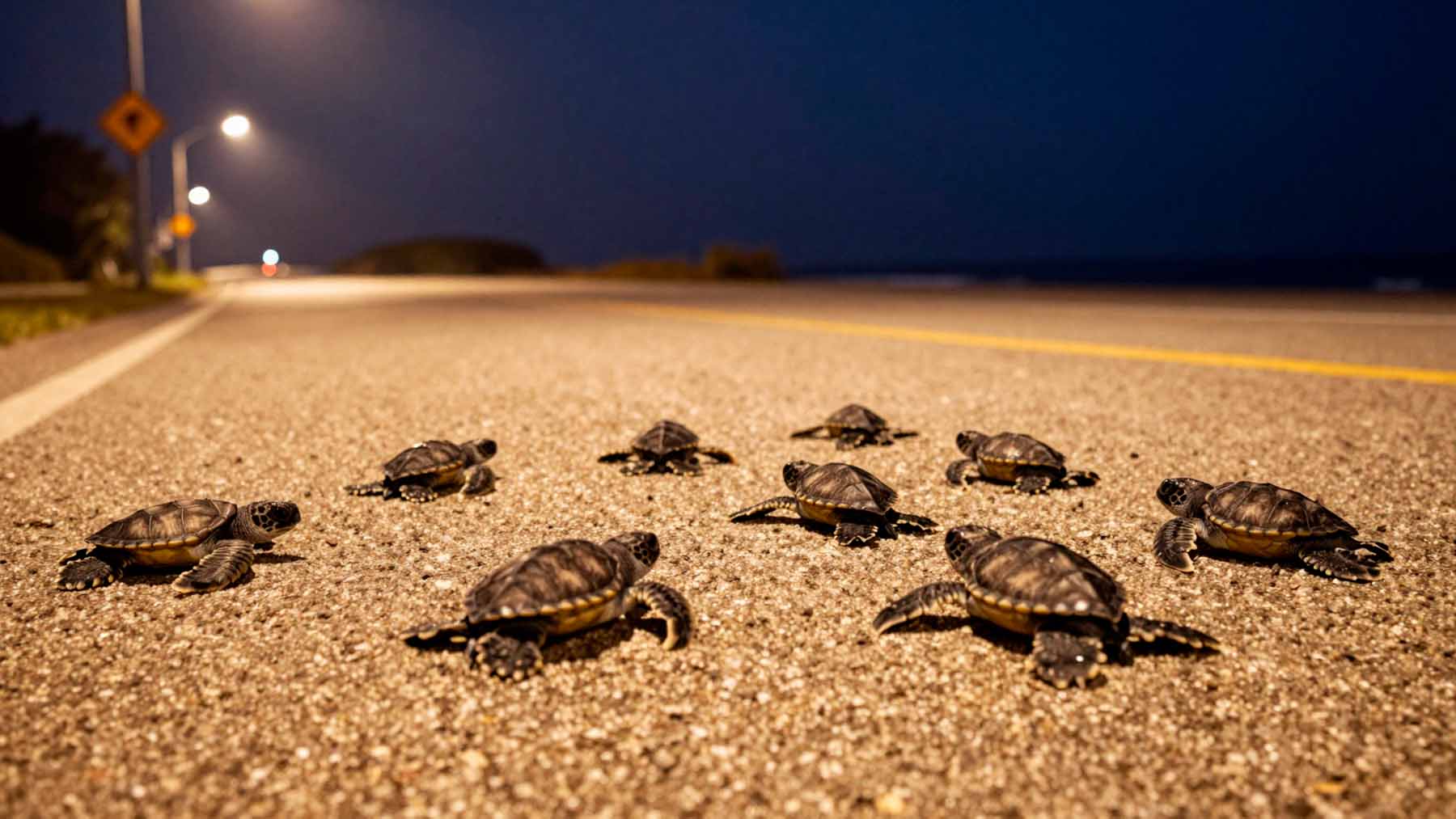
Seventy-five sea turtle hatchlings emerged from their nest on a Volusia County, Florida beach and did exactly what millions of years of evolution told them to do: they followed the brightest light on the horizon. The problem was that it led them straight up a beach road, away from the ocean.
Sea turtle hatchlings are born with a powerful internal compass — an instinctive “sea-finding” behavior wired to pull them toward the sea. In Volusia County, that compass didn’t fail. It just pointed somewhere it was never meant to go.
Born with a compass — but pointed the wrong way
Sea turtle hatchlings don’t learn to find the ocean. They’re born knowing how. Their instinct pulls them toward the lowest and brightest horizon — a cue that, on a natural beach, reliably points seaward. This behavior has guided sea turtles across coastlines for millions of years, long before humans built anything near the shore.
It works because it doesn’t require thought. Automatic, immediate, and extraordinarily precise. Under natural conditions, the open ocean reflects more light than the dark, vegetated dunes behind the beach, so the hatchlings simply follow the glow.
In Volusia County, that glow came from the wrong direction. About 75 hatchlings crawled up a beach approach road, moving confidently inland while the Atlantic sat behind them. The Volusia Sheriff’s Office responded, with deputies collecting the disoriented turtles and handing them over to county wildlife officials, who later released the hatchlings back into the ocean — giving them a second chance at a journey that nearly ended on asphalt.
Artificial light: a silent disruptor of ancient instinct
The hatchlings weren’t confused in any biological sense. Their compass was working exactly as designed. Artificial light near beaches can mimic — or simply overpower — the natural horizon cue the turtles are wired to follow. Streetlights, resort lighting, and illuminated roads create bright patches that pull hatchlings inland, and the turtles have no way to distinguish a natural horizon from a man-made one.
This kind of disorientation is a recurring pattern along Florida’s developed coastlines, not a freak occurrence. In a recent case in Bonita Springs, about a dozen hatchlings ended up inside a condominium’s storm drain. Before that, a man captured widespread attention on TikTok after finding a lone hatchling crawling down a sidewalk, far from the water. These incidents surface every nesting season — often quietly, sometimes going viral.
The Volusia event fits into that larger pattern. What made it notable was the scale: 75 hatchlings from a single nest, all heading the same wrong way, all at once, according to the City of Cape Canaveral Government.
A survival rate that leaves little room for error
Florida’s sea turtle nesting numbers can sound reassuring at first glance. According to the Florida Fish and Wildlife Conservation Commission, sea turtles produce between 40,000 and 84,000 nests along the state’s beaches each season, with each nest holding roughly 80 to 120 eggs. That’s a lot of hatchlings entering the water every year.
The survival rate, though, is brutal. Only about one in 1,000 sea turtles makes it to adulthood. Hatchlings are small, slow on land, and vulnerable from the moment they break the surface of the sand — and the ocean is full of predators waiting for exactly that.
Every hatchling pulled off course by artificial light represents a real loss. Not a statistical abstraction, but an actual animal that may exhaust itself on a road, fall into a drain, or simply fail to reach the water in time. For species already listed as endangered or threatened, those individual losses accumulate in ways the raw nesting numbers don’t capture.
The Volusia rescue worked out, but it required deputies, coordination with county officials, and a timely response. Not every disorientation event gets noticed. Not every nest sits near a road where someone can see what’s happening. This kind of incident plays out up and down Florida’s coast every season, largely out of public view.
What beachfront communities can do right now
The fix — at least in part — is practical and well-understood. Coastal property owners can follow turtle-friendly lighting guidelines that reduce the impact of artificial light on nesting beaches. That typically means switching to long-wavelength amber or red bulbs instead of white or blue-toned ones, shielding fixtures so light doesn’t spill toward the beach, and turning off non-essential lighting during nesting season. None of these steps require major investment.
Beachgoers can help too. Keeping the beach surface flat makes it easier for hatchlings to navigate toward the water, and avoiding flashlights, phone screens, and other personal light sources at night reduces the chance of pulling a hatchling off course. Small adjustments, made consistently, matter at scale.
Local authorities and wildlife officials play a critical role when disorientation does occur. The Volusia Sheriff’s Office response showed how quickly a situation can be corrected with the right coordination in place — rescue and release operations aren’t a long-term solution, but they do save lives in the short term.
The broader implication is worth sitting with. Sea turtles have navigated coastlines for millions of years using cues that worked perfectly until humans introduced new ones. The ancient compass still functions. The environment around it has simply changed faster than evolution can account for. Whether communities choose to adapt their lighting, their habits, and their awareness is, in the end, a choice about what kind of coastline they want to share.
Read the whole thing?
Get the week's signal, not the noise
Our sharpest reporting on energy, climate and nature — free, once a week.