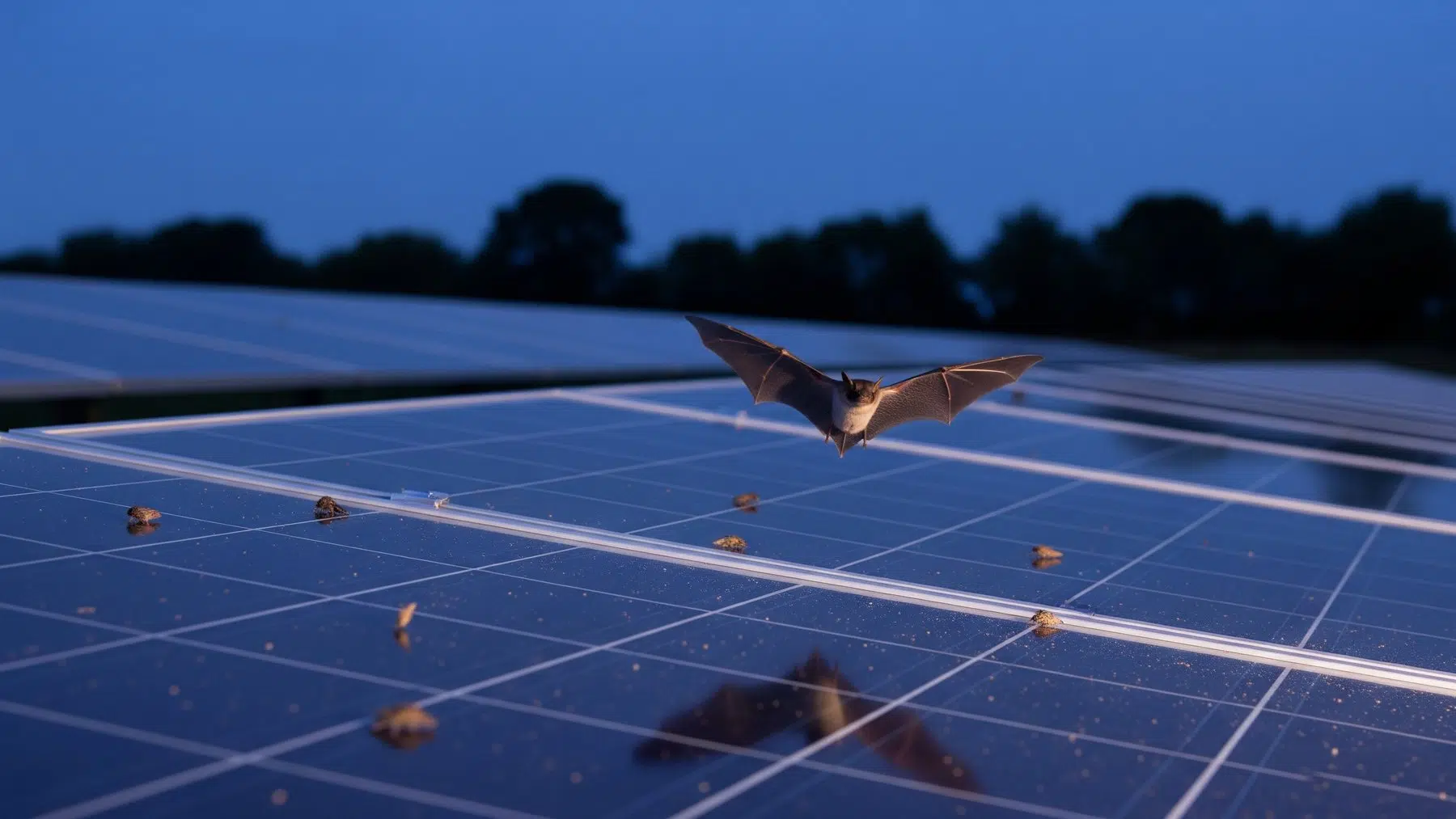
At dusk the grass between the solar panels fills with midges.
This is exactly the kind of place a bat should be working, low over open ground, mouth full of echoes.
On a fencepost at the edge, a small gray box listens for them.
Out at the field edge the clicks come steadily all night.
In the middle of the panels, they almost stop.
Why would a bat skip a field this full of insects and open air?
Why a flat panel reads as empty air
A bat sees the night by listening. It fires a call and reads the echo, and a messy world of grass, leaves and insects throws back a rich clutter of sound it can navigate and hunt inside.
A sheet of glass does the opposite.
A big, smooth, tilted panel works like an acoustic mirror, bouncing the call away at an angle instead of scattering it back.
Very little returns, so to the bat’s ears a whole field of panels can read like open water or empty sky, a place with nothing to echo off and nothing to eat.
That is the leading idea, not a settled fact. Bats are known to mistake flat surfaces for water and even dip to drink from them, and the best guess is that acres of glass simply do not sound like a place worth hunting, so the animals route around it.
The night the bats stopped coming
To catch this, ecologists ran the fields in pairs. In each place a bat detector sat out among the panels, and a matching one sat in a nearby field of open grass with no glass on it at all.
Same weather, same night, same county.
The only real difference between the two recorders was the panels, so whatever the microphones heard could be pinned on the solar farm and not on the luck of the location. Night after night, the machines logged every bat that passed.
The pattern was hard to miss. Out at the edges the two fields ran close, but toward the center of the panels the bat activity fell away, and one species after another simply was not there.
What the detectors actually counted
The numbers came from 19 solar farms across England, each matched to a bare field next door, in work led by a University of Bristol team and published in the Journal of Applied Ecology.
Of the eight bat species or groups they could pick out, six were significantly quieter over the panels.
The common pipistrelle told the sharpest story.
It is the most recorded bat in the country and it dominated the tapes here too, yet at the center of the panels its activity fell by about 86 percent, and by around 40 percent even at the edges.
Taken together, all the bats over the middle of the fields dropped by roughly two thirds.
Those are big cuts for a single land use. They do not prove a colony shrank, only that far fewer bats chose to fly and feed where the glass was.
Why no one can say for sure yet
What the work cannot do is tell you why. The team was careful to say the cause is still open, and the mirror idea is only the front runner among several.
Maybe the panels really do read as water.
Or the mown, sprayed ground under a solar farm carries fewer insects to chase, or the rows break up the hedges and flight lines bats use to get around, much as a fox has to relearn a yard once it fills with solar panels. All three could be true at once.
It is also worth keeping in proportion. This is a change in where bats fly, measured over a couple of summers, and not a count of lost animals or a proven hit to any population, the same caution that shadows an offshore wind tally.
What it means for the fields going up now
The reason this matters is timing. England is racing to cover more ground in panels, and most of the bat detectors in the country are read by the same small pool of ecologists who sign off on where those farms go.
The work does not argue against solar at all.
It argues for building it with bats in mind, leaving the hedges, margins and dark flight lines that let them move through, which the surveying Bristol team now wants folded into how sites are planned.
A separate group in France has since found bats changing how they fly and feed over panels there too, so the effect is not just British.
None of it makes the trade go away. A field can carry clean power and still lose the bats that used to hunt it, and the only way to have both is to design for it before the first panel goes down.
Read the whole thing?
Get the week's signal, not the noise
Our sharpest reporting on energy, climate and nature — free, once a week.