The water arrives through channels wide enough to drive a truck down.
It comes off the strait between two port towns and runs straight into the pumping station, and the last thing standing between it and the plant is a set of rotating drum screens.
Those screens are built to stop weed and fish.
What arrived that night was several tons of an animal that is 95 percent water and cannot swim against a current at all.
It took down three reactors before breakfast.
What a jellyfish actually does to a reactor
Nothing nuclear happens here.
A coastal station pulls seawater through in a single pass, uses it to carry away waste heat, and puts it back in the sea warmer than it came out.
The flow has to be large and it has to be steady.
Drum screens turn constantly to keep it clear and they handle weed and debris all year, but a jellyfish is soft and compressible, and thousands of them mat together against the mesh instead of being carried across it.
Flow through the screens collapses.
Clearing a drum by hand is the whole remedy, and the material breaks up as crews work it, so fragments travel on and lodge in the next barrier down the line.
The station drops the affected units as a precaution, crews clear the drums, and everything restarts, which makes this a problem that is slow rather than dangerous.
Why this particular stretch of coast
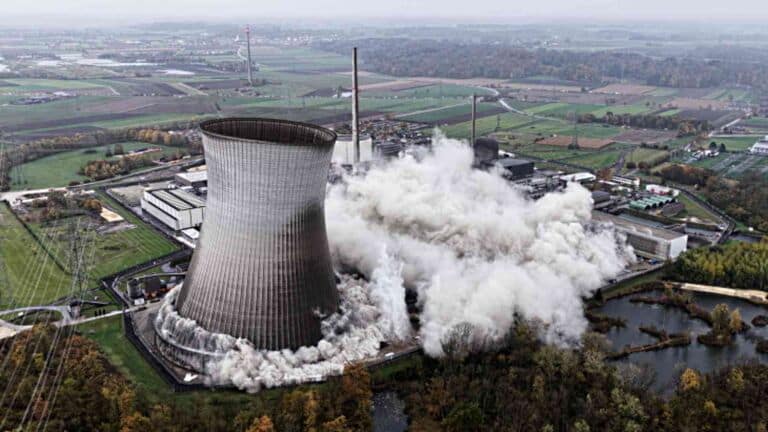
Six reactors sit on one beach between two ports at the narrow end of the Dover Strait.
Each one is a 900 megawatt unit, and all six drink from the same water.
Together they are the largest nuclear station in western Europe.
There is no cooling tower here and no reservoir. The sea is the cooling system.
Which also means one bloom arriving on one tide reaches every intake on the site at the same moment, because there is no second stretch of coast to fall back on.
Late summer is when the animals peak.
Surface water is at its warmest, the swarms are dense, and they go wherever water goes.
What actually happened
On the eleventh of August, units two, three and four stopped.
Unit one dropped to half power. Unit five was already down for scheduled maintenance. Unit six kept running at full.
Call it 3.2 gigawatts off the French grid inside a few hours.
The animal was identified as the barrel jellyfish, a native species of these waters rather than an import, which matters because it means nothing exotic is needed to produce this result.
The operator said there were no consequences for the safety of the installation, for personnel or for the environment, which is the standard formula and in this case an accurate one.
The date is the part worth pausing on.
Last year’s shutdown fell on the same date, when four units tripped automatically, the remaining two were already in maintenance, and the whole station sat at zero for about ten days.
The countermeasures were already running
This is where the story stops being about jellyfish.
After last year the operator put hundreds of thousands of euros into the problem, and by this summer the measures were live rather than planned.
Cameras went onto the drum screens and the intake channels in June.
Fishing associations and the maritime rescue service were counting daily, and three fishing boats were working around the clock to carry jellyfish back out to sea.
The daily counts in the days beforehand had been small.
All of it was running on the night it happened.
A spokesman said the population had multiplied faster than anyone expected, which is fair, and is also an admission that the 4 reactors lost last summer bought a year of preparation and no protection.
The list this belongs on
It is not a French problem.
A Scottish station lost both reactors to jellyfish in 2011, at a cost put at roughly 1.5 million dollars a day, and the same station was hit again a decade later.
The list runs longer than most people expect.
Sweden, Japan, Israel, the Philippines, South Korea and a plant on the California coast have all lost output to the same soft obstruction.
Warmer water is the common thread, and researchers pair it with overfishing and the loss of the predators that would otherwise eat the young.
It grows more of what jellyfish eat, speeds up their life cycle and stretches the breeding season, so the blooms arrive earlier and stay longer.
An intake cannot tell one animal from another, which is how a Florida station ended up logging nearly twenty thousand turtle captures across forty seven years without ever meaning to.
Nothing here is exotic and nothing here is solved.
A nuclear plant on an open coast is a very large pump with a screen in front of it, and what shows up at that screen is decided by the sea.
Read the whole thing?
Get the week's signal, not the noise
Our sharpest reporting on energy, climate and nature — free, once a week.