The $700 million Soda Mountain Solar Project is finally in the pre-construction phase after a previous regulatory rejection over its wildlife footprint.
The 300-megawatt facility covers 2,670 acres near California’s Mojave National Preserve. State officials insisted that developers alter the original plans to incorporate a section of buffer land for just one species.
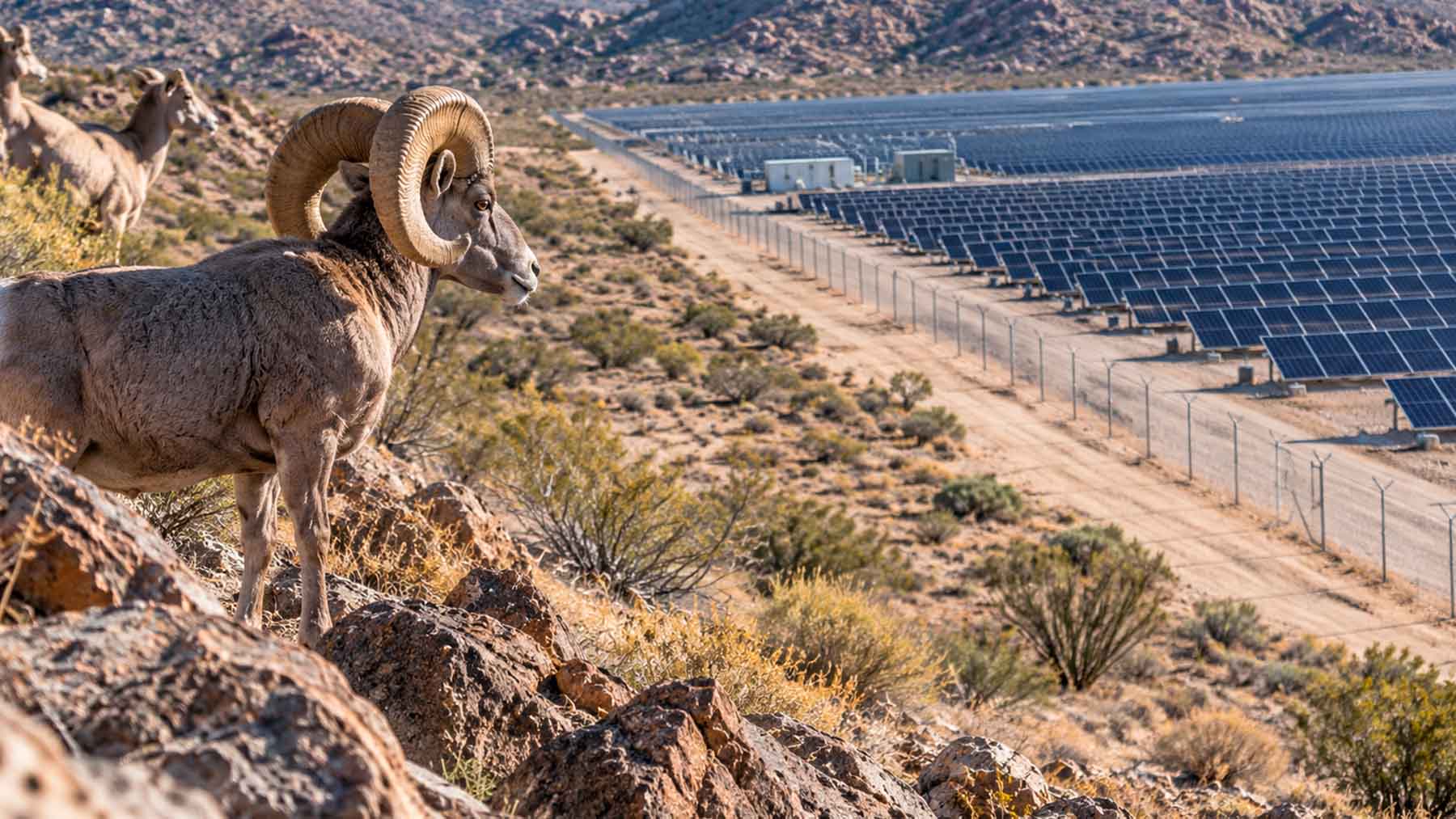
Desert bighorn sheep need space to move between mountain ranges. But biologists believe the gap is not wide enough. Will the sheep’s movements still be protected in the desert?
How plans had to be reworked so rejections could be overridden
Local county officials rejected the Soda Mountain installation in 2016. It took 10 years to work around lost utility backing, a county veto, and legal complications. New state energy legislation eventually saw the solar project given the go-ahead by the California Energy Commission.
Approved by the California Energy Commission in April 2026, the planned San Bernardino County installation on Bureau of Land Management (BLM) property remains in the pre-construction compliance phase and will incorporate photovoltaic arrays and a 300-megawatt battery storage system.
Construction plans detail an eight-foot-high security fence around the entire complex, which is standard for high-voltage equipment.
The site is located between the Soda and Cady Mountains. It is directly within a well-established corridor for desert bighorn sheep (Ovis canadensis nelsoni). Officials cited clean energy mandates when the project was approved after a decade’s delay, according to the California Energy Commission.
Following the project’s transition to the pre-construction phase in April 2026, the Bureau of Land Management completed its federal review process for the Right-of-Way amendments, issuing a final decision on May 29, 2026.
Incorporating a sheep buffer into a facility redesign
Developers’ strategy to get around the environmental objections involved shifting the layouts of the panels along the eastern site boundary. The state mandated a 0.25-mile “Bighorn Sheep Buffer” between the mountain slopes and the site perimeter.
This layout accommodates a path between separate bighorn mountain habitats to preserve genetic diversity across both habitats. The corridor will eventually connect the herds to a planned wildlife overpass above Interstate 15.
The state believes that the 0.25-mile buffer is an adequate environmental solution. Regulators decided that simply leaving this land near the steep ridges undeveloped means the animals will have enough space to navigate the valley.
Conservation groups and some independent researchers contend that a quarter-mile is not wide enough. While the California Department of Fish and Wildlife recommended a minimum 0.25-mile buffer, studies submitted by researchers advocate for a larger corridor of around 0.64 to 1.24 miles., which is around five times the current specification. They pointed to a substantial discrepancy between field science recommendations and the regulatory decision.
Behavioral avoidance and corridor width constraints
Biologists warn that the 0.25-mile gap is too narrow because desert bighorn sheep rely heavily on open sightlines and view tight, fence-lined passages as high-risk predator traps.
Field studies show bighorn sheep need wide, unobstructed terrain to spot threats and navigate safely.
Biologists express concern that once the project is built, a narrow gap flanked by eight-foot security fences, tall solar arrays, and operational noise could cause sheep to avoid the corridor entirely. Instead of walking through the open space, they turn back, turning the physical corridor into an active barrier.
Trying to funnel desert bighorn sheep does not work
Researchers stress that open ground on a map does not automatically create usable habitat for risk-averse wildlife.
Critics warn that funneling sheep through a 0.25-mile bottleneck could interrupt genetic exchange between the Cady and Soda Mountain herds.
State regulators argued the redesign balances clean energy goals with environmental care. The BLM still has to issue the final approval, reports the Basin and Range Watch, and it is by no means a given that this will come to pass.
Biologists maintain that corridors designed without considering animal behavior will fail to prevent herd isolation. Setting up buffer zones on paper does not guarantee wild species will actually use them on the ground.
Read the whole thing?
Get the week's signal, not the noise
Our sharpest reporting on energy, climate and nature — free, once a week.