Anyone driving the interstate between Las Vegas and Los Angeles has seen it.
Three pale towers standing on a dry lake bed, and when the array is aimed at them they glow hard enough to pick out from miles off.
Underneath, mirrors cover five and a half square miles of desert.
The utility that buys most of the output wanted out. The owners agreed to sell.
Everyone signed. The regulator said no.
And the reason had almost nothing to do with the plant itself, or with the birds it is famous for.
Why this kind of solar plant lost the argument
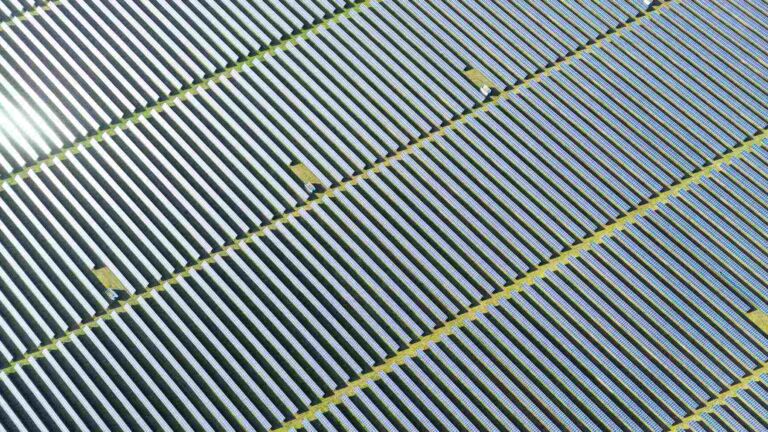
This is not a panel farm.
It is concentrating solar. Thousands of mirrors track the sun and throw its light at a receiver on a tower, which boils water, which drives a steam turbine.
That is a thermal power station with a mirror field instead of a furnace, and it has all the parts a thermal station has.
A photovoltaic panel does none of that. Light goes in, current comes out, nothing turns and nothing boils.
The two technologies then went in opposite directions on cost. Panels fell faster than almost anyone forecast. Mirror fields, turbines and receivers did not, because there is no equivalent of a factory learning curve for a boiler.
And a mirror plant carries a running cost a panel farm never has. On cool mornings it burns natural gas to bring the system up to temperature before the sun can do the work.
What is actually standing out there
The three towers are about 459 feet tall.
Around them sit 173,500 sun tracking heliostats, each carrying a pair of mirrors, spread across roughly 3,500 acres of federal land just south of the Nevada line.
Gross capacity across the three units is 392 megawatts, and the plant came online in February of 2014.
It cost 2.2 billion dollars to build, backed by a federal loan guarantee of 1.6 billion that has not been repaid.
The owners are an independent power producer, the technology company that developed the mirror system, and a search engine that took an equity stake early.
All of which is now sunk, which is exactly the problem.
The deal that everyone involved wanted
In January of 2025 the utility asked the state to approve termination agreements covering its contracts on two of the three units.
Those contracts carry roughly 250 megawatts and were written to run until 2039. Ending them would have stopped purchases in early 2026, thirteen years short.
The utility said that ending them would cost customers less than carrying them to term, though the underlying price forecasts are confidential.
The federal energy department, which holds the loan guarantee, supported it.
An independent evaluator reviewed it and agreed it saved money.
The third unit sits under a separate contract with a different utility, and those talks ran separately.
The vote, and the reason behind it
On the fifth of December in 2025 the commission rejected the agreements unanimously, and did it without prejudice.
The reasoning was not about the plant. It was about what would come after it.
Federal policy on renewables had shifted, and the commission decided that uncertainty over replacement projects undermined a core assumption behind its own reliability planning. Stripping out an uneconomic contract only helps if something arrives to take its place.
There is also a number underneath it that the coverage mostly skipped. Ratepayers have already put more than 333 million dollars into transmission built to carry this plant’s output.
Kill the plant and that spending strands. Grid connections and the wires behind them are frequently worth more than the generator bolted onto them.
The draft resolution put the position in one line. The plant is too uneconomic to keep and too risky to kill.
What a plant that cannot close does next
The utility can come back, and the ruling says how. It needs to name a concrete replacement project rather than an assumption.
Until then the contracts stand and the mirrors keep tracking.
The exit everyone quietly points at is the land. Three and a half thousand acres already cleared, fenced, permitted and wired into the grid is worth a great deal to anyone building anything.
Repowering that footprint with panels would cost far less than starting on open desert, though it would need fresh permits and fresh financing and years of both.
Desert solar has left stranded hardware before, and the difference here is that the hardware is still under contract.
A plant nobody wants to run and nobody is allowed to stop is not a failure of engineering.
It is what happens when the wires, the loan and the reliability math all outlive the business case.
Read the whole thing?
Get the week's signal, not the noise
Our sharpest reporting on energy, climate and nature — free, once a week.