Venus may have swallowed its own moon — and its slow 243-day rotation could be why
Earth has a moon. Venus doesn’t. That alone might not seem remarkable — but it should. The two planets are nearly identical in size, mass, and structure, close enough that scientists once called Venus Earth’s twin. Yet one world hosts a natural satellite that has shaped its tides, its geology, and possibly its capacity for life. The other orbits the sun alone.
Why Venus has no moon has puzzled researchers for decades. New research from UC Riverside points to a culprit hiding in plain sight — one that has nothing to do with a missing collision or a cosmic accident, but with something far more fundamental to Venus itself.
A tale of two nearly identical planets
Venus and Earth formed from the same swirling disk of gas and dust roughly 4.5 billion years ago. They ended up nearly the same size, with similar mass and a broadly comparable internal structure. That shared origin makes Venus’s moonless state genuinely strange — not just a curiosity, but a scientific puzzle worth taking seriously.
For years, two explanations dominated the debate. Some researchers argued Venus once had a moon that was later destroyed by a massive impact. Others suggested Venus simply never experienced the right kind of collision to produce one. Both ideas treated the absence as the result of something that happened — or didn’t happen — very early on.
Stephen Kane, an astrophysicist at UC Riverside, has proposed a third possibility. His study, published in The Astrophysical Journal, suggests Venus may not have needed any external catastrophe at all. The planet’s own properties — specifically how slowly it spins — could have sealed a moon’s fate entirely on their own.
Why Earth’s moon drifts away — and Venus’s wouldn’t
Our Moon is leaving us. Not quickly, but measurably. Scientists confirmed this using laser mirrors left on the lunar surface during Apollo 11, which allow researchers to track the Earth-Moon distance with precision. The Moon moves away from Earth at roughly four centimeters per year.
That outward drift isn’t random. It’s driven by Earth’s rotation. Our planet completes one full spin every 24 hours, and some of that rotational energy transfers to the Moon, nudging it gradually outward over billions of years — a slow, steady handoff of momentum from planet to satellite.
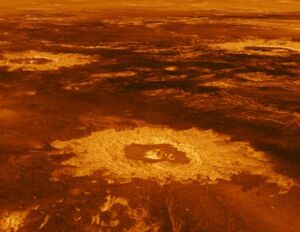
Venus offers no such handoff. One full rotation takes about 243 Earth days, longer than its own year. That extremely slow spin means a Venusian moon would receive no meaningful outward push. Gravity would dominate instead, pulling any moon progressively closer rather than releasing it into a wider orbit.
Simulations send a moon crashing into Venus
Kane built computer models to simulate gravitational interactions between planets and their moons. Before applying them to Venus, he validated them against the Earth-Moon system — confirming the model could reproduce the known behavior of a real, well-studied system. That step matters, because it grounds the subsequent findings in something verifiable rather than purely theoretical.
He then adjusted the model for Venus, plugging in the planet’s actual slow rotation rate and testing hypothetical moons ranging in mass from half that of Earth’s Moon to ten times as massive.
The results were consistent. Across nearly all conditions, the moon spiraled inward and crashed into Venus. Larger moons didn’t survive longer — they fell faster. “When I made this discovery, I was shocked,” Kane said. “I thought surely the broad range of scenarios I was exploring would lead to a variety of results. But it all went pretty much in the same direction.” Kane is careful to note that the simulations don’t prove Venus ever had a moon — only that if one existed, it likely couldn’t have survived.
Could evidence of a lost moon be buried inside Venus?
Finding physical proof of an ancient moon collision on Venus’s surface is probably not possible. About 80% of the planet’s surface dates to a single massive resurfacing event roughly a billion years ago, and whatever geological record existed before that was largely erased — buried under fresh volcanic material on a planetary scale.
The surface isn’t the only place to look, though. On Earth, seismic studies have identified unusual structures deep below the surface that scientists think may be remnants of the ancient impact that formed our Moon. Similar studies on Venus — requiring seismometers sent to the planet — might reveal comparable buried signatures.
A moon collision would also have had sweeping consequences: enormous energy and angular momentum delivered to Venus, potentially altering its rotation, reshaping its geology, and disrupting whatever climate it had at the time. That raises a genuine question — was Venus once more Earth-like, and did losing a moon help push it toward the hostile world it is today?
What this means for Earth-like worlds beyond our solar system
The implications of Kane’s work extend well past our own solar system. When astronomers evaluate distant exoplanets for habitability, they weigh distance from the host star, atmospheric composition, and the presence of liquid water. Whether a planet has a moon sometimes enters that conversation too, since moons can stabilize axial tilt and drive geological activity.
Kane’s findings add a new consideration. Forming a moon may not be enough — a planet also has to rotate fast enough to keep it. Slowly rotating Earth-like worlds orbiting other stars could be pulling their own moons to destruction, fundamentally changing how those planets evolve.
Kane himself is measured about what moons actually contribute. “My feeling is there are benefits to having a moon, but it isn’t required for habitability,” he said. Still, losing one violently could reshape a planet’s entire history.
When you look at Venus today — its crushing atmosphere, its surface hot enough to melt lead, its complete absence of a companion — you may be looking at one possible outcome for planets we’d otherwise call Earth-like. The difference between a living world and a dead one might come down to something as simple as how fast it spins.
Learn more about these findings here: Stephen R. Kane, Franck Selsis, Jérémy Leconte, Sean N. Raymond. Tidal Demise: The Evolution and Fate of a Hypothetical Venus Moon. The Astrophysical Journal, 2026; 1009 (1): 31 DOI: 10.3847/1538-4357/ae9d6c
Read the whole thing?
Get the week's signal, not the noise
Our sharpest reporting on energy, climate and nature — free, once a week.