Volunteers studying ground-based optical survey data have found several dozen high-energy stellar outflows in a large interstellar star-forming nebula.
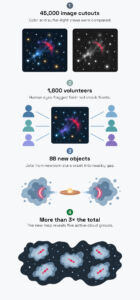
The study included the participation of more than 1,600 citizen scientists who completed about 680,000 classifications of over 45,000 DECam cutouts from a ground-based optical survey.
Visual inspection made by these volunteers led to the detection of 88 new Herbig-Haro jet structures driven by energetic protostellar jets and outflows.
Such crowd-sourcing has increased the number of known stellar jets in the Serpens-Aquila Rift region more than three times.
Harnessing public power to examine vast astronomical surveys
Millions of images coming from deep space via wide-field ground-based surveys contain plenty of visual data for manual auditing by citizen scientists and professional astronomers alike.
Computer algorithms tend to overlook faintly glowing shock waves that are concealed under thick layers of the interstellar gas and cosmic dust.
It is easy for the human eye to catch small distortions in shapes and faint emissions of nebulae that may be overlooked by computer algorithms.
The volunteers analyzed ground-based images from the Dark Energy Camera (DECam) on the Blanco telescope—blinking optical color composites (broadband g and i) against narrowband [S II] and images—to distinguish star jets from distant background galaxies or instrumental artifacts.
Pattern recognition by humans helped discover thousands of archival sky surveys from deep space.
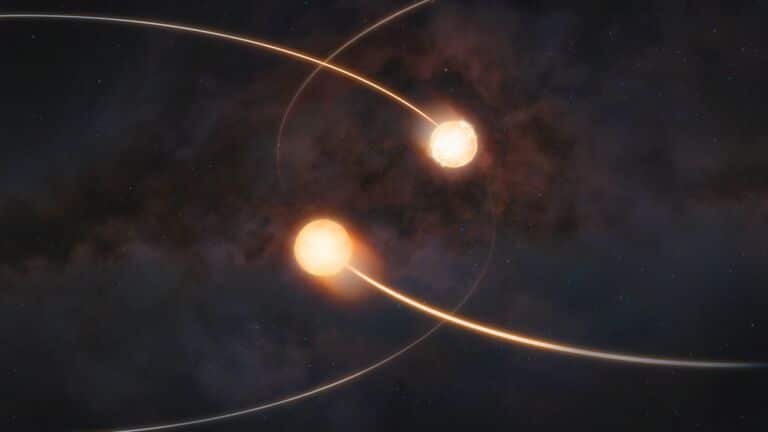
Tracking supersonic jets from violent infant stars
Young stars attract dense matter toward them by means of rotating accretion disks in their initial stages of development.
Intense magnetic fields that envelop these young star-forming protostars direct extra matter out into super-fast jets, which punch straight into the clouds surrounding them.
Streams of plasma ejecta collide violently with clouds of matter at speeds over one hundred miles per second.
Such plasma collisions create bright shock waves that astronomers refer to as Herbig-Haro objects or protostellar jet scars.
Super-fast plasma jets create tunnels of light inside dark interstellar dust clouds.
Expanding known outflows across the Serpens-Aquila Rift
The Serpens-Aquila Rift region spans multiple physically distinct star-forming clouds situated along the same line of sight at distances ranging from roughly 815 to 2,280 light-years (250 to 700 parsecs) from Earth, containing thousands of forming protostars embedded within dark clouds.
Previously, only a few of these active stellar jets have been detected within this region.
The discovery of 88 new Herbig-Haro shocks adds up to triple the number of active outflows that can be found in this rift.
These new jet locations are useful in helping researchers detect these hidden protostars that are concealed behind the thick cosmic dust.
A crowdsourced effort has tripled the number of active outflows found within this region.
Measuring mechanical feedback inside stellar nurseries
Alternating views between optical broadband filters and narrowband [S II] and emission lines enable scientists to study the process by which the stellar jets convert their mechanical energy to the molecular clouds they inhabit.
Plasma flows that escape inject energy in the form of high-level turbulence into the reservoir of gas, causing local expansion of clouds.
Injection of energy prevents gas clouds from contracting by gravitational pull, controlling the star-formation process.
Detailed maps of jets help us understand the manner in which young protostars mold their environments over millions of years.
Stellar jets control the birth rate of neighboring stars.
Defining the limits of crowd-sourced astronomical catalogs
Visual examination of image cutouts from the survey data has identified 88 newly detected Herbig-Haro objects, confirmed through their line emission in and [S II] filters.
While imaging confirms their identification as Herbig-Haro objects, single-epoch survey images alone cannot determine parameters such as jet expansion speeds or precise shock velocities.
To know the true velocity of the proposed outflows, the only way possible is by using the technique of spectroscopy conducted at the ground level via large optical telescopes.
In the coming days, this issue will be clarified by space observatories.
Volunteer classification via the Zooniverse Baby Star Search project successfully identified these 88 new Herbig-Haro shocks, though follow-up spectroscopy and multi-epoch imaging will be valuable for measuring their detailed velocities and physical properties.
All the study details can be found here: Rector, T. A., Kerr, R. M. P., Prato, L., Shuping, R. Y., Bender, C., Esplin, T. L., & Abhilash, S. E. (2026). Mapping Active Star-formation in Serpens and the Aquila Rift. The Astronomical Journal, 172(1), 55.
Read the whole thing?
Get the week's signal, not the noise
Our sharpest reporting on energy, climate and nature — free, once a week.