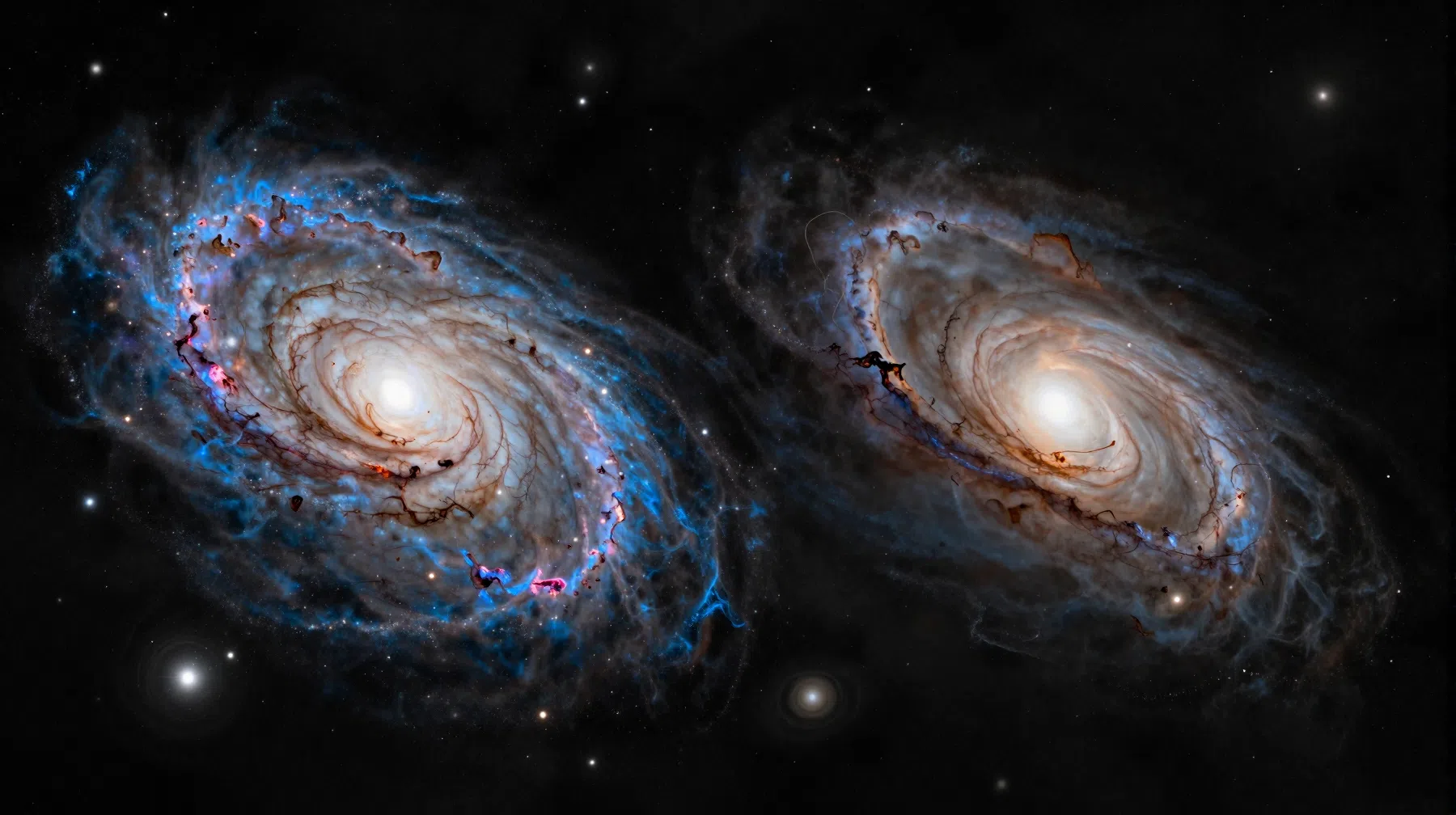
Some galaxies spend billions of years churning out stars at a relentless pace — then, almost abruptly, go quiet. Astronomers have watched this transition play out across the universe for decades, but a clean physical explanation for why it happens, and why it happens at a specific mass scale, has remained elusive.
A new study may have finally pinpointed the precise moment a galaxy crosses the point of no return.
A cosmic retirement no one could fully explain
The shift from vibrant star-forming system to quiet, dormant one is among the most well-documented patterns in modern astronomy. Scientists call this process “quenching.” They’ve catalogued it in survey after survey, observed it across cosmic time, and built entire theoretical frameworks around it. Yet a clean physical mechanism — something that explains not just that quenching happens, but why it happens at a particular mass scale — has remained stubbornly out of reach.
That gap is what a new paper led by Preetish Mishra of the Korea Institute for Advanced Study sets out to close. Working with an international team, Mishra proposes a specific, testable mechanism: a self-sustaining hot gas halo that forms around a galaxy once it crosses a critical mass threshold, permanently cutting off the fuel supply for new stars.
Simulating 20,000 galaxies across cosmic time
To test the idea, the team turned to the Horizon Run 5 simulation — one of the largest cosmological simulations ever constructed. It models a chunk of virtual universe roughly a gigaparsec across, incorporating the full physics of gas dynamics, gravity, star formation, supernovas, and supermassive black holes, running from shortly after the Big Bang all the way to the present day.
From that vast virtual cosmos, Mishra and colleagues selected roughly 20,000 of the most massive central galaxies and tracked them across their entire histories. The key measurement was the stellar-to-total mass ratio — essentially, how much of a galaxy’s total mass budget actually ends up locked into stars. Think of it as a star-formation efficiency score. It captures whether a galaxy is making productive use of its available material, or whether something is holding it back.
The critical mass: where star formation hits a wall
The results were clear. Star-formation efficiency peaks sharply in galaxies with total masses between roughly 10^12.4 and 10^12.7 solar masses. Below that range, galaxies convert incoming gas into stars at a relatively brisk pace. Above it, efficiency drops by more than a factor of three — an abrupt change, not a gradual fade.
The physical reason comes down to cooling. Below the critical threshold, infalling gas cools fast enough to condense and rain down onto the galaxy, continuously feeding new star formation. Above it, something changes fundamentally. The gas can no longer cool in time to contribute to new stars. The pipeline doesn’t slow — it effectively stops.
Hot gas halos: the self-sustaining ‘off switch’
As a galaxy grows past the critical mass, gas falling into it gets shock-heated into a dense, hot halo surrounding the system. Up to a certain point, that halo loses heat fast enough that the gas cools, falls inward, and keeps the star-formation cycle going.
Past the threshold, the halo reaches gravitational equilibrium — dense and hot enough to hold itself up against gravity for billions of years without collapsing. Cool gas stops arriving at the galaxy’s center. The raw material for new stars simply no longer gets delivered.
The galaxy doesn’t freeze in place. It keeps accumulating dark matter and pulling in smaller satellite galaxies through mergers. But the one ingredient that actually makes stars — cool, dense gas — stops flowing in. The factory stays standing; it just runs out of supplies.
Ruling out the competition — and flagging the caveats
One obvious alternative explanation is that galaxies above the critical mass lose more material through outflows — gas blown out by supernovas or active galactic nuclei. The team tested this directly by calculating how much of each galaxy’s normal matter remained gravitationally bound to the system. Variation across the sample was no more than 30 percent. That falls far short of explaining a factor-of-three drop in star-formation efficiency. The decisive change is on the inflow side, not the outflow side.
A few caveats deserve acknowledgment. Horizon Run 5 is a simulation, not a telescope, and its numerical outputs depend on the sub-grid physics used to model star formation, feedback, and black hole behavior. The authors ran sensitivity tests and the core result held up — but the exact value of the critical mass threshold could shift as simulation methods improve. The study also focuses on galaxies above 10^10.8 solar masses, so smaller systems fall beyond its reliable resolution.
What comes next: testing the theory against the real universe
The proposal is testable, and that’s its greatest strength. Future surveys of galaxy clusters and the warm-hot intergalactic medium — the diffuse gas between galaxies — could directly probe whether self-sustaining hot halos behave the way the simulation predicts. Observational signatures should be detectable if the mechanism is real.
This study connects a well-known observational pattern to a single, specific physical process — not just that galaxies above a certain mass tend to go quiet, but why they do, and what structure is responsible. Astronomers will be watching closely as upcoming survey data arrives to see whether that critical mass threshold holds against the actual universe.
Read the whole thing?
Get the week's signal, not the noise
Our sharpest reporting on energy, climate and nature — free, once a week.