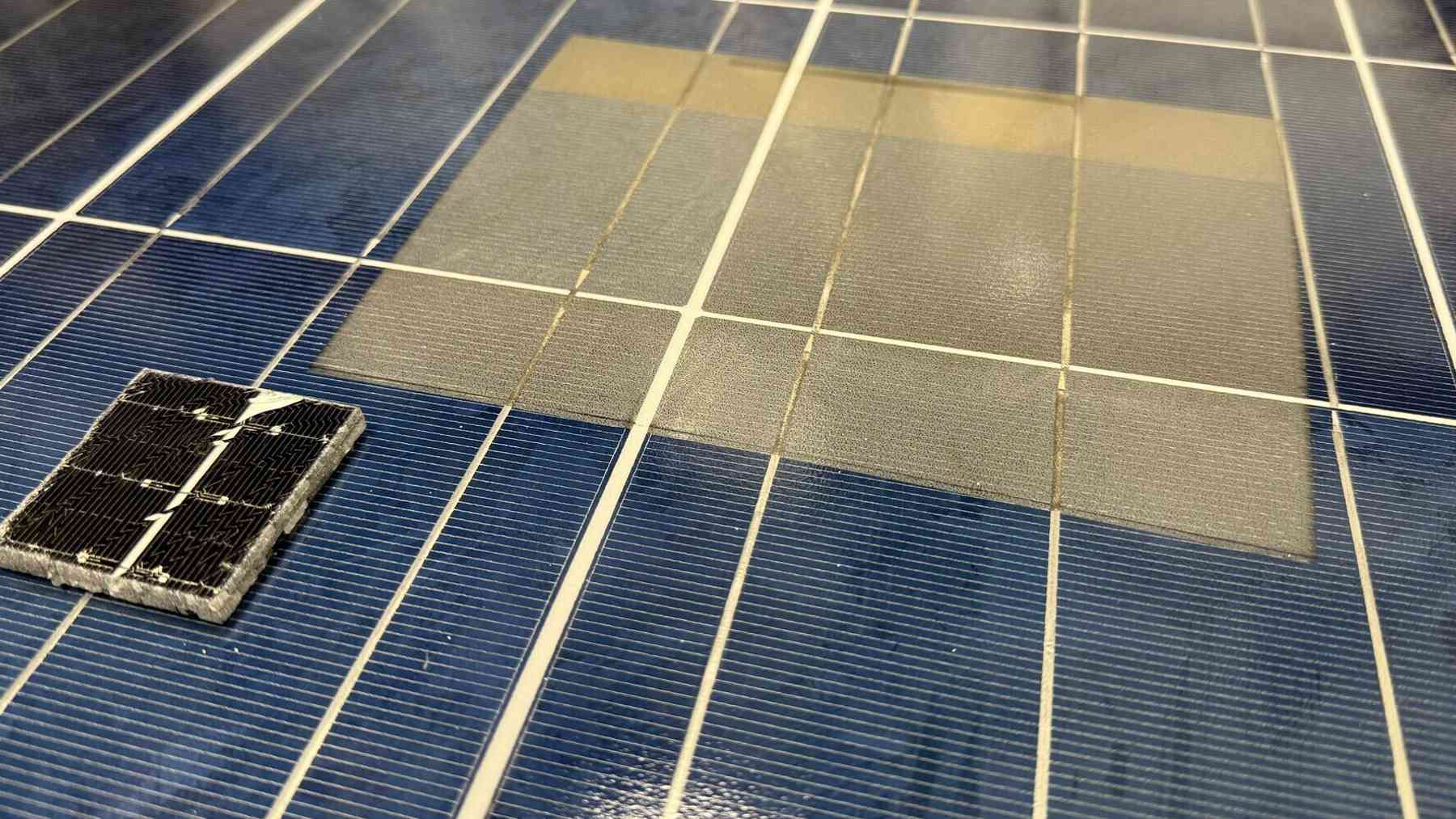
A thin red line creeps across the back of a cracked solar panel on a lab bench.
No chemical bath waits nearby.
No furnace hums in the corner.
Just a beam of infrared light, inching forward less than an inch at a time.
Underneath it, a stubborn plastic sheet starts to curl and lift on its own, and nothing else about the panel changes shape.
The question is what made that sheet let go after nothing else had worked.
The beam heats the glue layer, not the plastic itself
The trick is where the light goes first. Engineers at the University of Virginia aimed a continuous wave infrared laser through the front glass of a silicon module, at a wavelength of 1,070 nanometers, letting it pass through the glass until it reached the silicon wafer underneath. That wafer absorbs the energy and warms, and the heat then moves sideways into the glue layer bonded to it, a material called EVA.
The laser “selectively heats the silicon after transmitting through the glass, softening the ethylene vinyl acetate (EVA) encapsulant,” corresponding author Mool C. Gupta told pv magazine, allowing the backsheet to come away on its own.
That sequence sidesteps the backsheet entirely. Earlier methods attacked the layers directly with solvents or bulk heat. Driving the heat through the wafer itself turns the hardest part of the panel into the tool that unglues everything else.
A peel finished in 12 seconds leaves the wafer untouched
Picture a test panel clamped flat under the laser head, a patch smaller than a square inch coming free with each pass. The research team found that a beam intensity of 28 watts per square centimeter gave the cleanest result, and at that setting a few square centimeters of backsheet detached in 8 to 12 seconds, with no wafer cracking, warping or polymer breakdown.
That speed matters because a solar panel is not simple to take apart by hand. The backsheet is a tough weatherproof laminate built to survive decades of sun and freezing nights, and that same durability is what makes it resist nearly everything recyclers have tried.
Once a strip lifted, the rest peeled off mechanically. The glass and the silicon wafer stayed fully intact across the whole test panel.
Thermal modeling showed heat spreading past the beam’s edge
The team worked systematically across intensities from 23 to 33 watts per square centimeter before settling on 28 as the optimum setting. Raman spectroscopy showed the crystalline silicon was preserved, and electrical measurements across the finished wafer showed no loss in performance at that optimum intensity, while higher settings caused the recovered backsheet to decompose.
A thermal model ran alongside the physical tests, and it showed heat diffusing roughly a half inch beyond the laser spot itself. That spillover turned out to be useful rather than a flaw, since a single pass loosens a patch of adhesive noticeably larger than the beam.
The published method also estimates a per module processing cost near 22 cents, a figure from the authors rather than an independent audit.
Years of solvent soaks left recyclers stuck at the backsheet stage
None of this started from nothing. Conventional routes such as pyrolysis, solvent dissolution and hot knife delamination are slow, energy intensive, chemical heavy or destructive to the polymer, and each carried its own tradeoff. Because those older methods kept damaging something valuable, whole panels often ended up shredded into a low value powder that mixes glass, plastic and silicon together.
The same end of life problem is surfacing across the offshore wind fleet, where retired hardware raises similar questions about what can be recovered whole. A fast, precise way to lift just the backsheet fits into a larger shift, one also visible in a solar project built around planning for a panel’s full working life from the start.
Scaling past the lab bench is the next five year test
Even so, this remains a laboratory result, shown on small test panels rather than inside a facility handling hundreds of modules a day. Scaling a laser head built for careful, centimeter by centimeter passes up to industrial throughput is its own engineering problem.
Gupta has said the process could speed up with higher laser power or multiple lasers running together. What the work shows plainly is that the backsheet, long treated as an unavoidable contaminant, can be peeled away whole rather than burned or dissolved.
A panel built to survive decades of weather does not have to end as mixed debris in a landfill, even if getting there one laser pass at a time is still, for now, a slow and careful process.
Read the whole thing?
Get the week's signal, not the noise
Our sharpest reporting on energy, climate and nature — free, once a week.