Analysis of archived space telescope data led to the discovery of a potential Jupiter-like planet that formed around a dead white dwarf star.
Planets tend to form from the protoplanetary disks that exist around stars many years before their death.
However, the reanalysis of archived spectral data showed the presence of heavy metals and other chemicals around the shining remnants of the star.
This is a rare discovery, which offers strong supporting evidence and unique chemical signatures that point toward the potential formation of a second-generation planet candidate from the remains of a star.
Processing of stored observations of white dwarfs
The information gathered by spacecrafts several decades ago contained numerous chemical signatures that could not be accommodated in the existing system of classification.
The scientific study involved analysis of previous data on star HS 0209+0832 with the help of catalogues of elements and compounds.
As a result of better spectral analysis, the rare element niobium was identified in the homogeneous hot atmosphere of the star.
Without continuous pollution from outside, such heavy metals could not have existed in normal stars.
Chemical anomalies turned archive data into valuable evidence of planetary accretion.
Proposed identification of a second generation of planets created from the leftovers of the star
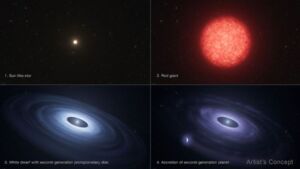
Sun-like stars expel their outer gas layers into space at the asymptotic giant branch stage when they exhaust their fuel.
This material can condense in circumstellar disks composed of processed metals that result from these violent deaths.
Theoretically, it is believed that such disks can collapse gravitationally to form new planets.
In contrast to the primordial terrestrial planets that were formed along with the stars, the Phoenix planets are entirely formed from the remains of the dead stars.
Theoretical models of second-generation debris formation suggest that planets can potentially be formed long after a primary star dies, although no surrounding disk was directly imaged in this system.
Observations on short orbital periods with space photometry
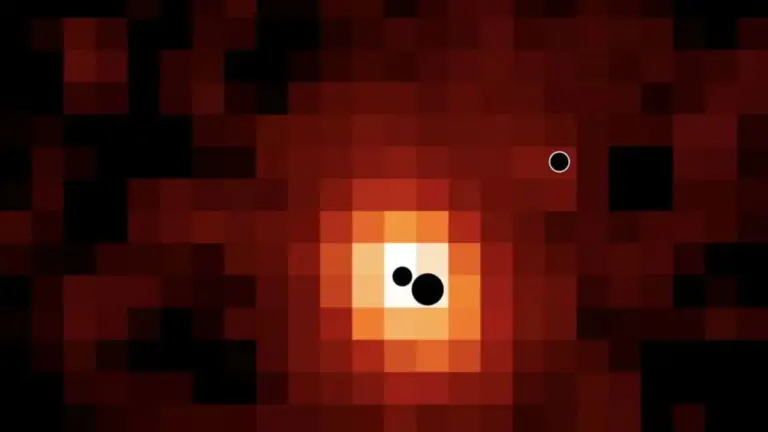
The dimming observed using the space-based telescope was periodic with a sinusoidal pattern that appeared every 4.39 days.
The light curve fluctuations matched the phase curve of an irradiated gas giant that was in very close orbit.
From the calculations done on the orbital plane, it has been found that the planet is close to the white dwarf star at a distance of 0.04 astronomical units.
This is because the giant planet is in such close proximity that it is subjected to high-intensity ultraviolet radiation from the white dwarf star.
Because of the tidal lock effect, there is one side of the planet that is in constant daylight facing the white dwarf star.
Modeling potential rapid mass loss and contamination of the surface of the star
Due to the radiation from the neighboring high-energy star, the planet becomes excessively hot.
Scientists hypothesize that a heated gas atmosphere on the candidate planet may escape into space to form a theoretical comet-like tail.
Some part of the substance is attracted by the gravity of the star into its well and deposits heavy elements on the surface of the white dwarf.
As reported in news about the NASA Hubble Space Telescope, accretion occurs.
Photoevaporation is proposed to explain the chemical contamination signal observed by the space observatories, as reported by Nature Astronomy.
All these processes suggest a scenario where the candidate planet could be losing its envelope due to evaporation from the neighboring star.
Considering the future of our solar system
The presence of alive planets near dead stars has an impact on how scientists view their life cycles.
Our sun is currently a hydrogen-fusing main-sequence star and is projected to evolve into a red giant in about five billion years, which will be followed by a white dwarf billions of years later.
The possibility and supporting evidence regarding the ability to produce second-generation planets provide interesting insight into the evolution of the universe.
Dead stars need not be the ultimate end of planet systems in the galaxy.
Observational efforts will soon prove whether there are phoenix planets near other white dwarfs in nearby areas.
Read the whole thing?
Get the week's signal, not the noise
Our sharpest reporting on energy, climate and nature — free, once a week.