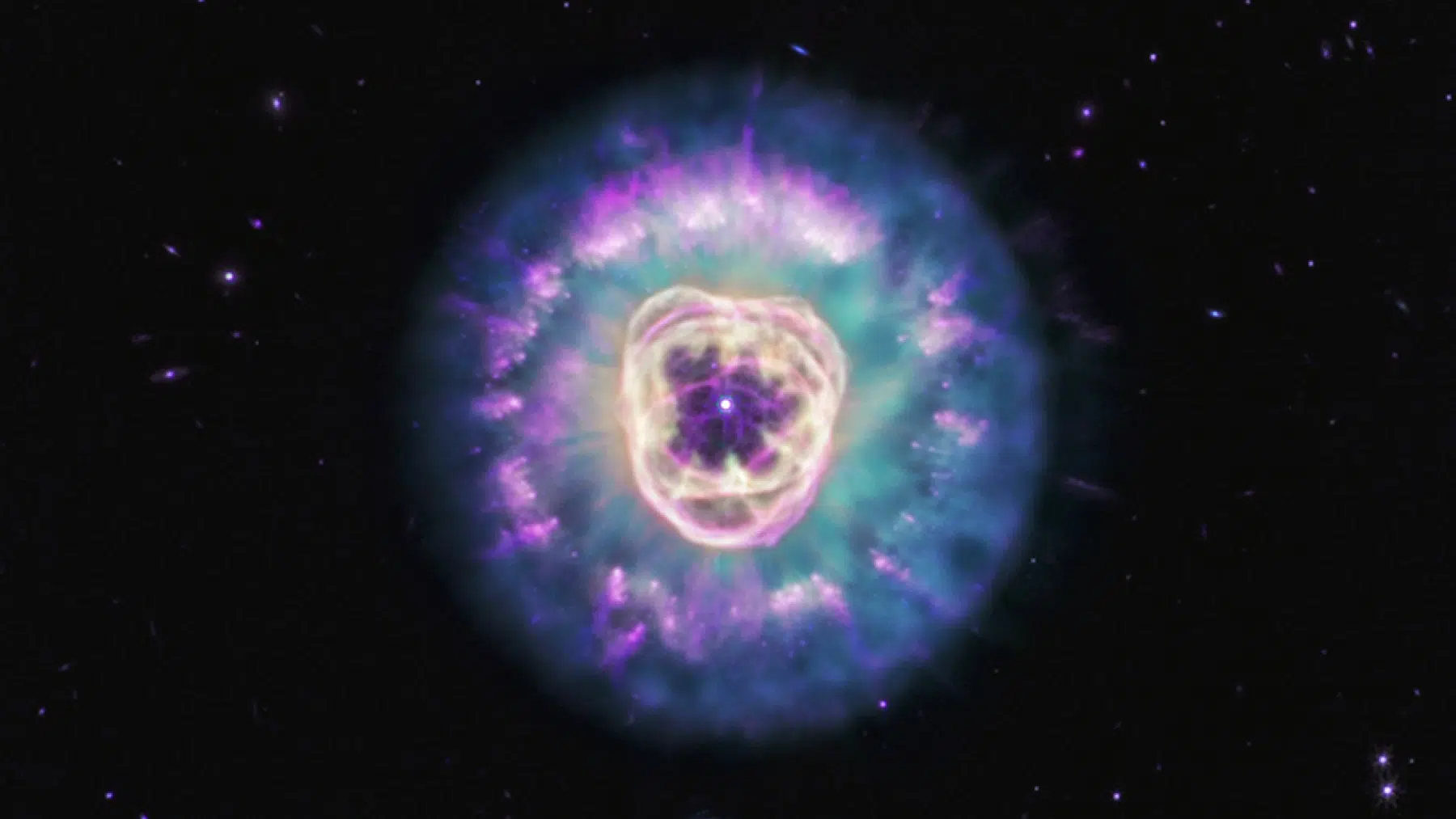
Somewhere in the constellation Gemini, a glowing face stares back at us from space — two bright eyes, a wispy mane of hazy tails, and at the center, a tiny button of light that turns out to be one of the hottest stellar remnants in the galaxy.
That face belongs to NGC 2392, the Lion Nebula. When the James Webb Space Telescope turned its infrared instruments toward it, astronomers got their clearest look yet at what’s been quietly reshaping this cosmic portrait for thousands of years — and what’s still driving it from within.
A nebula that looks like a lion — and now we can see why
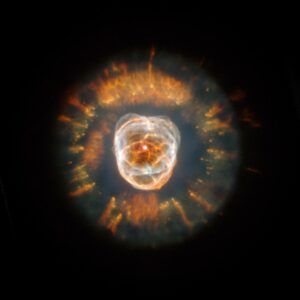
NGC 2392 earned its nickname honestly. Its glowing gas forms a distinct face-like shape, complete with surrounding wisps that resemble a mane. Hubble first captured this portrait in visible light back in 2000, giving astronomers a solid baseline view of its unusual appearance — including what looked like comet tails drifting outward from the central glow.
Visible light, though, only tells part of the story. Webb observed NGC 2392 using two instruments: NIRCam, its Near Infrared Camera, and MIRI, its Mid Infrared Instrument. Together they revealed dense dust concentrations and ionized gas regions that are far harder to detect at shorter wavelengths — details Hubble simply couldn’t reach.
The gas and dust making up this nebula have been evolving for several thousand years, and they haven’t stopped moving. Even now the material continues to shift. The lion’s face we see today is just one frame in a very long film.
How an ordinary star becomes a cosmic sculptor
It’s easy to assume that dramatic cosmic structures require dramatic origins — supernovae, collisions, catastrophe. NGC 2392 came from something far more ordinary: a lower-mass star, not unlike our own Sun, that simply ran out of fuel.
When a star like this can no longer sustain nuclear reactions in its core, it becomes unstable and begins to pulsate. Those pulsations push the star’s outer layers outward into space, and over time those expelled layers form expanding shells of gas and dust — what astronomers call a planetary nebula. Stars at this stage of life are responsible for producing much of the observable dust in the universe. What remains after the outer layers are gone is the exposed stellar core: an extremely hot, dense object called a white dwarf.
Planetary nebulae aren’t rare catastrophes. They’re one of the most common endpoints a star can reach, according to the European Space Agency.
The white dwarf at the center is ‘cooking’ the nebula from within
At the heart of NGC 2392 sits an oxygen-rich white dwarf — one of the hottest stellar remnants known. Its radiation output is extraordinary, and that energy isn’t just sitting there. It’s actively reshaping everything around it.
That intense radiation inflates a bubble of ionized gas that forms the lion’s recognizable, glowing face. The bubble grows outward continuously, destroying dust in its path as it expands. The white dwarf is, in effect, cooking the nebula from the inside out.
What astronomers haven’t fully explained is why the swept-up gas arranges itself into such complex patterns — rings, shells, layered structures. These formations appear in many planetary nebulae, but the exact mechanisms that produce such organized geometry from what starts as a chaotic stellar death remain an open question.
Dust clumps that survived — and the shadows they cast
The lion’s mane isn’t just decorative. It corresponds to the inner region of a dust shell that the white dwarf’s radiation is illuminating from the center outward. Look closely and you’ll find structures that resemble tufts of hair or comet-like tails trailing away from the core.
These aren’t wispy illusions. They’re compact clumps of dust dense enough to resist the white dwarf’s radiation — holding together where thinner material has been swept away or destroyed entirely. Their density does something else: it shields whatever lies behind them. Material in the shadow of these clumps survives longer than it otherwise would.
Webb’s infrared sensitivity is what makes these structures visible at all. In visible light they’re hidden; in infrared they emerge clearly, giving astronomers their first detailed look at the physical architecture of the mane and the role these clumps play in shaping the nebula’s overall structure.
A 10,000-year countdown — and what Webb’s snapshot tells us
Astronomers estimate the Lion Nebula will fully disperse in roughly 10,000 years. That sounds like a long time. On cosmic scales it’s barely a moment — a brief window during which we happen to have the tools to observe it.
Webb’s image captures the nebula at one frozen instant in that ongoing transformation. Gas and dust are still moving outward from the central remnant, and the nebula’s appearance will keep changing until there’s nothing left to see. Studying planetary nebulae like NGC 2392 gives astronomers a clearer picture of how stars evolve and, eventually, die. Since our own Sun is a lower-mass star, what happened here offers a preview — distant and impersonal, but real — of what the solar system will one day face.
That perspective is worth sitting with. Webb, a partnership between NASA, ESA, and the Canadian Space Agency, made this level of detail possible. What it’s showing us, ultimately, is that even an ordinary star’s death can leave something unexpectedly beautiful behind.
Read the whole thing?
Get the week's signal, not the noise
Our sharpest reporting on energy, climate and nature — free, once a week.