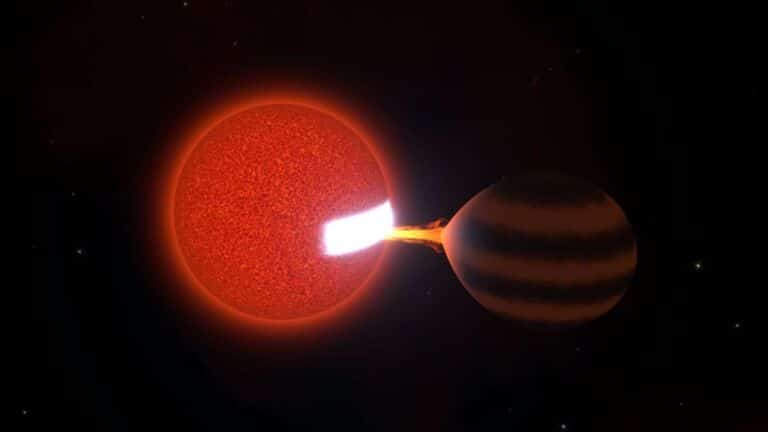
The analysis of data from the James Webb Space Telescope revealed that the hot Jupiter-like exoplanet WASP-17b has a highly distorted, elliptical atmosphere.
Traditionally, astronomers have relied on symmetrical spheres to model the shape of other planets when they pass in front of their stars.
However, using a new technique called transmission strings, researchers discovered considerable physical distortions along the outer edges of the planet.
This unusual atmospheric map serves as experimental confirmation of the already existing theories about severe weather on tidally locked planets.
Transmission strings: Charting the atmosphere of distant exoplanets
New computational methods were developed to help break down stellar transit data into small bits called transmission strings.
Spectroscopic data was collected about how starlight gets filtered at certain heights through the limb of the planet.
The transmission strings were developed by precise analytical models to demonstrate the physical characteristics at all points around the circumference of the planet.
Dividing up the spectra into smaller angle pieces gives scientists the opportunity to study the height of the atmosphere rather than just an average measurement.
This spatial profiling enables flat transmission light curves to be turned into multi-dimensional views of the far-away planets.
The discovery of an immense bulge in the atmosphere near the evening terminator
Profiles of the transit revealed that the hotter evening limb (reaching temperatures around 1,522 K) extends out more than the cooler morning limb (around 858 K), driven by equatorial winds carrying heat from the dayside.
The analysis revealed subtle radial variations of approximately 0.9% to 1.6% of the planetary radius across the limb, indicating a slightly asymmetric atmosphere rather than a grossly elongated or egg-like shape.
This makes the shape of the planet asymmetric in the form of an egg lying on its side.
A bulge in the atmosphere was observed.
The hot dayside makes the atmospheric gases bulge in a huge structure asymmetry, which cannot be explained using a spherical assumption.
This helps to prove that hot Jupiter-like bodies feature an asymmetric outer boundary during transit.
Atmospheric circulation patterns consistent with heat redistribution
Tidally locked gas giants have a consistent day-side facing their blazing hot host stars, whereas their opposite side remains in darkness.
Extensive equatorial jet streams move huge amounts of heat and hot gases from the illuminated areas to the shadowed zones.
The observed temperature differences and limb asymmetry are consistent with models of wind-driven heat redistribution from the dayside, rather than direct measurements of supersonic wind speeds.
Atmospheric processes restructure the outer layer of gases much more quickly than gravity does.
Studying these intense processes enables one to get an insight into how the climate system on the globe that is at thousands of light-years distance from the Earth works.

Verification of chemical composition despite large differences in temperature structures
Spectroscopy confirmed that key compounds, including water vapor and carbon dioxide, show abundances that are broadly consistent across the sampled transmitting limb within measurement uncertainties, rather than providing a complete global map of the entire planet’s atmosphere.
This confirms that the active weather systems are responsible for carrying chemicals on super-hot gas planets.
Confirmation of the theoretical chemical abundances increases confidence in the scientific community in the interpretation of exoplanet spectra, according to Cornell University.
Extending the scope of meteorological research in three dimensions in distant star systems
The discovery of structural asymmetries on WASP-17b provides an efficient method for studying other irradiated planets.
Nature Astronomy reports that the string mapping technique will be used in future observations of other candidate planets.
Progress made in tools for spatial analysis brings scientists one step closer to creating weather maps of various planets in the galaxy.
From simple radius measurements to the analysis of atmospheres in three dimensions, this is the dawn of a new era in comparative exoplanetology.
Future space observations will unveil the dynamics of climate systems on distant planets in the Milky Way.
Read the whole thing?
Get the week's signal, not the noise
Our sharpest reporting on energy, climate and nature — free, once a week.