Near Jupiter’s orbit, a frozen body is waking up into a comet
Three billion miles from Earth, in the cold darkness beyond Jupiter’s orbit, a small icy body that has drifted in near-silence for billions of years is beginning to stir.
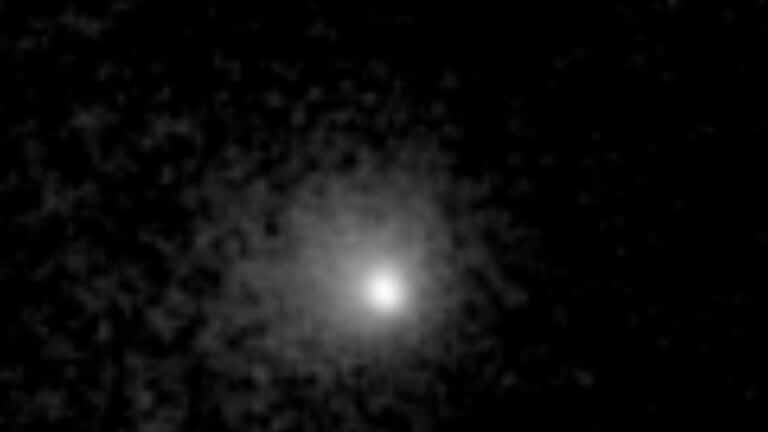
The object is called 450P/LONEOS — unremarkable for most of its existence, invisible to all but the most dedicated surveys. But between 2019 and 2024, astronomers watching it noticed something changing: a faint halo of gas and dust forming around its frozen nucleus, growing steadily brighter as the body crept toward its closest approach to the sun.
No one has ever witnessed this kind of transformation before.
A body between worlds
Centaurs are the solar system’s wanderers — icy, largely inactive bodies orbiting the sun in the vast space between Jupiter and Neptune. Most astronomers think they originally formed much farther out, in the Kuiper Belt beyond Pluto, before gravitational nudges sent them drifting inward.
What makes centaurs unusual is their orbital instability. A centaur’s path crosses that of at least one giant planet, so it can’t stay put forever. Over millions of years, Jupiter, Saturn, Uranus, or Neptune will either push a centaur closer to the sun or fling it out of the solar system entirely.
For decades, scientists suspected that the ones pushed sunward eventually become Jupiter-family comets — short-period comets with orbital periods under 20 years, shaped by Jupiter’s gravity. A logical theory, supported by orbital modeling. But no one had actually watched it happen. Until now.
450P/LONEOS: a centaur with a destiny
The Lowell Observatory Near-Earth-Object Survey first spotted 450P/LONEOS in 2004. It looked unremarkable — just another icy body tracing a slow, 22-year loop around the sun, well outside Jupiter’s orbit.
450P had already had a pivotal encounter decades earlier, though. Astronomers tracing its orbital history found that in 1992, it passed within just 2.9 million miles of Saturn — remarkably close on solar system scales — and that gravitational interaction dramatically compressed its orbit. The result shifted 450P’s perihelion to just 5.4 astronomical units, barely beyond Jupiter’s orbit at 5.2 AU, or roughly 506 million miles from the sun. For a body that had spent billions of years in the deep freeze of the outer solar system, the difference in solar heating was substantial.
A coma takes shape
Planetary scientist Charles Schambeau of the University of Central Florida led a team that began monitoring 450P closely using the Gemini North telescope in Hawaii. What they documented between 2019 and 2024 had never been recorded before.
A coma — a diffuse cloud of gas and dust surrounding a solid nucleus — was forming around 450P, and it was getting brighter. As 450P crept toward its August 2024 perihelion, the coma strengthened, behaving exactly as you’d expect from a comet responding to increasing solar heat. This is the first time scientists have directly observed a centaur in the act of transitioning toward comet-like behavior, and only a small fraction of centaurs have ever shown any activity at all.

What James Webb found inside the coma
To understand what was driving 450P’s activity, Schambeau’s team turned to the James Webb Space Telescope. What JWST found inside the coma was both clear and telling.
The telescope detected carbon dioxide gas but found no trace of water vapor. That absence matters. At 450P’s distance from the sun, the nucleus is simply too cold for water ice to sublimate under normal conditions — carbon dioxide, which vaporizes at much lower temperatures, is what’s powering the coma. “Detecting carbon dioxide gives us an important clue about what is powering the coma,” Schambeau said.
JWST also picked up hints of crystalline water ice. On pristine Kuiper Belt objects and comets, water ice is typically amorphous — molecules arranged without any particular structure, trapping pockets of gas within. As 450P has moved closer to the sun and absorbed more heat, that amorphous ice appears to be converting into a more ordered crystalline form.
During that conversion, trapped gases escape, dragging dust and ice particles off the surface with them. “The possible crystalline water-ice suggests that some of the ice in the coma has experienced heating or physical processing, rather than remaining completely unchanged since formation,” Schambeau said.
A window into the solar system’s past — and future
What 450P is showing scientists goes beyond a single unusual object. It’s a live view of a process that must have played out countless times over the solar system’s 4.5-billion-year history — but has never been caught in the act, according to the University of Central Florida via Phys.org.
The crystalline ice hints at material that may have remained largely unaltered since the solar system’s formation. Studying how it changes as 450P migrates inward helps researchers understand how comet nuclei evolve and how long they preserve the primitive chemistry of the early solar system.
For 450P to fully become a Jupiter-family comet, it must maintain its activity over time and receive at least one more gravitational push from a giant planet to shorten its 22-year orbit below the 20-year threshold. Neither is guaranteed. The findings have been accepted for publication in the Planetary Science Journal, and if 450P keeps brightening — and if the giant planets cooperate — we may be watching a comet being born in real time.
Read the whole thing?
Get the week's signal, not the noise
Our sharpest reporting on energy, climate and nature — free, once a week.