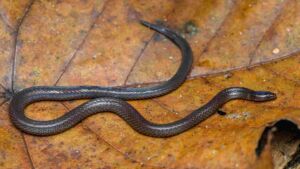
Researchers studying the ecosystems in Southeast Asia discovered that dwarf reed snakes employ cartwheeling as a way of escaping from their predators instead of relying on their usual slithering movements.
Normally, snakes escape danger that is approaching by lateral undulation and defense displays on the ground.
Clips taken by researchers in Borneo revealed that these shy snakes manage to make themselves roll into continuous loops.
This helps them achieve greater speed while moving.
High-speed laboratory footage of the rolling snake
Biologists who arranged expeditions in Borneo wanted to observe hard-to-find behaviors that were shown by mysterious dwarf reed snakes.
Natural histories of the area had mentioned the phenomenon of rolling, but there was no scientific evidence because of the shy nature of these snakes.
Scientists captured live animals and recorded their behavior in a lab setting using high-speed optical cameras.
Thanks to the high-speed camera technology, this became possible.
Videos captured every muscle movement of the animals when confronted with a threat.
The footage gave the first quantitative analysis of the process of how small snakes move from a stationary position to cartwheels.
Performing complicated mechanical loops to move the body forward
The physics behind animal cartwheeling involve a complex process of muscle movements and surface interactions.
The snake starts the process by bending its body into a lateral coil with its head lifted high.
Further tail movements against the surface propel the long body into a temporary aerial movement.
The falling body then hits the surface alternately to create a continuous series of forward rotations.
Left and right side body movements keep the body moving forward without the need for hard axles, reports Toho University.
Head stabilization during fast rotation escapes
However, rapid rolling of the body tends to cause serious disorientation in creatures that aim to negotiate difficult terrain.
By doing this, the dwarf reed snake manages to avoid being disoriented when rolling.
Despite the rapid spinning of the tail, the head always remains pointed in the direction of escape.
With this, the snake manages to utilize visual stabilization to avoid obstacles in the narrow routes without becoming disoriented.
An upright position of the body prevents the snake from being rolled off course as it moves rapidly.
Rolling speed comparison with normal speed of movement
Ground-dwelling small lizards that crawl normally have limited mobility due to the presence of thick leaf litter.
Rolling escape has been found to alter the parameters of escape performance in an experimental determination of translational velocity in the laboratory.
Rolling speeds peaked from 5.64 to 12.11 feet per second, or about 3.8 to 8.3 miles per hour.
It is interesting to make a speed comparison.
It turns out that the spinning rolls are up to four times faster compared to maximum slithering speed.
It matters greatly when it comes to defense for vulnerable prey from dangerous predators, according to Current Biology.
The evolutionary reasons for rare wheel locomotion
The use of wheel-like locomotion is very rare among animals due to the serious biomechanical constraints and hurdles to evolution.
Scientists continue their research in order to find the reason for which certain animals, like the dwarf reed snake, evolve a costly form of escape.
It is costly terms of energy spent, which means that wheeling is used only when predator attacks are vital enough.
This is selective pressure.
Researching such a rare behavior helps understand the process of the evolution of specializations amongst tropical animals.
For future studies, it is crucial to know how often wheeling escape is used in comparison with regular types of defense.
Read the whole thing?
Get the week's signal, not the noise
Our sharpest reporting on energy, climate and nature — free, once a week.