Solar projects and over 3,000 old-growth oak trees don’t seem like elements for a compromise. Yet that is precisely what occurred in East Sacramento County.
The Coyote Creek Agrivoltaic Ranch Project was once expected to remove about 3,500 mature blue oaks under the approved plan. In an October 2026 agreement, the scope of that number was altered.
If the settlement terms hold true, then no more than 200 mature blue oaks will be removed.
What made this solar project different from the start
The Coyote Creek Agrivoltaic Ranch Project was approved by Sacramento County in November 2025. The project calls for solar development across 1412 acres of the 2,704-acre Barton Ranch property.
Oak-dotted hills cover parts of the site in East Sacramento County.
Initially, the project looked as if it would simply represent a large-scale renewable energy development.
That perception was altered when attention turned to the landscape on which it would be constructed.
Then attention shifted from the panels to the landscape
The version of the project that was ultimately approved would result in the removal of approximately 3,500 mature blue oaks.
Concerns related to the project did not merely extend to the removal of the trees themselves.
Wetlands, rare native plants, and wildlife habitats would also be impacted under the approved plan.
The debate soon expanded past a single solar project. It became a question of whether clean energy can coexist with habitat preservation.
An October agreement dramatically changed the outcome
California Native Plant Society and other environmental and recreational groups negotiated an agreement with Sacramento Valley Energy Center, the entity developing the project.
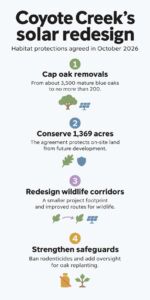
Perhaps the most visible indicator of the shift away from the original intent was in regard to the projected removals of blue oaks. Removals were reduced from around 3,500 mature trees down to no more than 200.
Wildlife corridors were redone as part of the agreement, and the overall footprint was decreased. The settlement also added new oversight for replacement planting of oak species and prohibited the use of rodenticide.
An additional 1369 acres of on-site conservation became a part of the agreement. Those on-site conservation areas were designed to enhance habitat connectivity throughout the property.
Funding was also designated towards enhancing habitat and cultivating rare native plant species within the Sacramento region.
The compromise did not erase the original concerns
Reducing impacts does not equal elimination of those impacts. Groups involved in the settlement still would have preferred the habitat to remain undisturbed.
The agreement was developed after the county had already given its approval for the project.
Prior to the county giving its approval for the project, environmental groups challenged the project’s assessment process and implored public officials to revisit consideration of the proposal.
During the Board of Supervisors process, over 900 comments were received. Nearly every one of those comments opposed the project.
The settlement enabled the project to proceed in an entirely revised format.
The settlement extends beyond tree removals
The agreement’s influence extends far beyond the reduction in the number of blue oaks.
Additional protections now apply across the remaining acreage of Barton Ranch. Under the terms of the agreement, any future development on the remaining portion of Barton Ranch is precluded due to permanent conservation designation.
As such, a significantly larger amount of habitat will be preserved and protected than was previously proposed as part of this project.
Similar conflicts are likely to emerge elsewhere
As continued growth in renewable energy expands, similar disputes will arise in other regions.
Developers require land. Communities desire renewable energy.
At the same time, many of these communities contain older habitat types in areas where renewable energy may be located.
The agreement between Coyote Creek and various stakeholders does not resolve this conflict. It shows that a project’s ultimate configuration is not necessarily fixed once an initial proposal receives approval.
Read the whole thing?
Get the week's signal, not the noise
Our sharpest reporting on energy, climate and nature — free, once a week.