Over Rogers Dry Lake in the California desert, a drone lifted off carrying technology built for a very different world. Below it stretched a flat, sun-baked expanse — stand-in terrain for the Moon and, eventually, Mars. As the drone descended, the system onboard scanned the ground, assessed its original target, and quietly rejected it. No pilot intervened. No command came from the ground. The system simply chose a safer spot and steered itself there.
That split-second decision, made entirely without human input, is what future spacecraft will need to survive.
A drone in the desert, a system built for space
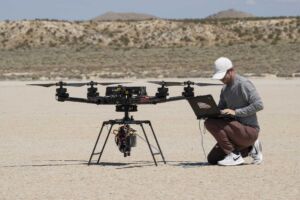
On August 27, an Alta-X drone lifted off over Rogers Dry Lake near NASA’s Armstrong Flight Research Center in Edwards, California. Onboard was the SPLICE payload — Safe and Precise Landing – Integrated Capabilities Evolution — a guidance, navigation, and control system years in the making. The drone ran through simulated lunar descent and landing maneuvers, replicating the kind of approach a spacecraft would make coming down toward the Moon’s surface.
The dry lakebed wasn’t chosen by accident. Its flat, featureless terrain makes it a reasonable stand-in for alien ground — the kind of landscape where a spacecraft can’t afford to guess wrong.
How SPLICE decides where — and where not — to land
At the heart of SPLICE is a terrain-mapping process driven by lidar — light-detection and ranging sensors that generate high-resolution digital elevation maps of the ground below. As the system descends, it reads the surface in real time, building a picture of what’s down there. If the original target looks unsafe, SPLICE doesn’t wait for instructions. It redirects on its own.
No pilot, no ground controller, no override command. The guidance, navigation, and control components work as a single integrated system — sensing, evaluating, and acting in sequence — and that level of autonomy is exactly what makes it relevant beyond Earth.
Almost a decade in the making
“This flight test is the culmination of almost a decade of work for the SPLICE project,” said Davis Adams, NASA project manager. That’s not a figure of speech. The development trail goes back years, with earlier milestones marking each stage of progress.
In 2019, NASA conducted flight tests simulating a descent altitude and landing trajectory comparable to a lunar approach. The following year, tests demonstrated two NASA-developed precision landing sensor systems. Both rounds were enabled by NASA’s Flight Opportunities project, based at Armstrong, which supports exactly this kind of incremental, real-world validation.
Researchers at NASA’s Johnson Space Center in Houston developed the SPLICE payload itself, then partnered with Armstrong specialists to integrate, test, and fly it aboard the Alta-X drone in June and July — verifying communications, data handling, telemetry, and command-control performance before the full August demonstration.
From Moon Base missions to Mars: what SPLICE unlocks
The August test did more than confirm SPLICE works. It raised the system’s technology readiness level — a formal measure NASA uses to track how close a technology is to operational use — positioning SPLICE for integration into future robotic and crewed lunar flights.
NASA has already been working with commercial lunar lander providers to implement SPLICE iterations into their platforms. Several landers slated for upcoming Moon Base missions are expected to draw on data collected through SPLICE’s development to execute soft touchdowns on the lunar surface. Adams also noted that the guidance system is planned for addition to NASA’s software catalog in fall 2024, after which industry partners will be able to access and build on it directly.
“We are coordinating with industry regarding the usage of the guidance system once the system is available in the NASA software catalog,” he said.
Beyond landing: autonomous movement on alien surfaces
The applications may not stop at touchdown. Some companies are already evaluating SPLICE’s navigation capabilities for precision landing, but Adams pointed to something further: potential extensions into autonomous surface mobility — rovers and robots that navigate independently after they land.
That matters because of a fundamental constraint in deep-space operations. Communication delays between Earth and the Moon — let alone Mars — make real-time human control impractical. By the time a signal travels and a response returns, the moment has passed. A system that can assess terrain, make decisions, and act without waiting doesn’t just solve the landing problem — it lays the groundwork for everything that happens after.
If SPLICE continues to mature, it could become a foundational layer for how spacecraft arrive and how they move once they get there. The August test was one proof point. The next steps are already in motion.
Read the whole thing?
Get the week's signal, not the noise
Our sharpest reporting on energy, climate and nature — free, once a week.