One way to find a new species is when it clearly stands out.
The reverse was true with the gecko found in China’s Qinling Mountains. It stood out by blending in.
For many years, the gecko was given a name based on its similarity to other geckos.
Three new specimens, however, caused researchers to take a second look. That closer inspection revealed a different story.
What looked settled was no longer certain
These animals were very close to Gekko swinhonis. This species has been recorded in many places throughout northern China.
On the surface, the geckos from the Qinling Mountains seemed to match it perfectly. However, the species these geckos had some issues of its own.
Scientists working on G. swinhonis were discovering that this species exhibited characteristics that indicated it could potentially include several separate species.
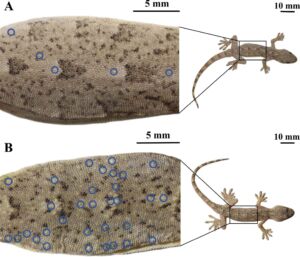
In addition to genetic separation among the different populations, some populations were also showing physical differences.
Scientists began to question if the geckos actually belonged to G. swinhonis.
The obvious identification was becoming harder to defend
To prove it, they needed genetic data. The genetic analysis provided the researchers with their first solid proof that the gecko is unique.
When scientists created a “family” tree for all the geckos, it showed the Qinling mountain geckos as part of their own “branch”.
Additionally, the scientists physically examined each of the geckos. They observed that the skin of the Qinling mountain geckos was very smooth.
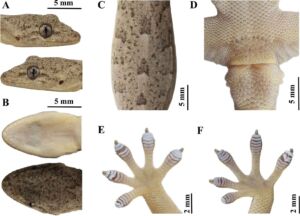
In contrast, G. swinhonis had scales covered by many tiny projections.
Further, the Qinling geckos had fewer small bumps. Also, the number of scales differed between the two groups.
Finally, the proportions of toe length differed as well.
These differences remained consistent across the specimens that were examined.
None of the traits appeared in isolation. However, none of these characteristics alone suggested that a new species existed.
One clue was never going to be enough
There was additional evidence that increased confidence in their classification as different from each other.
DNA studies showed they were genetically distinct. Morphology studies demonstrated physical differences.
Their separation on an evolutionary tree also supported the theory that they are different.
As reported in the ZooKeys study, molecular, phylogenetic, and morphological evidence all pointed to the same conclusion: these animals are part of a new species.
One decision changed the way the region looked
Instead of continuing to treat them as part of G. swinhonis, researchers decided to give them their own formal description and name.
Their scientific name is Gekko luanchuanensis, commonly referred to as the Luanchuan Gecko.
Identifying a new species is not simply a matter of assigning a new name to a list.
It can also reveal that scientists know less about a region than they once thought.
Often, it is more important to know about where a species lives rather than how many species live there.
The gecko may not be the biggest surprise
The Qinling Mountains provide one of China’s largest biological barriers and divide two groups of species that have evolved along completely independent paths.
These mountains form a natural boundary between two major biological regions of China.
The area is an excellent location for unrecognized diversity to evolve and remain undiscovered for extended periods of time.
Some of China’s biodiversity may still be hiding in plain sight
Researchers believe that suitable habitat exists not only in areas where the geckos have already been collected but also beyond those areas.
If animals this similar to well-documented species can go undetected for such long periods of time, it suggests another possibility.
Some of China’s biodiversity may still be hiding in plain sight.
Read the whole thing?
Get the week's signal, not the noise
Our sharpest reporting on energy, climate and nature — free, once a week.