It’s now possible for bones to survive for hundreds of thousands of years.
The systems which allow an organism to consume liquids and solids will typically be gone by then.
Part of the throat area of a 165-million-year-old fossil from Northern China illustrates this point.
The remains belong to an animal from the Jurassic Period. Much of its throat survived in great detail.
This unique preservation allowed paleontologists a new look at how several significant mammalian attributes developed.
The fossil belonged to an unusual mammal relative
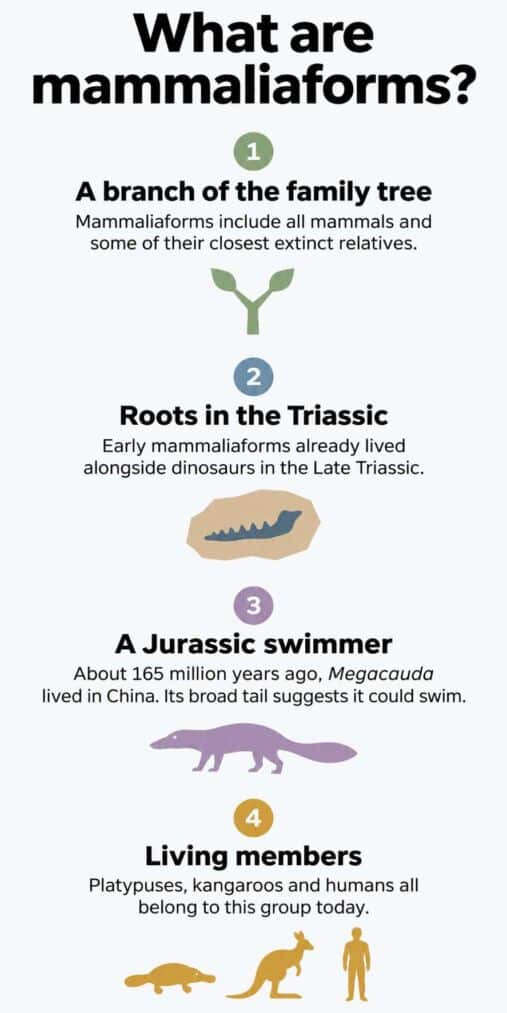
Megacauda is the name given to this newly identified mammal relative. The animal lived between 168 and 163 million years ago.
It belonged to a group known as Mammaliaforms, close relatives of modern mammals.
Yet this creature does not resemble what many would imagine when thinking about early mammal relatives.
One reason for this is its flat, wide tail. It also had shorter hind legs compared to its forelegs and feet.
Those features made it unlike many other early mammal relatives.
Much more than bones survived in this fossil
While the most notable parts of the fossil were likely its tail and limbs, they were not the surprising parts.
What made the specimen so exceptional was the preservation of tissues from the throat region.
Generally speaking, soft tissue does not get preserved in fossils.
As a result, it has been difficult to determine exactly when the advanced feeding systems of mammals began to develop.
A portion of the pharynx (the passageway used for swallowing) and surrounding bone structure were preserved.
Modern mammals use this region for eating, drinking and nursing.
As one of the earliest mammal relatives with this anatomy preserved intact in the fossil record, the specimen provides an opportunity to study its evolution in ways not normally possible.
Mammal-like feeding may have started earlier than expected
The preserved throat suggests that important feeding adaptations appeared long before modern mammals, according to a summary published by Nature Portfolio.
Mechanisms required for sucking and swallowing may already have existed in their relatives by the Middle Jurassic.
That pushes the origins of these mammalian traits farther back in time than previously demonstrated.
The anatomy also provides evidence of an early mammalian feeding apparatus, according to the study published in Nature.
Those features survived in a fossil more than 165 million years old.
Its body hinted at a life spent partly in water
The rest of the body provided another clue. Evidence suggests it spent part of its life in and around water.
The flat tail may have aided movement through the water.
Limb and foot anatomy point in the same direction. So do the animal’s unusual teeth.
Unlike those of many other early mammalian relatives, they were designed specifically for cutting meat rather than grinding plant material.
Taken together, these characteristics indicate a predator searching for prey that may have included fish, salamanders, and invertebrates.
The old picture no longer matched the evidence
Early mammalian relatives were commonly depicted as small and relatively homogeneous animals living primarily in the shadow of large dinosaurs.
This fossil depicts an entirely different scenario. At approximately 1-2 kilograms, it was similar in size to a modern-day platypus.
Moreover, it is currently recognized as the largest Jurassic mammaliaform ever discovered.
Its physical anatomy and morphology also indicate a level of semiaquatic existence similar to that exhibited by the modern platypus.
Dinosaurs were not the only ones evolving
This species was not alone in experimenting with new ways of life.
Some evolved traits suited for life in and around water. Others occupied different habitats and lifestyles.
It also exemplifies how mammalian relatives continued to evolve and experiment with new forms of existence during the Age of Dinosaurs.
Although dinosaurs dominated nearly every Jurassic ecosystem, they did not represent the only organisms exploring new ways of living within different habitats.
Read the whole thing?
Get the week's signal, not the noise
Our sharpest reporting on energy, climate and nature — free, once a week.