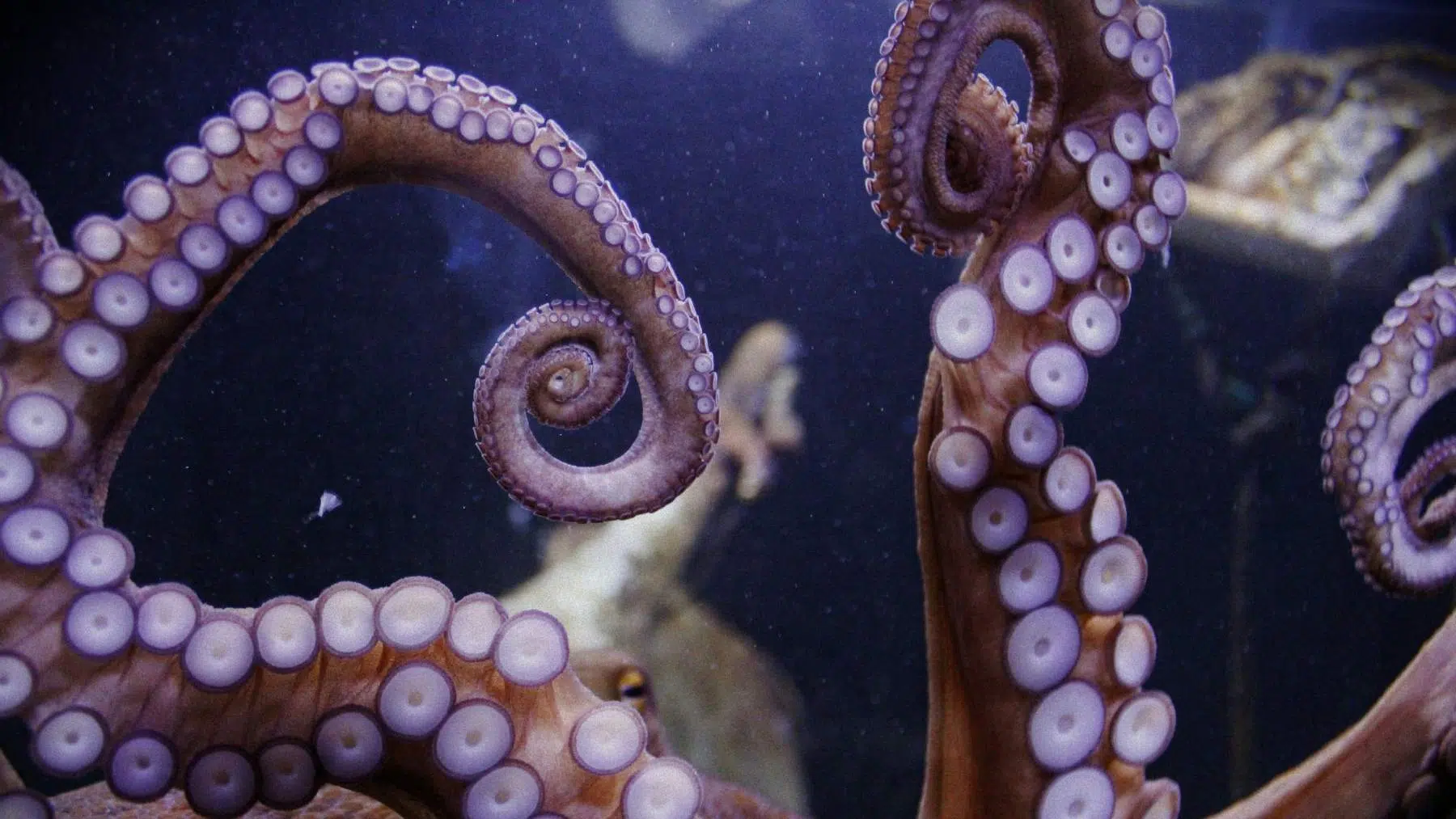
Most people picture an octopus as a master of disguise — boneless, bashful, threading itself through a crack in the reef to vanish from sight. It is a creature defined by smallness and stealth.
New fossil evidence is forcing scientists to tear up that image. Researchers have uncovered preserved jaws from the Late Cretaceous seafloor suggesting that the earliest octopuses were something altogether different: enormous, powerful hunters that may have sat at the very top of the ancient ocean food chain, roughly 100 million years ago.
How scientists could reconstruct that story from fragments of fossilized jaw is where things get interesting.
A discovery buried inside rock
Octopus fossils are extraordinarily rare. Their bodies are almost entirely soft tissue, which decays quickly and leaves almost nothing behind. That gap in the fossil record has made it genuinely difficult to trace where octopuses came from or how large they once grew, leaving researchers to piece together evolutionary history from scattered, incomplete clues.
Researchers at Hokkaido University found a way around that problem by focusing on fossilized jaws — the one durable structure in an octopus body that stands a real chance of surviving millions of years inside rock.
To find those jaws, the team used high-resolution grinding tomography combined with an AI model trained to detect jaw structures embedded within dense rock samples. The fossils came from sites in Japan and Vancouver Island, recovered from calm ancient seafloor environments where fine sediment preserved extraordinary detail. They date to the Late Cretaceous period, between 100 and 72 million years ago.
Jaws that tell a story of brute force
The fossils belong to an extinct group of finned octopuses called Cirrata. By analyzing the size, shape, and surface condition of each jaw, researchers could reconstruct how these animals fed — and the picture that emerged was not subtle.
Extensive chipping, scratching, cracking, and polishing marked the jaws. These are the signatures of repeated, high-force contact with hard-shelled prey, and the wear patterns were more extreme than anything observed in modern cephalopods eating similarly tough food.
In the most well-developed specimens, up to 10 percent of the jaw tip had been worn away relative to total jaw length. That figure points to animals that were not occasional hunters but aggressive, persistent predators that regularly tackled difficult, resistant prey.
Up to 20 meters long — and possibly intelligent
Jaw dimensions allowed researchers to estimate body size, and the results were striking. These ancient octopuses may have reached total lengths of nearly 20 meters — potentially larger than many of the marine reptiles sharing the same ocean.
One detail stood out beyond sheer scale. In both species studied, the wear on the jaws was uneven: one side of the biting surface showed significantly more erosion than the other. That asymmetry suggests the animals may have favored one side when biting, a behavior researchers describe as lateralization. In modern animals, that pattern is associated with advanced brain function, and its presence in creatures from 100 million years ago raises a genuine question about cognitive complexity in early octopuses.
“The most surprising finding perhaps was the extent of wear on the jaws,” said Professor Yasuhiro Iba of Hokkaido University. “This indicates repeated, forceful interactions with their prey, revealing an unexpectedly aggressive feeding strategy.”
Rewriting the octopus family tree
Beyond size and behavior, the fossils carry significant implications for the octopus evolutionary timeline. They push the known record of finned octopuses back by roughly 15 million years — and for the broader octopus lineage, the revision is around 5 million years.
That places octopus origins at approximately 100 million years ago, a meaningful correction to what the scientific community had previously accepted. The study was published in Science on April 23, 2026, and represents the first direct fossil evidence of giant predatory octopuses, giving researchers something concrete to anchor the early chapters of octopus evolutionary history.
Invertebrates at the top of the ancient ocean
For decades, the standard model of ancient marine ecosystems placed vertebrates — fish, marine reptiles, early sharks — at the top of the food chain. Invertebrates were assumed to occupy supporting roles. This research challenges that assumption directly.
“This study provides the first direct evidence that invertebrates could evolve into giant, intelligent apex predators in ecosystems that have been dominated by vertebrates for about 400 million years,” said Professor Iba. He noted that powerful jaws and the loss of an external skeleton — traits shared by octopuses and large marine vertebrates — may have been essential to reaching massive size.
The AI-assisted approach used here also opens a broader possibility. By combining digital fossil-mining techniques with machine learning, researchers may be able to locate many more hidden fossils and reconstruct ancient ecosystems in far greater detail than traditional methods allow. The ocean of 100 million years ago may look very different once these tools are applied more widely.
If a creature as soft and seemingly fragile as an octopus could evolve into a 20-meter apex predator, the assumptions we carry about which animals dominated any given era deserve careful scrutiny. The fossil record still has more to reveal.
Read the whole thing?
Get the week's signal, not the noise
Our sharpest reporting on energy, climate and nature — free, once a week.