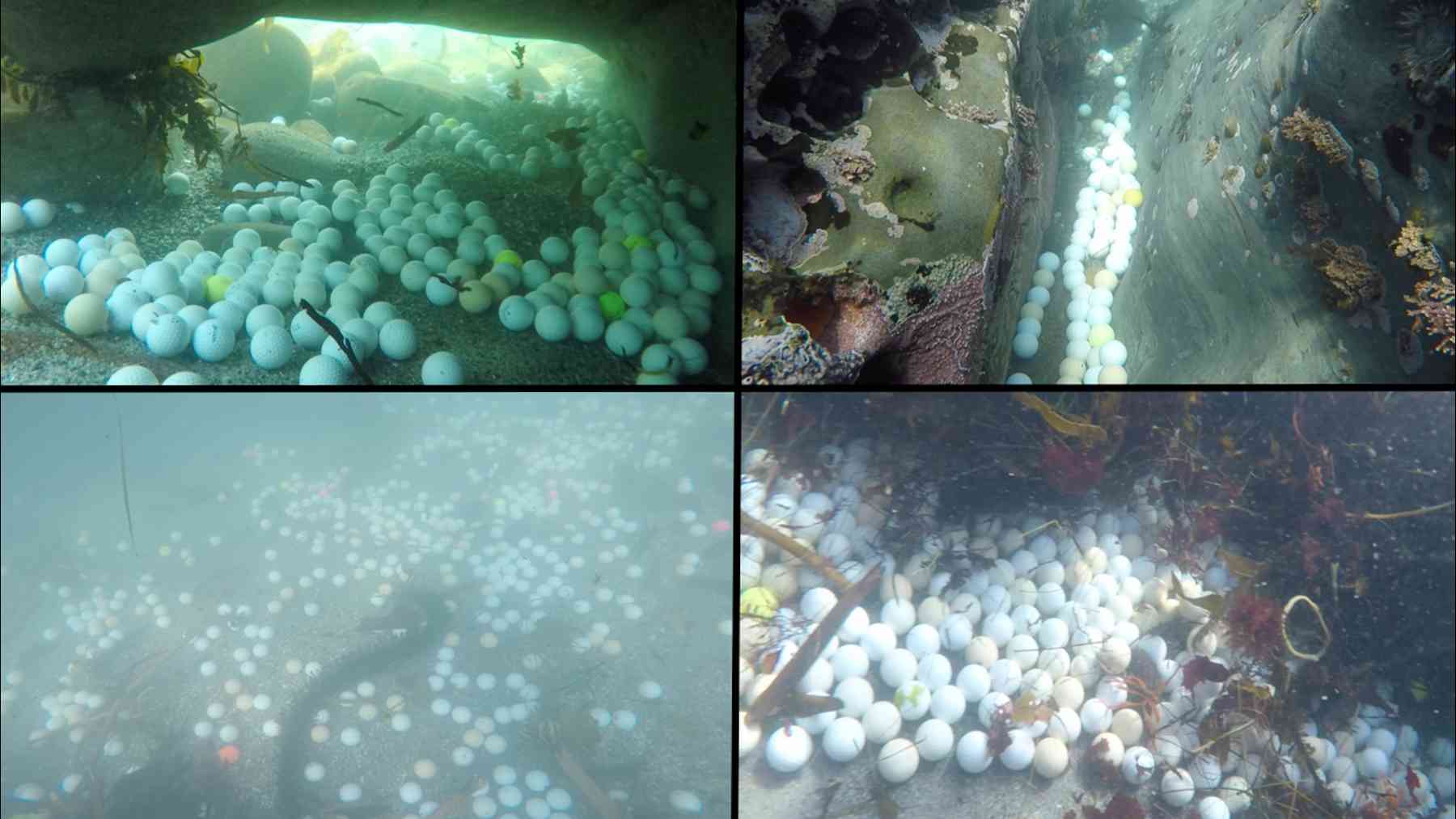
The cove looked empty from the surface.
Then a teenage diver ducked under the kelp near Pebble Beach.
The sandy bottom was not sand at all.
It was white, dimpled, and endless.
Every direction she turned, there were more.
She started counting golf balls instead of fish.
A sinking shell hides a toxic core
A golf ball looks like an inert little sphere, but it is built from layers that behave very differently once they reach saltwater. The cover is a urethane elastomer wrapped around a synthetic rubber core, and manufacturers mix zinc compounds into that core for flexibility and durability. Those additives are the part nobody pictures when a ball sails into the water.
Because golf balls are denser than seawater, they do not float away to wash up somewhere visible. Instead they drop straight to the bottom and stay there, out of sight of golfers, beachgoers, and anyone walking the cliffside trail above.
The core carries zinc oxide and zinc acrylate, along with benzoyl peroxide. The shell above them is ground down slowly by surf, seawater and rock, in the dark, for years. Intact, a ball poses little threat; the concern is what it sheds as it comes apart.
Researchers describe those core additives as acutely toxic to marine life, and the worry is that they leach out alongside plastic fragments once the cover fails. That slow breakdown is exactly why a cove that looked clean from a boat turned out to be carpeted below.
A single cove near five golf courses
The discovery happened in the Monterey Bay National Marine Sanctuary, in a small cove off Pebble Beach Golf Links near Carmel, California. A teenage free diver named Alex Weber was exploring the water there when she found the sandy floor of the cove blanketed with golf balls.
Her diving partner saw the same thing. Weber and Jack Johnston kept coming across large numbers of lost, broken and unraveling balls on the bottom while snorkeling near Carmel by the Sea. Weber later described the moment plainly, saying “the entire sea floor was covered in golf balls.”
Five courses fed that single stretch of coastline. Two sit along the coast and three sit up the Carmel River, with balls rolling underwater down the river to the ocean. A fairway hazard on land had become an underwater dumping ground nobody had mapped.
50,681 balls weighed in at 2.5 tons
Weber kept collecting long after the first dive. When she had amassed 10,000 golf balls, she reached out to Matt Savoca, a postdoctoral researcher at Stanford University who studies human impacts on marine ecosystems, and that partnership turned a garage full of buckets into a documented count.
Seventy-five collections at three sites recovered 39,602 balls from intertidal and nearshore waters next to the courses or downriver from them. Added to concurrent cleanups by the marine sanctuary and the Pebble Beach Corporation, the total reached 50,681 golf balls, roughly 2.5 tons of debris, about the weight of a pickup truck. The count was published in Marine Pollution Bulletin.
Savoca put the scale in perspective, saying “Just in America, you’re talking about tens of thousands of tons of this debris, every year.”
Even the retrieval method was improvised. They used kayaks to ferry the balls back to shore, bucket by bucket.
Over 60 pounds of hidden microplastic
Each retrieved ball told the researchers something about how long it had been sitting there. Most showed only light wear, and some could have been resold and played. Even so, the team estimated that over 60 pounds of irrecoverable microplastic had already shed from the balls they collected.
That fragment weight does not disappear, it simply becomes too small to scoop up, drifting into the same microplastic pathways that carry tiny plastic pellets and fibers across entire coastlines.
Course managers did not dismiss the findings once they saw the evidence. Savoca has written that they were initially surprised, and that they are now working with the marine sanctuary on ways to keep stray balls out of the water before they erode. Pebble Beach spokesman Mark Stilwell said the company has since collected roughly 20,000 additional balls, a shift not unlike the slow policy changes researchers have tracked around offshore marine habitats elsewhere.
More than 100,000 balls lost to the water each year
The project has limits worth being honest about. No ill effects on local wildlife have been documented to date from exposure to golf balls, so the toxicity risk remains a chemistry finding rather than a confirmed ecological harm.
Even so, the math on future losses is sobering. By multiplying the average number of balls lost per round played, one to three, against the average rounds played annually at Pebble Beach, the researchers estimated that patrons at these popular courses may lose over 100,000 balls per year to the surrounding environment. Savoca has revised the figure higher, at as many as 186,000 balls, or about 9.42 tons, each year at Pebble Beach alone.
Every one of those balls sinks the same way, out of sight, into a cove nobody checks until a diver happens to look down.
Read the whole thing?
Get the week's signal, not the noise
Our sharpest reporting on energy, climate and nature — free, once a week.