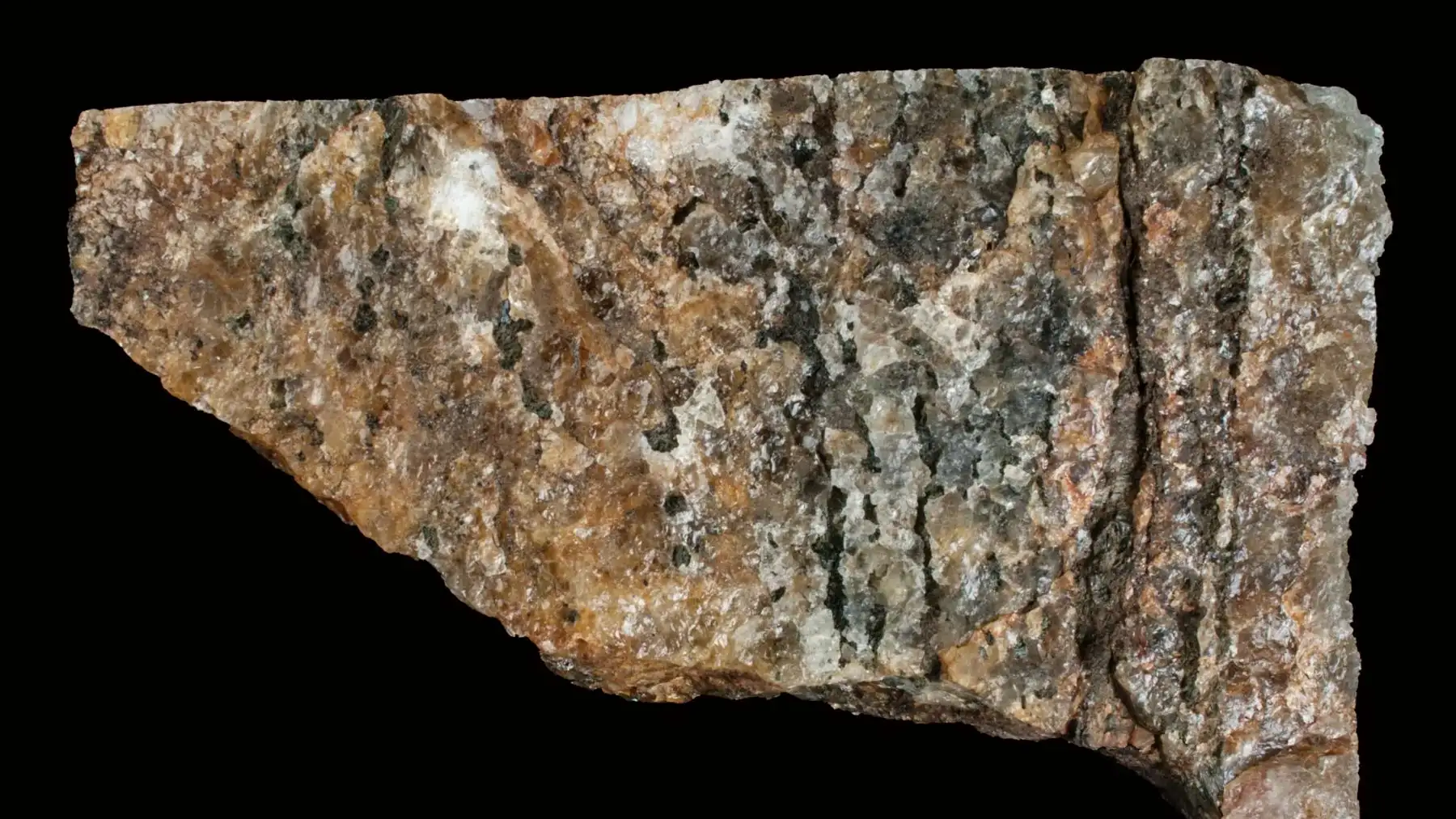
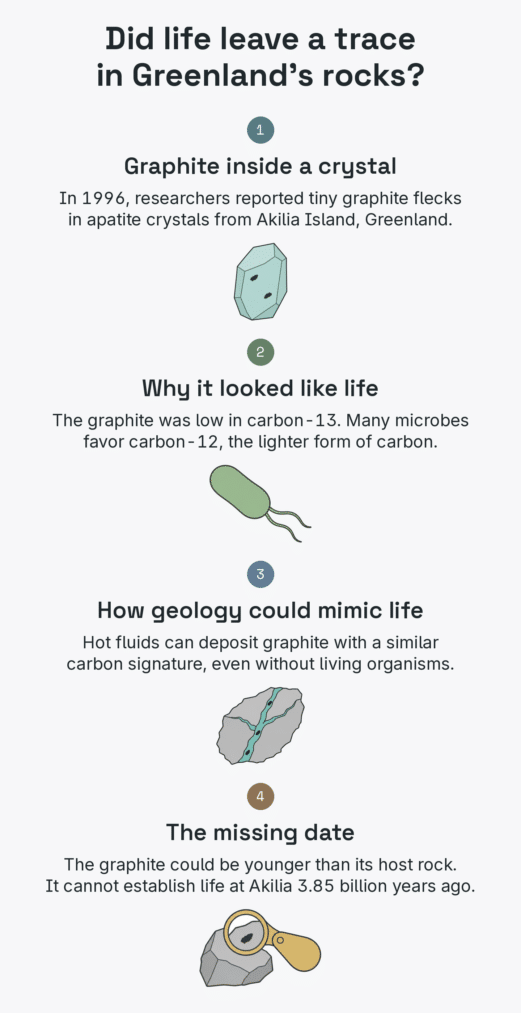
On the remote, windswept shores of Akilia Island in southwest Greenland, a team of geologists thought they’d found the ultimate prize. In 1996, scientists led by Stephen Mojzsis announced something that stunned the geological world: microscopic flecks of graphite locked inside ancient crystals, carrying what looked like the unmistakable chemical fingerprint of living organisms — from 3.85 billion years ago.
The implications were staggering. That date placed life’s emergence right in the middle of the Late Heavy Bombardment, when Earth was still being pummeled by cosmic debris. For a brief moment, Akilia held the title of the oldest known cradle of life on the planet. Then scientists started looking closer.
A fingerprint written in carbon
The evidence itself was invisible to the naked eye. What Mojzsis and his colleagues identified were microscopic graphite inclusions trapped inside apatite crystals — tiny mineral prisons holding what appeared to be ancient carbon. Using advanced mass spectrometry, the team measured the ratio of carbon isotopes inside those flecks and found something striking: the carbon was severely depleted in Carbon-13, the heavier isotope.
That depletion matters because biological enzymes preferentially use lighter carbon during metabolism. This isotopic skew has long served as a classic biosignature — a chemical signature that life leaves behind. At the time, the result seemed nearly conclusive.
The timing only amplified the excitement. If life existed 3.85 billion years ago, it was somehow surviving — possibly even flourishing — right at the tail end of the Late Heavy Bombardment, when cosmic debris still rained down on a young Earth. That challenged a deep assumption: that life needed a long, quiet window to emerge. Akilia suggested biology could take hold with remarkable speed, even under brutal conditions.
When the scientific crucible heated up
Science rarely lets a dramatic claim stand unchallenged for long. Within a few years of the 1996 announcement, an interdisciplinary wave of geologists, metamorphic petrologists, and isotope geochemists arrived to cross-examine the Akilia rocks. The scrutiny was intense and methodical.
Researchers Christopher Fedo and Martin Whitehouse raised a problem that cut to the heart of the claim. The rocks hosting the graphite inclusions, they argued, weren’t ancient marine sediments — the environment where biological carbon would naturally accumulate. Field mapping and chemical analysis pointed to something else entirely: igneous volcanic rocks, chemically transformed by extreme hydrothermal fluids over geological time.
That process — metasomatism — can dramatically alter a rock’s composition, making volcanic material mimic the signatures of sedimentary rock. It’s a subtle but devastating distinction. Carbon in a volcanic setting tells a very different story, and if the host rock isn’t sedimentary, the entire biological interpretation collapses.
The problem with four billion years of pressure
Even setting aside the rock-type debate, another obstacle loomed. The Akilia rocks have endured nearly four billion years of crushing heat and pressure deep within Earth’s crust — a geological ordeal that makes it extraordinarily difficult to prove the graphite and the apatite formed at the same moment in time.
High-temperature, non-biological chemical reactions occurring deep underground can produce carbon isotope signatures nearly identical to those generated by living organisms. Without confirmed simultaneous formation, the biological interpretation loses its footing. Correlation in space — graphite inside apatite — doesn’t prove correlation in time.
The scientific consensus has since shifted accordingly. The Akilia graphite is no longer accepted as definitive proof of early life. That’s not a minor revision. It’s a complete withdrawal of one of the most celebrated findings in the history of geobiology.
What the controversy built
Here’s what makes the Akilia story more than a cautionary tale: the decades of fierce debate it sparked genuinely transformed the field. Geobiologists from the European Geosciences Union emerged from the controversy with a far more rigorous framework for evaluating deep-time biosignatures.
The new standard now demands four things. Researchers must demonstrate that the host rock is genuinely sedimentary in origin. They must show that the carbon was trapped during the rock’s original formation, not introduced later. Every plausible non-biological chemical pathway must be identified and ruled out. And the spatial relationship between minerals must be matched by a credible temporal one. Akilia didn’t just fail — it raised the bar for everyone who came after.
The search for Earth’s earliest life has since moved toward better-preserved candidates, including the 3.48-billion-year-old stromatolites of Western Australia, where the geological context is clearer and the biological case considerably stronger.
Yet the icy outcrops of Akilia still deserve their place in the story. They invite a broader question worth sitting with: if identifying life in rocks from our own planet is this difficult, what does that mean for the search beyond it? The hardest questions about our origins don’t yield to enthusiasm alone. They yield to rigor — and sometimes, to the courage to dismantle what we most wanted to believe.
Read the whole thing?
Get the week's signal, not the noise
Our sharpest reporting on energy, climate and nature — free, once a week.