
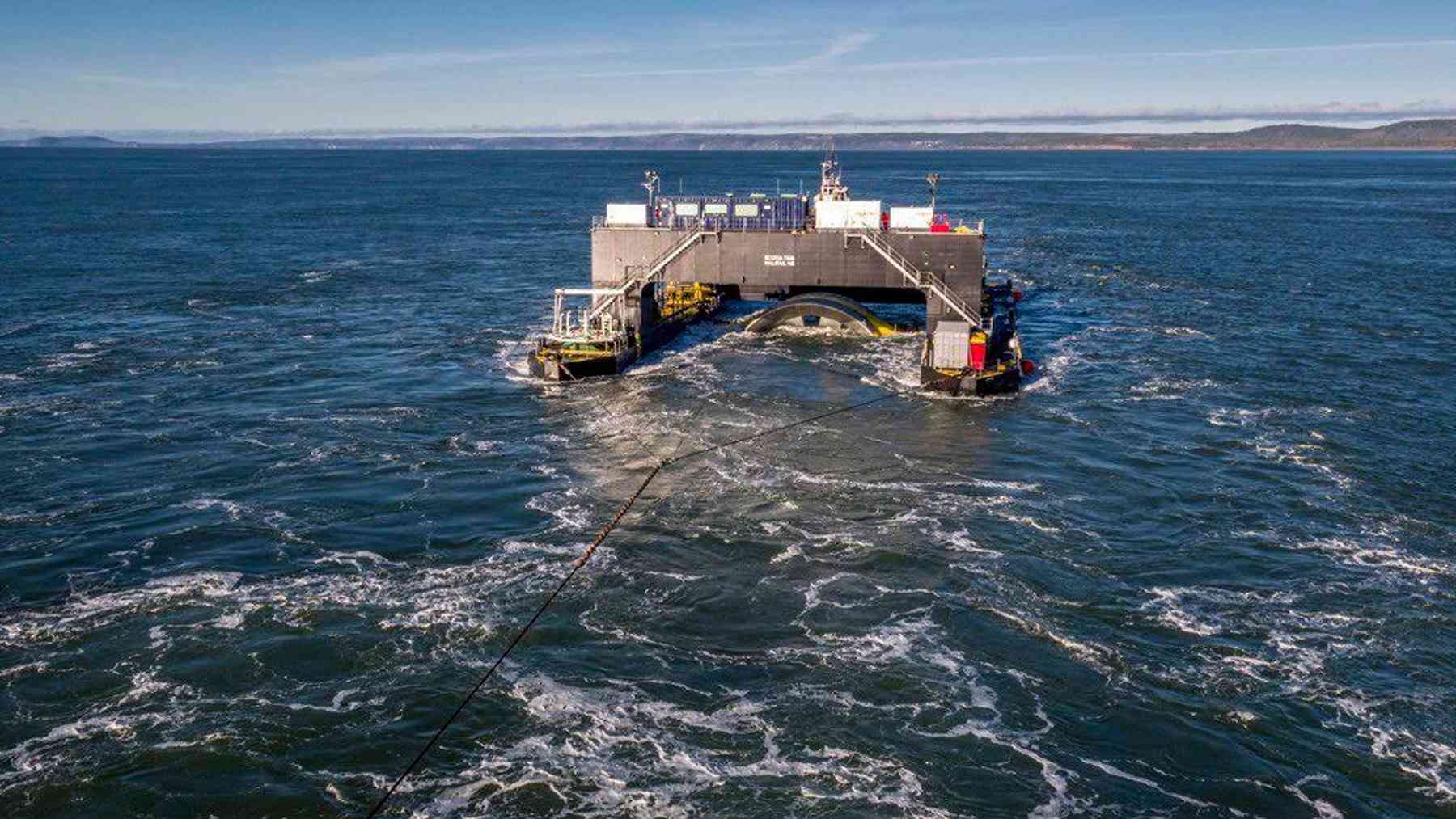
A crane groans against the current, and a dripping shape rises out of the gray water.
It is a machine about five stories tall.
Months earlier it had been lowered to the bottom of the Bay of Fundy.
Nobody could see it down there, not on the calmest day.
Only a cable to shore carried its power to the grid.
What the crew found when they pulled it back into daylight is the useful part of the story.
The anodes are meant to be eaten first
The Minas Passage is a narrow strait, roughly three miles wide, that magnifies the Fundy tides like a thumb over a hose, which is exactly why a turbine 52 feet across was lowered into it. Engineers who leave steel in moving salt water do not try to stop corrosion outright.
Instead they aim it somewhere cheap, bolting blocks of a more reactive metal onto the structure so the sea consumes those instead of the load bearing parts. Those blocks are sacrificial anodes, and losing them slowly is normal.
Losing them quickly is information. The wear in a channel like this is not one dramatic failure but something steady and cumulative, the kind of damage that stays invisible until somebody lifts the machine out and looks at it in daylight.
Seven months on the floor of a 190 foot channel
The turbine was lowered into the passage in November and recovered the following June, a stretch of about seven months on the seabed. Crews brought the prototype up from 190 feet of water and towed it to Saint John’s West Side Docks for modifications.
Getting it back up was its own operation. The machine was disconnected from the grid in late April for retrieval and onshore upgrades, and it then took nearly two months to raise because a mooring line had tangled around its subsea base.
That is why the seven months on the bottom and the time spent generating are not the same number.
What came up on the rim of the 52 foot rotor
This is an open center machine, with the blades attached to the outer rim, and the rim is where the evidence was. Fierce Fundy currents ripped away metal anodes attached to the rotating rim. An initial inspection found that some of the turbine’s anodes, which help protect it from corrosion, were missing, and parts of the rotor were missing as well and had to be reshaped and reinstalled.
The structure itself held. A spokeswoman said a detailed inspection of the overall exterior found it in good condition.
The machine ran in the passage for about six months, which the venture’s director called “the first machine that was able to generate power for that amount of time in that environment.”
Three weeks of blade life for the machine that came before
That comparison matters because a smaller prototype from the same developer had gone into the same passage years earlier and fared far worse in far less time. Tidal forces near 10 knots in the passage exceeded estimates and exceeded the turbine’s design.
Twenty days after deployment, all 12 rotor blades had been destroyed by flows two and a half times stronger than the design case, and engineers later said the fiberglass reinforced blades had survived only about three weeks.
When that first machine was finally lifted, the company’s chief executive put it plainly: “We’ve underestimated the loadings in the Bay of Fundy.”
Engineers responded by changing the shape and the materials rather than the basic idea. The later machine kept the open centered rim design and hardened it against sustained battering. A migration route built for fish passing a dam turbine is one kind of engineering problem; holding shape against a current that never stops is a different one.
What one recovery means for the next design
None of that erases the useful result. A turbine came back from one of the most punishing tidal channels anywhere scarred rather than shattered, and it was towed off for modifications rather than for scrap. That is the clearest signal the approach itself was not absurd.
The bay kept setting the terms afterward. A second turbine from the same project is still sitting on the ocean floor after it was abandoned when its parent company went bankrupt, and officials have since run remote vehicle surveys and a high resolution scan while assessing whether it can be retrieved safely. Elsewhere in the bay, a bankrupt developer’s moored tidal platform broke loose and crashed onto the rocks near Westport on Brier Island.
A footbridge cut from a retired turbine blade only has to hold still under a crowd. A Fundy rotor has to hold its shape twice a day forever.
The honest caveat is that the power was slight: the venture sold only 41.4 megawatt hours to the utility that year, enough for about four homes. The anodes torn off that rim are the real takeaway, and they say the ocean does not negotiate.
Read the whole thing?
Get the week's signal, not the noise
Our sharpest reporting on energy, climate and nature — free, once a week.


