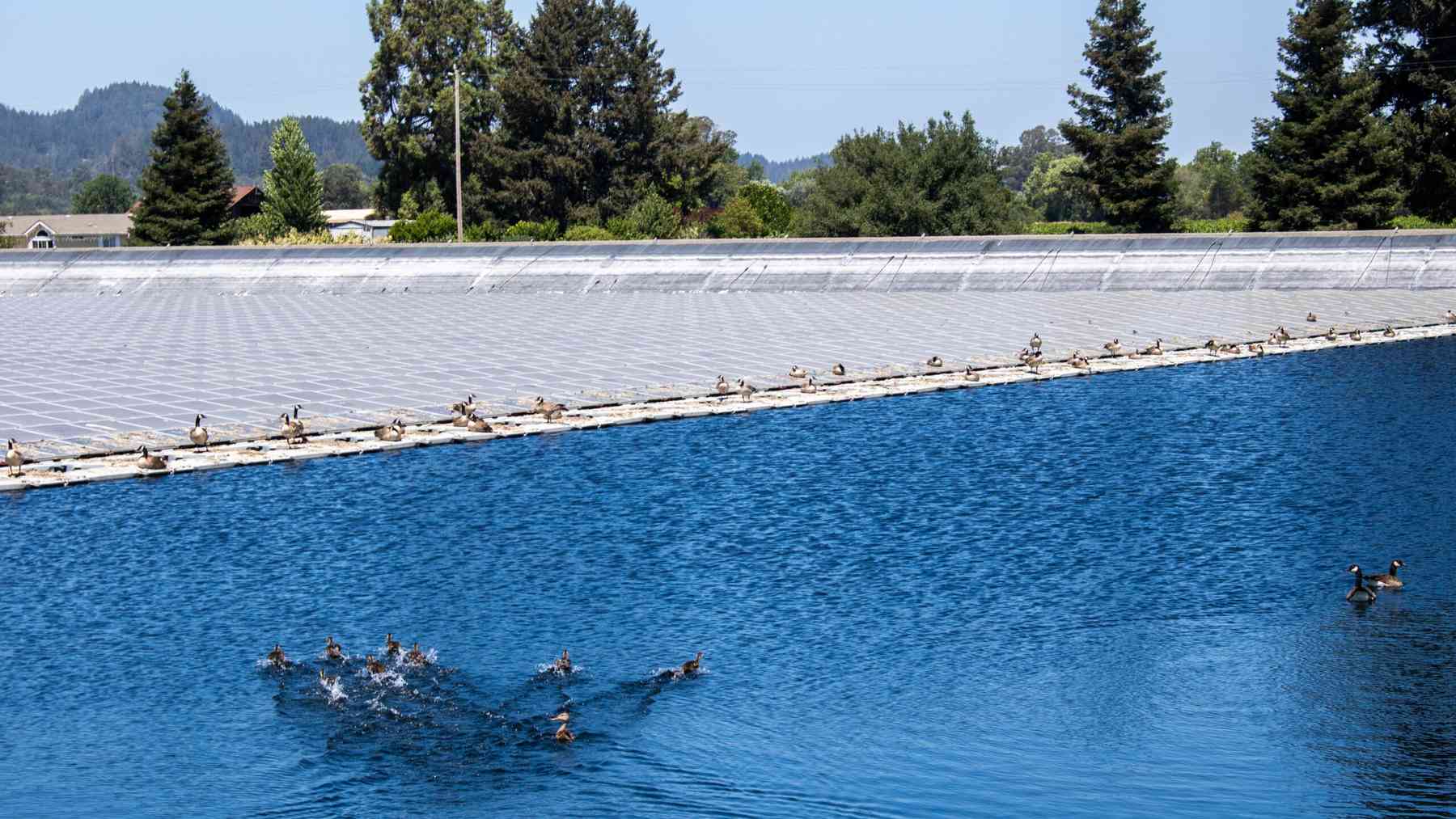
A line of geese stands at the exact edge where dark glass meets open water.
Behind them stretches a pond nobody would call scenic.
It holds treated wastewater, not irrigation runoff or drinking supply.
Above the water sit thousands of tilted solar panels on pontoons.
The geese do not spread across the whole array.
They have claimed one strip of it, and the choice itself is the strange part.
One edge of the array works like a sandbar
At the wastewater treatment plant in Healdsburg, California, a floating array covers two treated water ponds with 11,600 solar panels mounted on pontoons. A reporter visiting the site noticed white goose droppings along one edge of the floating panels while mallard ducklings moved beneath the floats across the pond, and the city’s water and wastewater manager has pointed out Canada geese walking on the panels to visiting groups.
That edge offers what geese already use on any lake or farm pond: a flat, dry platform at the waterline, with a clear sightline to the water and open space to launch from if a coyote or dog appears. A floating panel row does the same job as a sandbar, built from metal frames and marine grade plastic instead of silt.
Whether that is really why birds favor one strip over another has not been settled. Scientists working on floating arrays list how waterbirds use each separate part of the structure as an open question rather than a finished answer.
A pond transformed since the panels arrived in 2021
Before the panels went down, the same stretch of water was a flat industrial pond behind a chain link fence, holding treated water until it could be piped out to irrigation. Now white droppings streak one edge of the array in a pattern visible from the bank.
Plant staff have said from the start that cleaning bird droppings would be part of routine panel upkeep. Ducklings paddling under the pontoon rows get shelter from wind and from the open sightlines that would expose them on bare water.
None of this was in the original design brief. The array was approved to generate power, shade the water and cut the algae blooms a sunlit pond would otherwise grow.
The largest floating array in the country when it switched on
The Healdsburg system was completed in January 2021, built by developer White Pine Renewables, rated at 4.78 megawatts and covering roughly 8 percent of the city’s electricity use. The city described it then as the largest floating solar array in the United States, a title it has since lost to an 8.9 megawatt array at a New Jersey water treatment plant. The tertiary pond under the panels holds about 25 million gallons on an ordinary day.
Researchers at the University of California, Davis have been documenting bird behavior at floating arrays in California and beyond, and reported in Nature Water that they watched black crowned night herons rest on floating structures before dawn and cormorants compete for space on the same hardware. “That’s why it’s so important to understand how waterbirds are going to respond to floating solar,” said Elliott Steele of the university’s Wild Energy Center.
That fieldwork treats these ponds as habitat nobody fully planned for. Biologists are now asking which design choices decide which species get the best spots.
A habit traced back to one Napa pond from 2008
American floating solar traces back to one irrigation pond. Far Niente winery switched on a 994 panel array on its vineyard pond that year, widely reported at the time as the first commercial installation of its kind, and operators have been watching what moves in underneath ever since.
Since then floating arrays have scaled up fast, from fewer than a thousand panels on that Napa pond to multi megawatt projects covering acres of reservoir, the same leap in scale that let an orchard canopy in Switzerland shelter fruit trees under moving panels.
Every new site adds another data point. So far the geese, cormorants and herons keep showing up rather than staying away, and biologists are pressing designers to build wildlife into pontoon layouts from the planning stage, the same forward thinking behind Norway’s eel escape route.
Gaps that still need tracking as more ponds get covered
Not every outcome is settled. Droppings concentrated on one edge of an array can affect water chemistry, and the same researchers flag pollutant leaching from floating hardware and long term shifts in bird behavior as gaps. A pond full of geese is not automatically a healthy pond.
What looks like a thriving perch could just as easily be birds settling for the nearest flat surface available. That distinction matters more as cities weigh covering drinking water reservoirs the same way.
As more cities and wineries cover their ponds in panels, the birds seem to be deciding, one webbed footprint at a time, that the hardware suits them too.
Read the whole thing?
Get the week's signal, not the noise
Our sharpest reporting on energy, climate and nature — free, once a week.