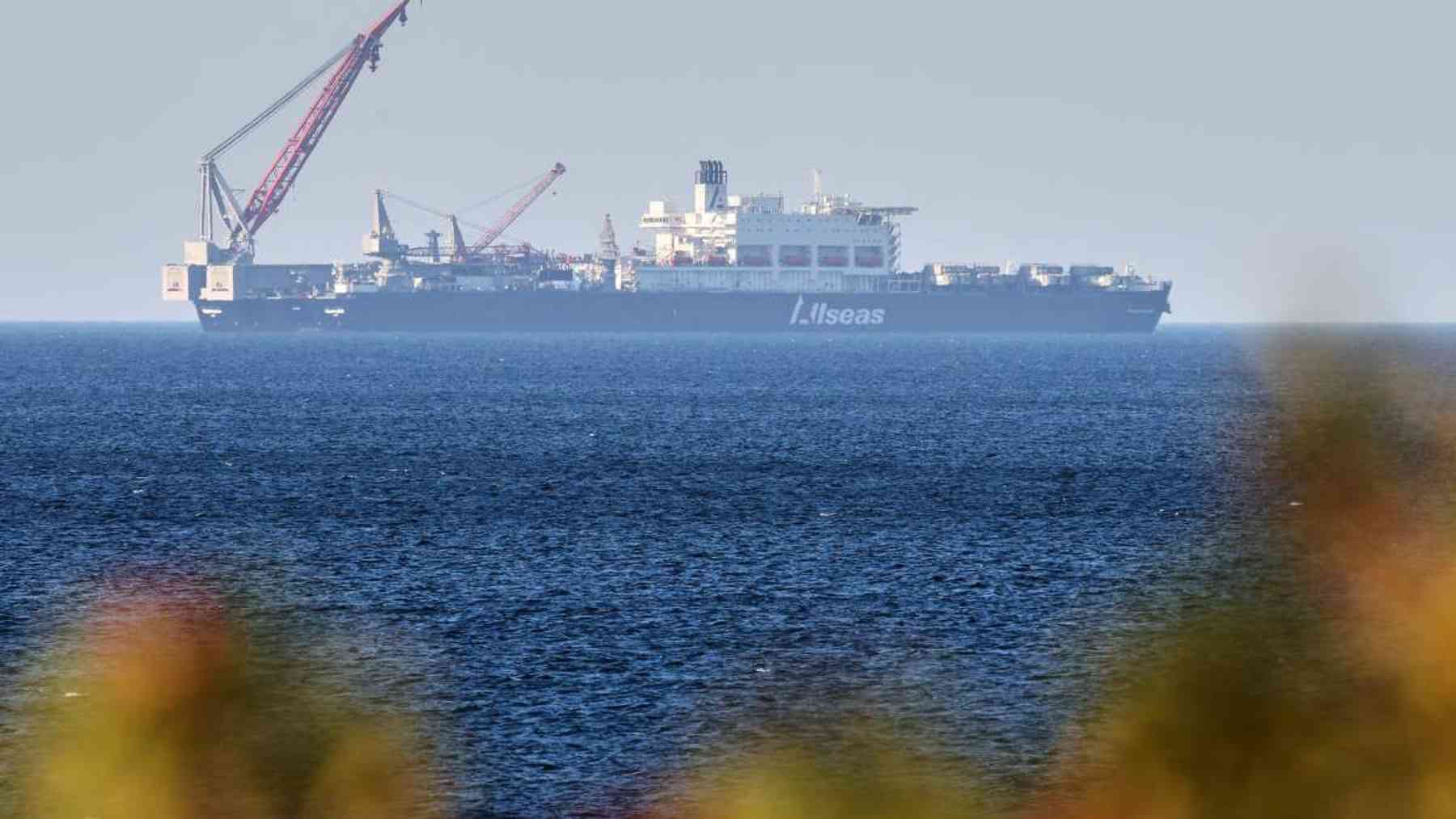
The bridge deck ran high overhead.
A ship nearly four football fields long was sliding beneath it at walking pace.
Its hull sat far lower in the water than it normally rides.
Nothing about that was an accident.
Crews aboard had filled the hull with seawater on purpose.
They needed the ship to sink just enough to fit.
Flooding the hull made the ship shorter where it mattered
The vessel, called Pioneering Spirit, is built to lift entire offshore platforms rather than carry cargo in a hold, so the height of its structure above the waterline changes with how much ballast water its tanks hold. To pass under the bridge, it took on ballast water, increasing its draft from about 36 feet to roughly 65 feet, a jump of nearly 30 feet achieved entirely by flooding internal tanks.
The deeper the hull sank, the lower its towering crane structure dropped relative to the bridge deck above. No cargo changed. No structure was removed. Only the water inside the ship moved.
Registered in Malta, Pioneering Spirit is 1,253 feet long and 407 feet wide, the largest construction ship ever built and the widest ship in the world. Nothing else afloat has that beam.
Three hour wait decided the crossing window
Even ballasted down, the ship could not simply go when it was ready. Pioneering Spirit passed under Denmark’s Great Belt Bridge at 12:55 p.m., nearly three hours later than planned as it waited for a required gap in other southbound traffic, a crossing detailed in Danish coverage of the transit.
The depth directly beneath the bridge runs around 197 feet, but the marked channel the ship had to follow is far shallower than the water under the span itself. That left a narrow lane for a hull sitting 65 feet down.
A spokesman said before the crossing that the ship was “ballasted down to the draft it needs to have” and ready, with only the clearance window missing. Smaller traffic had to clear the lane first.
A crawl of roughly 3 miles per hour
Once the window opened, the ship did not hurry. It traveled at a walking pace of about 3 miles per hour during the passage, giving pilots aboard time to correct for current and wind without the sharp course changes a faster ship would need.
The ballasting itself had been finished well before the bridge came into view, and the vessel held that lowered position as it approached. None of it was improvised.
Two pilots had boarded near Skagen to discuss the route with the ship’s command, and the passage was coordinated with Danish authorities, the operator and traffic control.
Four hours to pump the water back out
Sinking the ship was only half the job. After clearing the channel, the ship pumped out ballast water for around four hours before continuing south through the narrows, slowly rising back toward its normal transit draft as pumps pushed seawater out through the same system that had let it in.
The deep setting was never meant to last. It was held only as long as the bridge demanded. That return to a lighter draft mattered because shallower water still lay ahead, where cargo depends on exact clearance the way a single bridge can decide which route a mining truck is allowed to take at all.
Off the coast of Darss, the vessel was set to install two offshore substation platforms and their substructures.
Oil rig heritage now lifts wind substations
The trip was for offshore wind. The ship installed two offshore substations for a German transmission operator, part of a grid connection providing a combined capacity of up to 927MW, lifting topsides weighing thousands of metric tons onto their supports with its own cranes. A platform like that carries electricity generated far out at sea back toward shore, and until set in place it travels as pure dead weight, much like a warship under tow riding toward its destination.
A vessel built to lift drilling platforms off the seafloor and now setting wind turbine substations links two chapters of offshore engineering inside one hull. So the ship went on south toward the German coast, riding higher again, its ballast tanks mostly empty once more.
The gap under the bridge that day was never published to the inch, since the real margin also depends on the water level. What is certain is that a ship nearly a quarter mile long found just enough room by temporarily making itself heavier, then let that extra weight go once the hardest part was behind it.
Read the whole thing?
Get the week's signal, not the noise
Our sharpest reporting on energy, climate and nature — free, once a week.