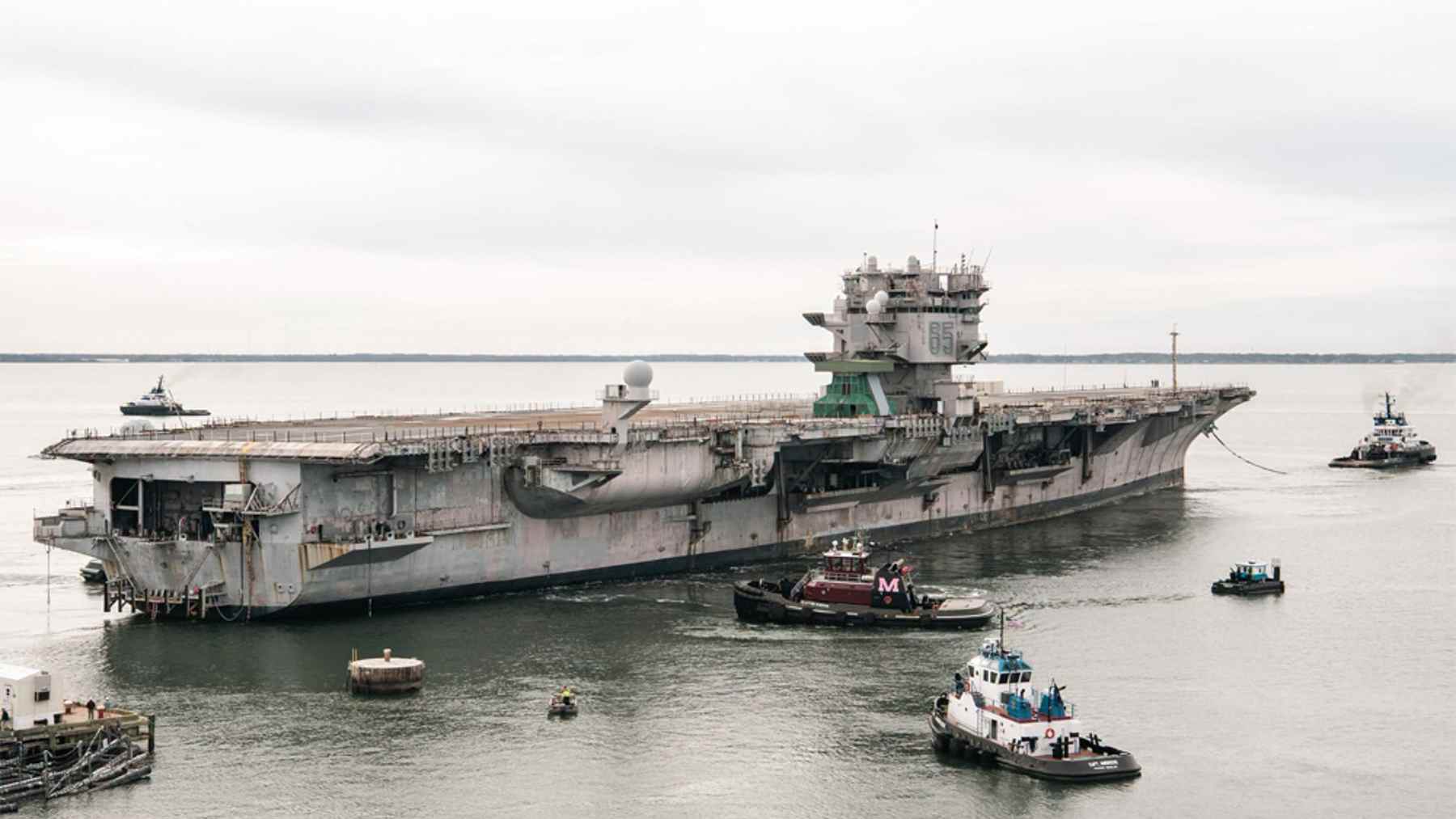
A ship longer than three football fields left its pier in Virginia this week with nobody driving it.
No engines turned inside the hull.
No one on board answered a wheel.
Everything that moved it came from outside, carried entirely by lines and tugs.
Behind that hull sat eight nuclear reactors, emptied of fuel years ago and riding south as dead weight.
The question the tow crews had to answer first is how you steer something that cannot steer itself.
A hull with no power depends entirely on the vessels pulling it
The former USS Enterprise has no propulsion and no steering of its own left, so every turn, every correction and every slowdown has to come from the other end of the towline. The Navy confirmed that ex-Enterprise began its final transit, departing Newport News Shipbuilding for Mobile, Alabama, where the ship will be dismantled.
That arrangement is ordinary for a dead ship. The scale is not.
At 1,123 feet she was the largest ship in the Navy right up to her decommissioning, and she remains the longest naval vessel ever built, with a beam of 248 feet and a full load displacement of more than 93,000 tons. Wind pressing on that flat flight deck acts on the hull like a sail, a sideways force the tow has to absorb rather than power through.
A fourteen year wait at one pier ends with a single morning departure
The hulk left almost fourteen years after the carrier came home from her last deployment, and for nearly all of that time she sat at the same shipyard while the Navy emptied her reactor plants and stripped her out.
She had steamed to that pier under her own power for the last time. She left it on a line.
Her service life ran from the Cuban Missile Crisis to the post-9/11 wars. The world’s first nuclear powered aircraft carrier played a central role in American naval operations during the Cold War, the Vietnam War and later conflicts including Operations Enduring Freedom and Iraqi Freedom, and her decommissioning ended a career of nearly 55 years, the first for a nuclear powered carrier.
A $536 million contract covers years of cutting in a port holding another famous hull
The timeline behind this tow is long. The carrier returned to Norfolk from her final deployment on November 4, 2012, and the Navy completed defueling of her reactor plants in 2017, decommissioning her in a hangar bay ceremony on February 3, 2017. USNI News has reported the Navy has spent about $1.3 billion on the total inactivation.
The dismantling itself is a multi year job rather than an afternoon’s work. She was towed seventeen months after the dismantling contract was awarded, a $536 million fixed price contract to a maritime dismantlement contractor, and completion is expected by September 2030.
Mobile is also holding another famous hull, though the two are passing rather than gathering. The former ocean liner SS United States has been in Mobile since March 2025 undergoing remediation and preparation for reefing, and her owners say Okaloosa County plans to deploy her as an artificial reef in the Gulf about 22 nautical miles southwest of Destin-Fort Walton Beach.
Eight separate reactors mean crews must cut a path no one has tried before
Here the piloting problem turns into an engineering one. A naval analyst told USNI News in July that for submarines the reactor compartment is removed as an entire section and shipped off to a disposal site.
The carrier’s eight separate reactors, more than any carrier built since, rule that approach out, so the ship has to be taken apart around them instead. That makes the tow the first and simplest stage.
Workers in Mobile now have to section a vessel that was never designed to come apart while keeping the sealed compartments contained throughout, and no one has dismantled a nuclear powered aircraft carrier before. The Navy’s inactivation and disposal program office has said lessons from this ship will inform disposal options for the ten Nimitz class carriers as they retire, which means part of the cutting sequence here becomes the template rather than following one.
A coastal passage past Florida still outweighs the fourteen year wait
The hardest test may already be behind the tow crews rather than ahead of them. Getting a 1,123 foot hull with zero propulsion out of the Chesapeake, down the Atlantic coast, around the Florida peninsula and into the narrower reaches of Mobile Bay demands constant small corrections that a powered ship would never need.
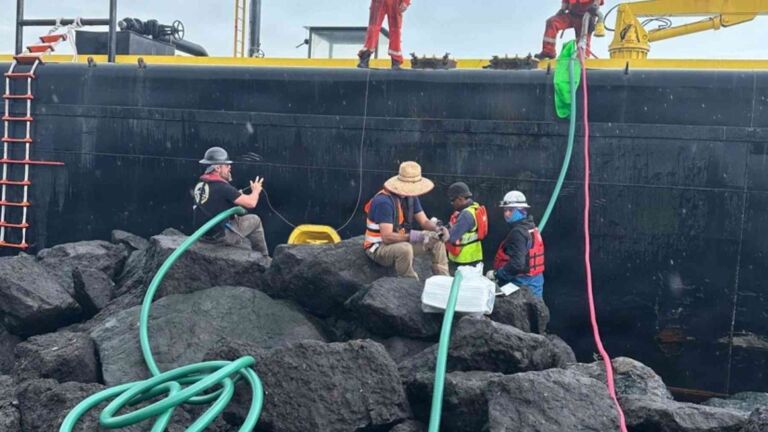
A single towboat pushing barges on an inland river already shows how quickly a routine passing maneuver can go wrong when a tow drifts outside the charted channel. Scale that up to a defueled carrier and the margin for error narrows further.
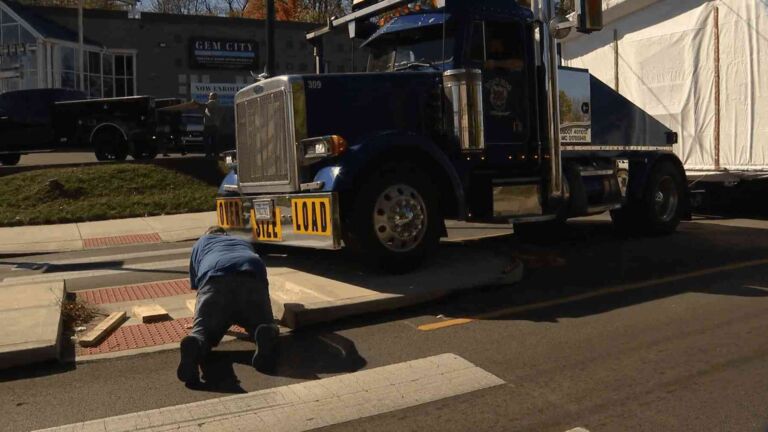
The same patience shows up in moving outsized loads over land, where heavy equipment can need temporary steel beams laid down just to cross a single bridge deck. A dead aircraft carrier at the end of a towline asks for that same discipline, stretched over a coastline instead of a roadway.
Read the whole thing?
Get the week's signal, not the noise
Our sharpest reporting on energy, climate and nature — free, once a week.