

A wind turbine appears to be one big machine that works alone with the wind.
Wind turns the blades, and the blades make power.
Yet a new proposal, now under review, is asking a turbine to do another job.
This plan wants the machine give off a sound that no person can hear.
Why would a turbine need a silent voice?
A funding proposal at Iowa State University
The plan comes from the U.S. Department of Energy. The department is proposing to fund Iowa State University for the work.
The project is titled “Advancing aerodynamic whistle-based ultrasonic bat deterrence technology to enable ultra-large wind turbines”.
In simple terms, it means improving an air-driven ultrasonic whistle to keep bats away from turbines, so that very large turbines can be used.
The department’s review of the plan was completed in January 2024. It was signed on 2 February 2024.
The work is not that simple. The university needs to fully design and build all the whistles, and then test them rigorously.
Two places to test the project
The first part would take place in a laboratory. Teams at Iowa State University in Ames and at Virginia Polytechnic Institute in Blacksburg would run acoustic tests.
They would study two kinds of design, called active and passive. The tests would measure amplitude, frequency, and flow speed, along with modulation.
The second part would then be outside the laboratory. Field testing would take place at the University of Minnesota’s Eolos Wind Research Station in Rosemount.
There, the test turbine is a Vestas V110-2.0 MW machine. It is already standing at the station, which regularly carries out research similar to this.
To carry out their testing, the crew would fit the machine with these deterrent whistles. They would also add microphones, weather protection equipment, and wind screens.
What the whistles are
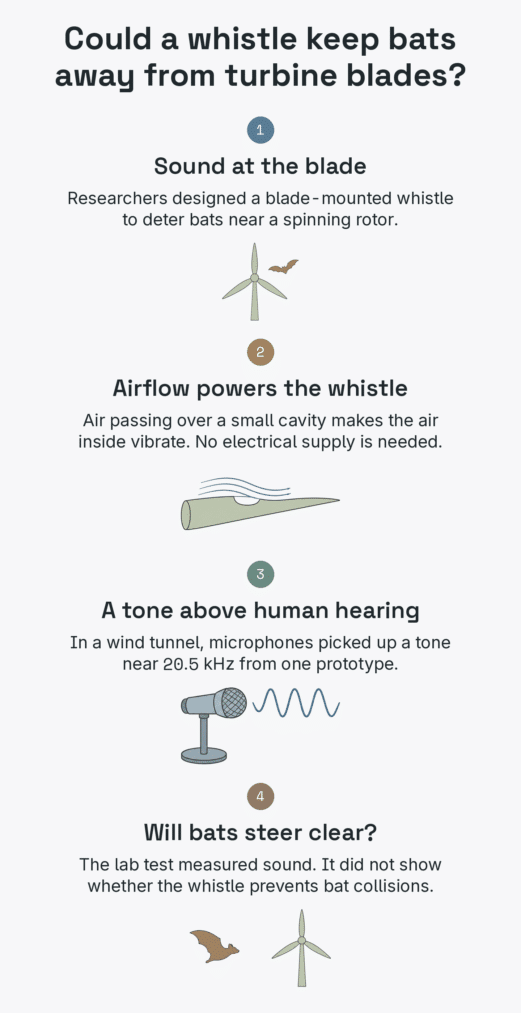
The project title names the key. These are aerodynamic whistles, and their purpose is ultrasonic deterrence of bats.
Ultrasound is a sound pitched above human hearing, so no person on the ground would be able to tell the difference with their ears. Other machines would be needed to detect if they were working.
The project is still in its proposal phase, so no results are clear yet. Researchers are keen to get the project off the ground to see whether it would make a true difference.
The department expects no significant effects on ecological, historical, or cultural resources from the testing.
A lot still remains unknown
As this is only in its proposal phase, there isn’t any real-world evidence.
The initial tests used a laboratory air supply, but the proposal does not say how air in the outside world would reach the whistle on a turbine. This would need to be tested in the real outdoor environment.
The paper also only tested its whistles in a laboratory chamber. No reports on field trials have been done yet, so a fall in bat deaths has not yet been recorded.
The testing also found that the sound is strongly directional. How well it would cover the space around a turbine would need to be tested.
A whistle that works in a wind tunnel may behave differently on a turbine. Wind, weather, and blade motion all change the sound.
Field testing would address whether the sound will actually keep bats away. As of 2024, this has not yet been fully answered. But in the years since then, rigorous outdoor testing will possibly have real-world answers as to whether ultrasonic whistles really do keep bats away.
Other methods for bat protection like this one could also be on the cards to keep these creatures alive.
Read the whole thing?
Get the week's signal, not the noise
Our sharpest reporting on energy, climate and nature — free, once a week.


