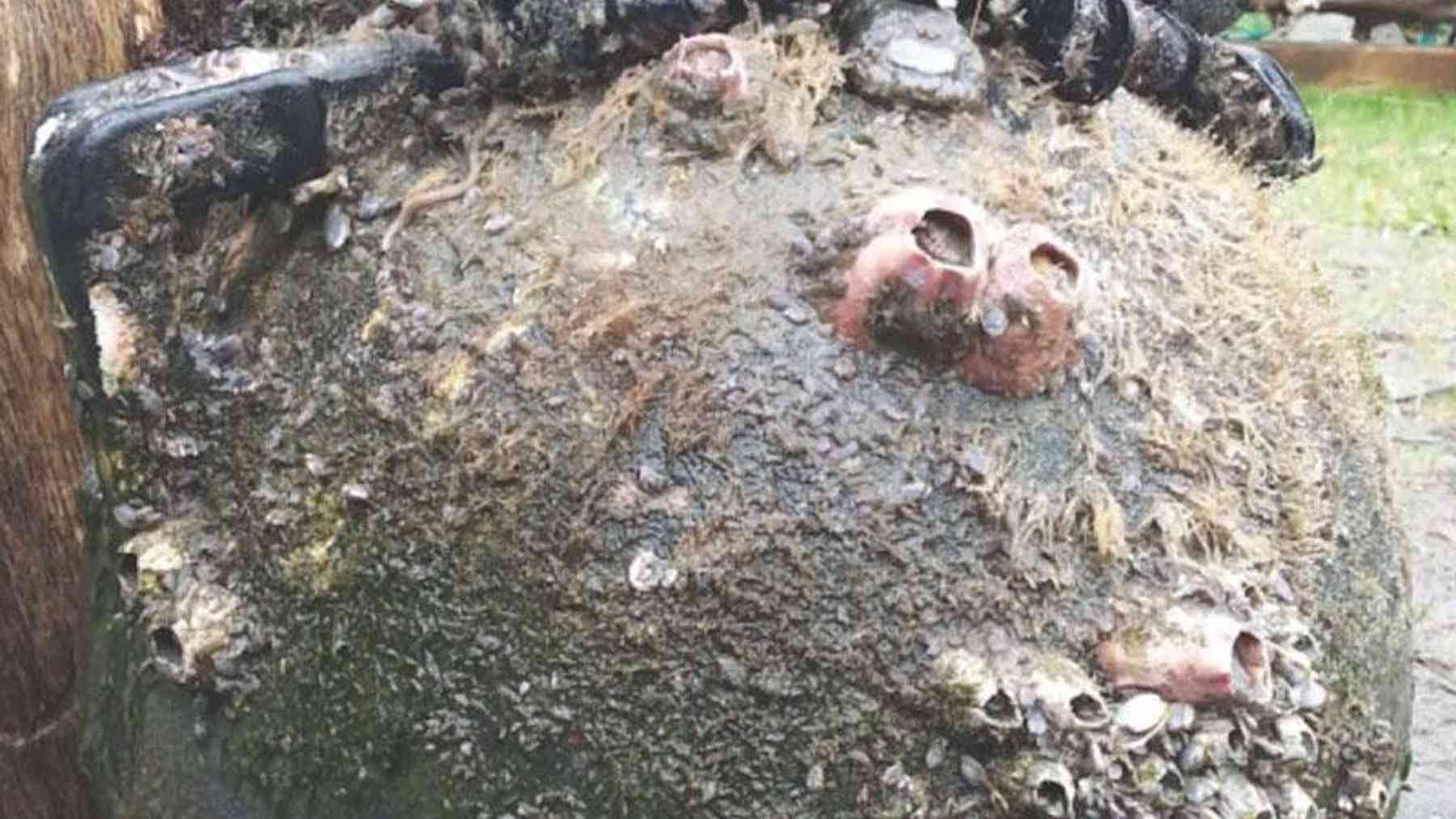
A plastic buoy rolls out of the surf on a gray Washington beach, trailing algae and crusted with shellfish.
It looks ordinary at first glance, just another piece of flotsam.
Then someone bends down and notices the mussels are still alive.
So are the barnacles crowded across its surface.
They did not grow here.
They came from the other side of an ocean.
A plastic hull kept a Japanese reef alive for six years
The buoy that washed ashore at Long Beach, Washington carried Mediterranean mussels, rose barnacles and sea anemones, still living when it landed. Researchers who examined hundreds of objects like it found the animals were not passengers hitching a short ride. They had been feeding, growing and in some cases breeding on those hulls for the length of the crossing.
The explanation researchers offer is simple physics with a strange outcome. Wooden debris gets bored through by shipworms and breaks apart at sea, taking its hitchhikers down with it, which limited how long rafting communities could survive in the past. Plastic and fiberglass do not share that fate.
A buoy, a dock section or a boat hull can stay watertight and buoyant for years. It becomes a slow moving tide pool that never stops moving. Carlton has said plastic debris can now carry entire communities of species for far longer than wood ever allowed.
A tsunami off Japan’s coast set the ocean drift in motion
The source event sits on one stretch of coastline. A massive earthquake and tsunami devastated Japan’s Tōhoku region, and the retreating water dragged buildings, boats, buoys and whole docks out to sea. A year later, beach walkers in Oregon and Washington began spotting debris marked with Japanese characters, and scientists confirmed much of it came from Tōhoku.
What followed was not a single dramatic landing but a slow, years long trickle. Objects came ashore across the Hawaiian Islands and mainland North America from Alaska to California, each one capable of carrying its own miniature reef.
One landing stood out. A Japanese motorcycle, sealed inside an insulated storage container that kept it afloat for a crossing of more than 4,000 miles, turned up on a remote beach on Graham Island in British Columbia. It was among the first items lost in the tsunami to reach the west coast of North America.
634 pieces of debris yielded 289 living species over six years
This was not a single sighting but a sustained, multi year field investigation. Marine ecologist James Carlton of Williams College led the work, and the team coordinated with local, state and federal officials and volunteer beach cleanup groups to collect and photograph samples.
The hardest numbers landed in the journal Science. In total, 634 pieces of Japanese debris were assessed, and scientists found 289 species of animals on them, mostly invertebrates such as mollusks, crustaceans and worms. Those species crossed thousands of miles of open Pacific over six years to reach North America and Hawaii.
Some pieces were modest, a single buoy or crate. Others were enormous moving habitats. A 66 foot dock float, torn loose from a fishing port in northern Japan, washed ashore at Agate Beach north of Newport, Oregon, its surfaces carrying dozens of Japanese organisms, including a brown algae that covered the structure, at least eight species of mollusk, barnacles, worms and a sea urchin. Carlton told reporters the diversity was “somewhat jaw dropping.”
No known precedent exists for a crossing this long
What makes the finding genuinely odd is how rarely anything like it had been documented before. None of the species were known, or expected, to survive a transoceanic rafting voyage between continents, largely because the open ocean is a harsher environment than the coastal waters they are built for.
The paper describes the episode as a rafting event with no known historical precedent, the longest documented transoceanic survival and dispersal of coastal species by rafting. Co-author John Chapman of Oregon State University called it “one of the biggest, unplanned, natural experiments in marine biology, perhaps in history.”
None of this is confined to a single coastline. Surveyors found colonized wreckage from the Pacific Northwest down through California and across to Hawaii, each landing site adding its own tally. The pattern echoes other ocean processes that reshape coastlines over years rather than days.
Twenty percent of arrivals in 2018 could still reproduce
So far, no new species are known to have colonized the West Coast directly because of the tsunami, which is the honest and still unresolved part of the story. Arrival is not establishment. Whether a rafting species takes hold depends on how many reproductively viable individuals arrive, how often, and whether suitable habitat is waiting.
The clock has not stopped either. Animals were still arriving on tsunami debris through the summer of 2018, and roughly 20 percent of the species that arrived were capable of reproduction. That delay between landfall and a detectable population is not a gap in the research, it is how invasion timelines work in the wild.
The uncertainty is not a failure of the research. It leaves a window of time for action, even as the full consequences of the long distance rafting remain open.
Read the whole thing?
Get the week's signal, not the noise
Our sharpest reporting on energy, climate and nature — free, once a week.