Glare caused by airport solar panels turned into a serious safety problem.
It was difficult to predict where it would appear. Knowing when it would occur was equally challenging.
Estimating how intense it might become was just as difficult.
A different solution was created.
Potential glare was forecast using models before projects were constructed.
Reflected sunlight can create problems long before construction
When enough light is reflected, an observer may notice the effect.
It can cause glare, ghosting, obscuration and, in extreme cases, damage to the retina.
Engineers developed an analysis tool to predict these effects.
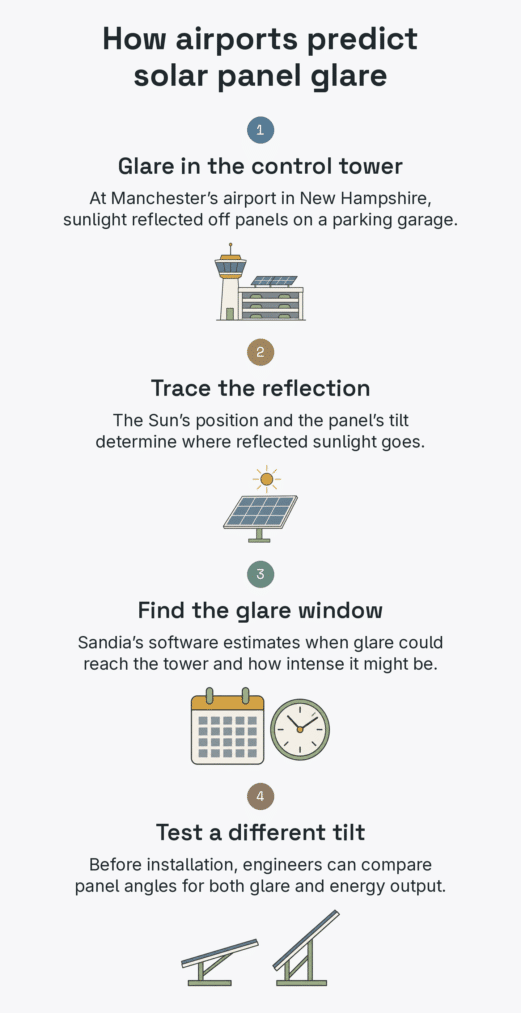
Panel orientation, site layout, and panel inclination are analyzed to predict whether glare will occur.
Expected energy output can also be estimated from this analysis. Visibility impacts can be considered at the same time.
Different designs can be compared to ensure sufficient energy output is achieved without causing visibility issues.
Airport operations helped expose an overlooked visibility problem
Glare was observed from the air traffic control tower at Manchester Boston Regional Airport. The source of the visibility issue was eventually traced.
Finding a long-term solution became a priority.
Pilots and Air Traffic Controllers rely on clear visibility in airport environments.
Airports already have many factors to manage, so additional visibility issues can become problematic.
Even minor visibility issues may be problematic as continuous monitoring of visibility and aircraft movement is required.
One incident attracted attention far beyond Manchester airport
The incident attracted wider attention.
Later, U.S. Department of Energy highlighted SGHAT as a way to predict glare impacts before solar projects are built.
This example was used in developing policy and analytical methods for further projects.
In 2012, the visibility issue prompted a direct response. Airport officials acted to reduce the impact.
Ultimately, the solar panels (worth approx. $3.5 million) were covered with tarpaulins.
The experience demonstrated that predicting glare issues can avoid much of the disruption caused by fixing them later.
Glare problems become much harder to solve afterwards
Reflected light issues can be difficult to mitigate after construction. Design changes become more limited once panels have already been installed.
Sandia National Laboratories developed the Solar Glare Hazard Analysis Tool to evaluate potential glare and ocular impacts from proposed solar installations.
In 2013, the Federal Aviation Administration required any solar systems to be analyzed with SGHAT if they were to be installed at federally mandated airports.
However, this example does not mean every future solar installation will produce similar effects.
Some aspects of the solar installation may not be captured accurately.
If there are gaps in the modules, supporting structures, or complex design features within the PV system, this can affect accuracy.
Obstacles, both natural and artificial, between the panels and the observer may not be considered.
Large sites may introduce uncertainty into the results. Not all reflective surfaces are considered in some calculations.
A small design adjustment can change everything later
Changing orientation, inclination, and position of panels can cause significant changes in glare.
Potential conflicts can be identified early in the design process. That creates more opportunities to adjust the design.
While energy production remains important, visibility impacts must also be carefully considered.
Minor design changes can significantly alter local reflection patterns over time.
If glare is avoided during the design stage, it may not need to be addressed later.
Predictions still face testing under changing real-world conditions
More and more decisions in approving projects, designing sites, and mitigating issues are based on predictions made before infrastructure is in place.
These predictions in visibility-sensitive locations will still be closely scrutinized.
Every new installation provides further testing of whether the reflection risks predicted in models correspond to real-life situations.
Read the whole thing?
Get the week's signal, not the noise
Our sharpest reporting on energy, climate and nature — free, once a week.