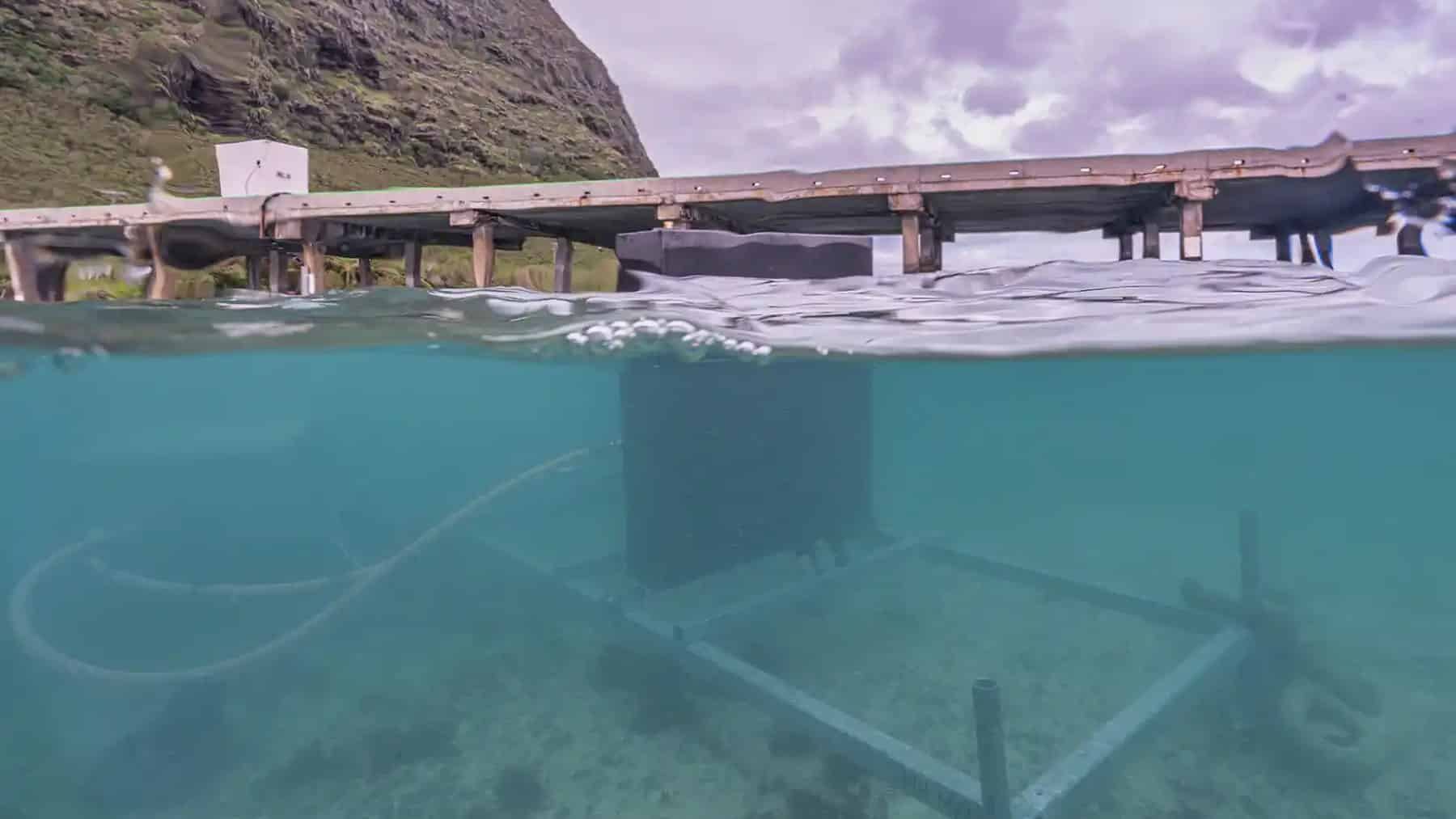
The water off Makai Research Pier is shallow enough to wade in.
That is exactly where engineers chose to put something new.
A dark flap roughly the size of a record breaking television screen tips back and forth with every passing swell.
It does not float on the surface and it does not sit miles out where the ocean turns violent.
It sits almost at the shoreline, bolted to the seabed, doing a job wave machines have struggled to do cheaply for decades.
So how does something this small make power at all?
A hinge built to bend with the wave instead of fighting it
The device is called SURF-WEC, short for Small Underwater Research Flap Wave Energy Converter, and its whole trick is scale. A buoyant flap anchored just offshore, roughly the size of a television screen, oscillates back and forth with each passing wave, like a door swinging on its hinges. Instead of resisting the surge, the flap simply pivots with it.
That swinging motion is converted into something a machine can use. The movement drives a hydraulic system, pumping fluid through a sealed circuit and building pressure. Once enough pressure accumulates, it turns a motor coupled to a generator.
No turbine blades spin loose in open current and nothing large churns offshore. Engineers call this an oscillating surge converter, a category built around catching the back and forth push of a wave rather than its height. Because the flap works with the motion instead of against it, the loads on its hinge stay far smaller than on a rigid platform facing the same swell.
Six feet of water, a sandy bottom and a storm that moved the schedule
The site is Makai Research Pier, near Waimanalo on Oahu’s windward side. Federal environmental paperwork for the project describes a self leveling, sandy bottomed location where the device would sit in about six feet of water depth, close enough to shore that a small crew could handle the whole installation from land.
Just before deployment, the team faced an unexpected challenge. A powerful Kona storm was approaching Oahu, bringing strong winds and wave conditions well beyond what the researchers had anticipated from historical wave data.
Instead of rushing the full system into the water, the team secured only the frame in place and waited out the storm. Two days later, with the worst of the storm past and new modeling in hand, the team installed the rest of the system, anchoring it to the seabed and connecting it back to the pier. The converter began generating its first power shortly after and has been rocking with the waves there since March.
Two years on a bench before a single wave touched it
Long before it ever got wet, the device went through a slower, stranger kind of testing onshore. Engineers used an electric actuator to mimic the movement of the flap in an ocean wave, allowing them to refine the system in a controlled environment.
That bench rig stood in for the sea. Dry testing let the team evaluate system performance, understand efficiency losses throughout the system, and test operation under extreme conditions before any hardware touched the coast.
A researcher on the project described the leap in plain terms. “We’re taking something from a whiteboard, building it in the lab, and then seeing it work in the ocean.” In all, the device reached its spot near the pier after three years of preparation.
A year of open data from a device nobody expected to matter this much
The plan is to leave it in place far longer than a quick trial. It is expected to run for up to a year, and researchers will use the deployment to collect real world performance data and compare active and passive approaches to wave energy capture. Every reading is meant to be shared rather than kept private.
That openness matters because the field is thin on evidence. One researcher on the project said the marine energy community is “so data starved,” with few deployments and little accessible or shared data from the ones that have happened.
A control system can switch the flap between letting the sea push it naturally and actively adjusting its response to each wave. Modelling indicates active systems can capture more energy, but they also need power for sensors and controls. That efficiency trade-off is the same one our tidal turbine blade coverage has tracked as larger marine machines try to outlast storm loads.
What a flap this small can and cannot do
The interesting inversion here is one of size. Wave energy has spent decades going bigger and farther offshore to survive the ocean, and this project tests whether something the size of a television, sitting in a few feet of water on a sandy bottom, can earn its keep instead.
Siting choices like that echo the habitat constraints that larger hydropower turbine designs elsewhere have had to be reshaped around. A flap this small will never replace a power plant on its own.
The team is still collecting storms and calm spells before drawing firm conclusions. A final report is planned, and it is to be publicly available, which, for a technology that has spent decades sinking expensive prototypes into deep, punishing water, may be the more useful result. The full project account is published by the laboratory that led the engineering, and the siting details come from the federal environmental review.
Read the whole thing?
Get the week's signal, not the noise
Our sharpest reporting on energy, climate and nature — free, once a week.