
Water slides over a low wall of concrete and stone masonry in the middle of a Maine mill city.
Beneath the spray, something smaller is trying to go the other way.
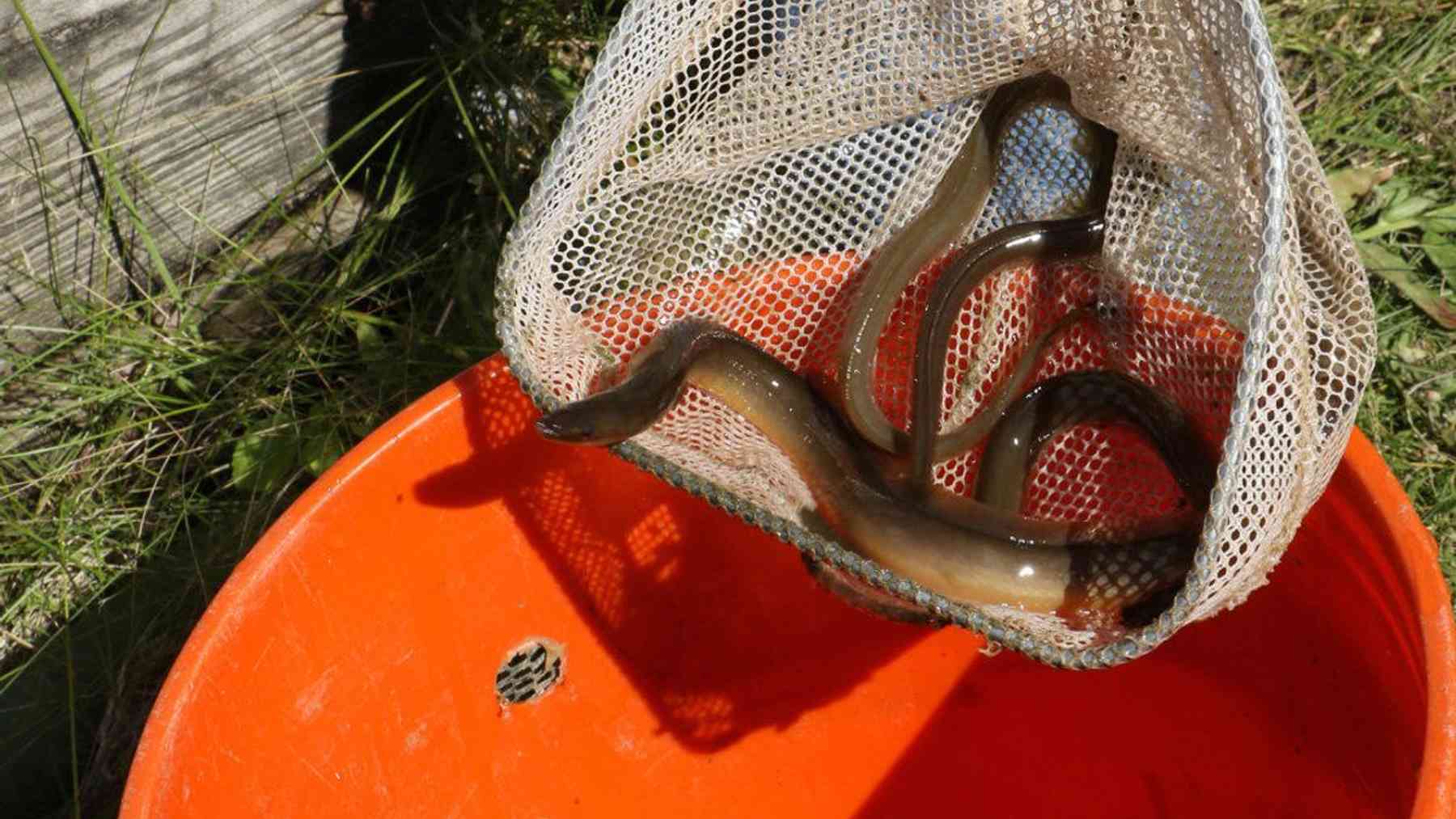
Each summer, young eels arrive from the ocean and hit the wall.
They stop there, pressed against stone, with nowhere left to climb.
Engineers found their fix in an odd place, the supply list of a shellfish farm.
So how does a coil of ordinary rope turn into a climbing wall a fish can actually use?
Why an eel can climb what a salmon cannot
The plan at Upper Barker Dam is almost embarrassingly simple. In the relicensing paperwork now before federal regulators, the operator’s proposed method is installing mussel spat rope, the coarse strand shellfish growers use to catch and hold young mussels. The material was never designed with a fish in mind.
So why would eels bother with it at all? Unlike salmon, which need deep moving water and a running start to leap, young eels work differently. To get past a barrier, these fish need friction rather than depth, and a wet, textured surface is often all an elver needs.
That is where the rope earns its keep. Its rough, fibrous surface gives small hooked bodies something to grip, turning a strand meant for shellfish lines into a ramp that can be fixed beside the dam.
One turbine still blocks the trip back down to the sea
Climbing up is only half the journey. Adult eels eventually have to come back down the same river to reach the ocean and spawn, and at this dam that trip runs toward a single 950 kilowatt turbine. The same filing pairs the rope with perforated plates with 1 inch hole openings at the intake, meant to hold fish out of the machinery while river water passes through.
That leaves engineers juggling two opposite jobs at the same small facility. One structure has to hold fish back while another has to welcome a slippery, determined eel headed the other way entirely.
The dam itself is modest. The project generates nearly 4,700 record breaking hours of output a year in megawatt hours, barely enough to register against a regional grid, yet it sits squarely across a river eels have used far longer than any dam has stood on it.
Eleven nighttime surveys downstream turned up just 44 eels
For years almost nobody had a count of how many eels were trying to climb through this part of the watershed. The clearest numbers come from the next dam downriver, the lower Barker Mill project, where surveyors went out after dark in the summer of 2015.
Crews ran eleven nighttime surveys of juvenile eels, each lasting between one and one and a half hours. A total of 44 eels were observed downstream of that project dam in the bypassed reach, a thin tally gathered in the one stretch where anyone was looking. That figure counts fish below the lower dam, not arrivals at the upper one, which has never had a dedicated eel count of its own.
Passage at Upper Barker will provide 141.6 acres of habitat, ground that has sat just out of reach for generations of young eels working upriver from the Sargasso Sea. At the time of the federal review, the only dam downstream of the lower project with dedicated upstream passage for juvenile eels was the Worumbo Project, which gives some sense of how thin the ladder network on this river still is.
The paperwork has outlasted several migration seasons
The timeline here is its own kind of curiosity. The application for a subsequent license was filed on July 29, 2021, and federal staff did not issue notice that the project was ready for environmental analysis until March 23, 2026. A city official said in August 2026 that fish passage at Upper Barker is likely by 2031.
Part of the wait comes from coordinating two dams at once rather than one, since the settlement ties the upper dam’s flows and passage schedule to the lower dam downstream. Both have to be worked out together, the same tangled logistics that held up a sockeye run for a century before anyone finally cleared it. The river does not wait for a docket number, and neither does an elver fighting the current below it.
A rope this cheap could travel far beyond one river
What makes the Auburn plan worth watching is not the dam itself but the material. Mussel spat rope is a commodity sold by the roll rather than a custom fabrication, and it can be cut, coiled, and restrung almost anywhere an operator needs a climbing surface.
That kind of borrowed, repurposed fix stands out in dam engineering, where retrofits are usually built to order, much like the scrappy ingenuity behind a wet wipe mound cleared from the Thames.
It will not solve everything. The rope only helps eels heading upstream, and the screening meant to protect them on the way down is a separate piece that still has to be built and tested in the river.
Even so, there is something almost comic about the solution. A product made to grow shellfish off the Maine coast may help decide whether an entirely different Maine species keeps its ancient route home.
Read the whole thing?
Get the week's signal, not the noise
Our sharpest reporting on energy, climate and nature — free, once a week.


