As dust accumulates on a photovoltaic (PV) array, its effect will be felt almost immediately.
Output will decline well before visible soiling.
In many parts of the world, this presents an added difficulty. There is little to no rain to naturally remove this build-up.
Researchers in Germany have taken an alternative route. Rather than attempt to clear the soiling, they sought to induce the PV module to clean itself.
Controlled oscillations replace traditional solar maintenance routines
A variety of measures have been employed to address this issue.
In most cases, these require manual intervention, robotic equipment, significant quantities of water, and contact with the PV modules.
Using appropriately applied vibration, the system is able to dislodge and cause soiling to migrate across the panel.
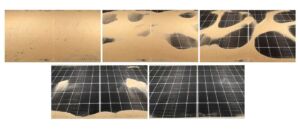
In doing so, the method avoids any form of direct contact with the PV module. Consequently, there should also be minimal risk of inducing damage such as scratching.
Desert solar farms face uniquely demanding conditions
With more and more solar power being generated in remote, arid areas, soiling becomes an ever-greater concern.
As well as high levels of available irradiation, these sites are typically subject to heavy dust fall.
Furthermore, the lack of readily available clean water means that many current technologies are rendered impractical.
If a large number of modules are distributed across a site, each requiring cleaning, costs and logistical challenges will grow substantially.
Self-cleaning arrays can therefore offer considerable benefit in terms of reduced site visits.
Initial success still leaves major questions open
Research indicates that dust and sand can lead to PV yield reductions of roughly 20 percent.
Clearly any solution needs to be at least able to meet this level of performance.
As demonstrated by Fraunhofer IDMT, preliminary trials demonstrated progressive reduction in the level of soiling present.
By applying acoustic excitation, the various media moved progressively from the PV module.
Work continues to develop a demonstrator comprising three PV modules with embedded exciters. Functionality is expected to be assessed on-site.
These tests should give some indication of the potential of the technique, but further assessment in a wider range of circumstances is required.
Virtual testing still depends on real dust
Prior to fabricating any trial arrangement, the characteristics of the desired vibrations can be modeled.
This obviates the requirement for multiple pre-trials and will allow expedited determination of optimal locations for the devices.
However, as the nature of the soiling encountered in practice will vary, it follows that the performance of a given test rig cannot necessarily be extrapolated.
As the Fraunhofer IDMT AkSoRe project continues, further site-based trials are needed to verify the method’s ability to remove soiling.
Surface soiling characteristics dictate system cleaning response
It is anticipated that some degree of dependency on the nature of the media present will exist.
Whether the accumulation consists of dust, sand, or other deposits, each will react to a particular excitation.
Likewise, depending on the angle at which the modules are mounted, the displaced soiling may behave in differing ways.
Of course, further factors will influence the suitability of a given configuration in different geographic locations. Appropriate control strategies will need to be developed to accommodate these.
Long-term durability determines ultimate system applicability
Clearly, a key unknown is the longevity of the method and associated devices.
If the system’s efficiency fluctuates too markedly, the benefits of self-cleaning will be negated.
The technology can either be incorporated during manufacture of PV modules or added post-installation.
At this point, the research team has proven that media can be induced to traverse a module via vibrational input.
The task now is to demonstrate its continued efficacy under the widest possible range of practical scenarios.
We will only know for sure when the dust falls again.
Read the whole thing?
Get the week's signal, not the noise
Our sharpest reporting on energy, climate and nature — free, once a week.