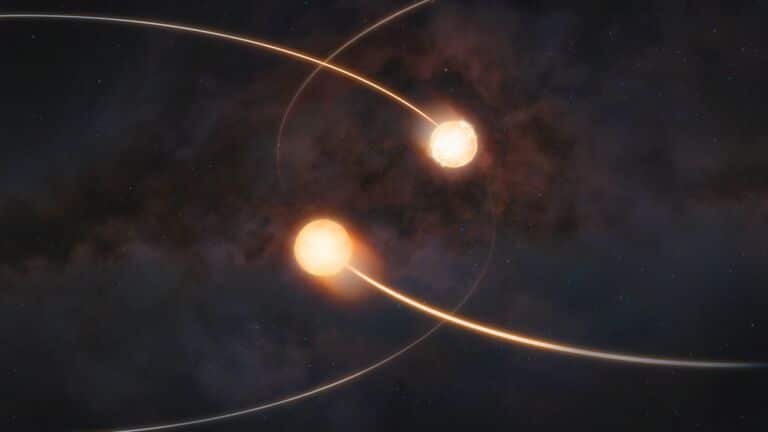
For millennia, two stars orbited each other in quiet lockstep at the edge of the Andromeda galaxy. Then, in 2023, astronomers noticed something odd: one of them was slowly growing brighter. By 2025, that slow simmer had become an explosion — the pair’s brightness surging dramatically within a single week.
What unfolded next was something no observatory had ever caught in real time. NASA’s James Webb Space Telescope arrived on the scene just 47 days after the peak of the eruption, capturing a stellar merger as it happened — a Sun-like star spiraling into a massive supergiant, the two becoming one.
A slow buildup, then a sudden explosion
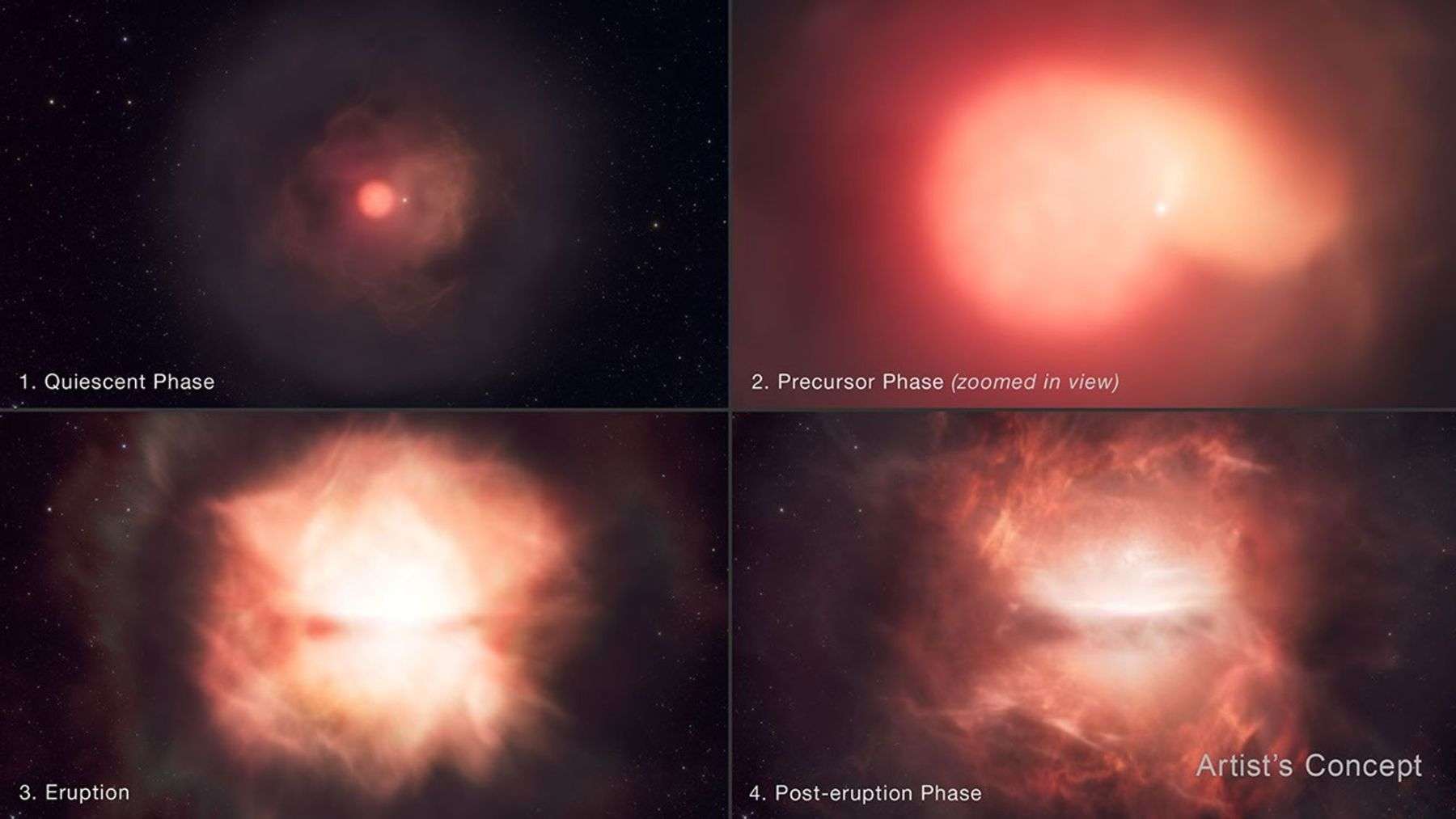
The system now nicknamed Bao first raised flags in February 2023, when researchers spotted unusual infrared variability in data from NASA’s retired NEOWISE mission. Before 2018, the object had held a steady luminosity. Something had changed.
Over the next two years, multiple telescopes tracked a gradual brightening and dust ejection — hallmarks of a star being slowly consumed from the outside in. By September 2024, the Wide-field Infrared Transient Explorer (WINTER) confirmed the brightening was accelerating. Then in July 2025, NASA’s SPHEREx caught Bao fading in visible light while brightening in infrared, a sign of deepening activity.
The turning point came on October 17, 2025. The Zwicky Transient Facility detected a sudden eruption: brightness surged and temperature spiked within a single week. Researchers had expected a star this large to produce an outburst unfolding over years. The speed caught even the scientists off guard.
What is a stellar merger — and why is this one different?
When two stars orbit closely enough, the smaller one can spiral into the outer layers of the larger, triggering what astronomers call common envelope evolution. The shared outer gas forms an envelope around both stars, and drag robs the infalling companion of its orbital energy.
Most known binary mergers involve two relatively small stars that circle each other thousands of times before finally combining. Bao’s merger happened in just seven orbits — roughly seven years. That speed reflects the extreme size mismatch between the two stars involved.
The primary star, nicknamed “Big Bao,” was seven times the Sun’s mass, 350 times its radius, and 18,000 times brighter. Its companion, “Little Bao,” was slightly less massive than our Sun. Simulations showed that Little Bao was dragged all the way into Big Bao’s core — an encounter researchers described as “almost like a bomb exploding inside a living star.”

Webb’s role: arriving at just the right moment
NASA’s James Webb Space Telescope observed Bao on December 24, 2025, only 47 days after the eruption peaked. That’s the earliest follow-up ever achieved for an event of this kind, made possible through a fast-tracked Director’s Discretionary Time program.
Webb’s mid-infrared data revealed dust the primary star had shed over centuries, giving the team a way to reconstruct the system’s history before, during, and after the merger. That retrospective clarity had never been available for a stellar merger in progress. Observations from the Neil Gehrels Swift Observatory, Gemini North, SPHEREx, and WINTER extended the picture across ultraviolet, visible, and near-infrared wavelengths.
What the merger tells us about stellar evolution
Observing Bao in real time gave researchers something they’d never had before: a direct measurement of how efficient common envelope evolution actually is. In previous cases, astronomers had to reverse-engineer that efficiency from ancient stellar remnants — a far less precise method.
The modeling also produced the first-ever mass estimate for a destroyed companion in a merger like this. Little Bao likely weighed in at about 0.7 solar masses, a result that anchors the physics of the entire event.
Common envelope evolution isn’t just a curiosity. Systems that survive the process can evolve into neutron stars, black holes, or millisecond pulsars — making it a foundational step in some of the universe’s most extreme outcomes. Bao’s newly merged star remains poorly understood internally, and only future observations will reveal how it stabilizes.
A preview of many more discoveries to come
The methods used to study Bao now serve as a template. By monitoring the system continuously and following up within weeks of the eruption, the team demonstrated that real-time stellar merger science is possible — not just in theory, but in practice.
That template is about to meet a much larger dataset. NASA’s recently launched Nancy Grace Roman Space Telescope is expected to expand the number of detectable transient events through its Galactic Bulge Time-Domain Survey. “There’s going to be a large influx of similar discoveries just ahead,” said lead author Viraj Karambelkar.
Bao — formally catalogued as AT 2025abao — is now a benchmark case for the field. What was once a quiet binary system at the edge of Andromeda has become the clearest example yet of how two stars can spiral together, merge, and leave behind something entirely new.
Read the whole thing?
Get the week's signal, not the noise
Our sharpest reporting on energy, climate and nature — free, once a week.