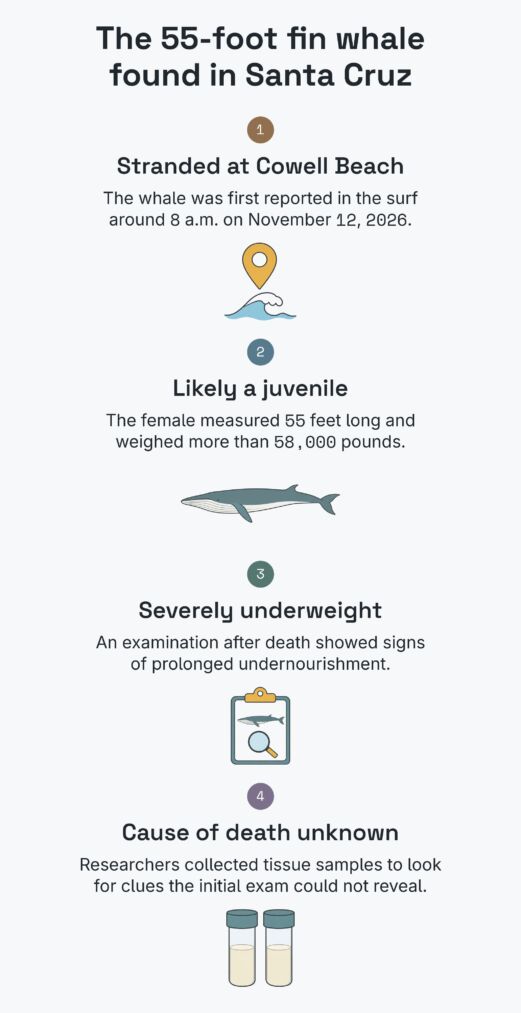
The fin whale was spotted in the water off Cowell Beach on Tuesday morning and was confirmed dead by midday.
On sight, there were multiple apparent issues with the whale. However, no immediate reason presented itself to account for these.
Representatives from a number of marine agencies attended to view the deceased whale.
Further investigation will be required through various lab tests, with results potentially taking many months.
Body mass loss exceeded typical whale health parameters
Most striking was the degree to which the whale had lost body mass.
This was highly unusual given the fin whale’s classification.
When healthy, their body size places them near the top of the planet’s animal kingdom.
In this case, the reverse was true. Following the necropsy, it was evident that the whale had experienced a significant duration of inadequate feeding.
While this would go some way towards explaining the low body condition of the whale, the underlying issue remained unexplained.
Stranding at Cowell Beach created immediate logistics
The whale had initially been located in the water off Cowell Beach on the Tuesday morning.
Due to the scale of the operation, the carcass was removed overnight for further work elsewhere.
Fin whales are a regular presence around this stretch of California coast, although less so than gray or humpback whales.
Physical examination revealed condition but not the cause
Initial observations during the necropsy gave a good indication of the whale’s general state and some further limitations.
The fin whale was determined to be more than 58,000 pounds and 55 feet in total length. It was identified as a sub-adult female.
Consequently, it was clear that the whale had lost considerable mass, but this alone did not explain why the decline occurred.
Samples taken at the time will allow more in-depth analysis.
As noted by the University of California, Santa Cruz, laboratory testing could help establish why the whale’s health deteriorated.
Further investigation of collected tissue remains essential
Diseases can manifest in ways that are difficult to detect during a field examination.
As such, there is much that can be learned from the tissue obtained at the time of death.
Depending on the nature of any findings, one or more hypotheses may be favored or eliminated.
In some cases, no conclusive cause may ever be identified. This is a frequent scenario encountered when investigating marine mammal stranding events.
The key insights frequently arise well after the incident has subsided.
Difficult disposal choices followed rough sea states
Various avenues for the disposition of the carcass were discussed once the necropsy was complete. These were constrained by a combination of factors.
One option that was considered was the interment of the whale’s remains to enable removal and study at a later date.
This was precluded due to a number of reasons including safety and weather.
Alternatively, the carcass could have been disposed of at sea. However, with deteriorating sea states anticipated, this posed a significant hazard to the vessels involved.
The carcass would need to be taken out to significant distances at sea from any coastline.
Given the prevailing conditions and its mass, this was not feasible.
Future laboratory testing now carries the investigative burden
Over the next few weeks, laboratories will analyze a large number of sample sets across several facilities. That testing could uncover factors and variables missed at the outset.
As fin whales are still classified as endangered under federal protection, they face a variety of ongoing challenges.
Whether the cause can be identified now depends on the laboratory findings.
For now, however, we know how the whale came to be in this state, but not why.
Read the whole thing?
Get the week's signal, not the noise
Our sharpest reporting on energy, climate and nature — free, once a week.