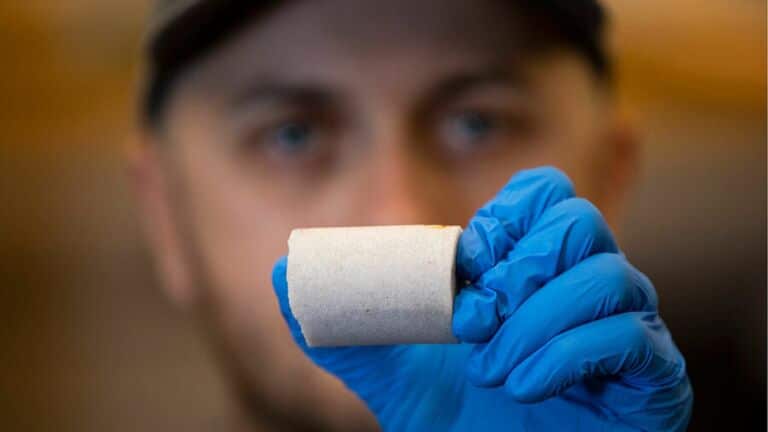
A camera sits inside a sluice channel in the Netherlands.
It points at a rotor that looks nothing like a propeller.
Trout drift past the turning blades and keep going.
In machines built around a fast spinning propeller style runner, as many as one in five fish drawn through a confined sluice can be killed by the blades.
Screens and bypasses work around that problem.
None of them fixes the rotor itself, and that is the part this design finally changes.
The open rotor shape is what spares the fish
The fix did not come from a new material or a bigger machine. It came from turning a wind turbine on its side and lowering it into moving water. The Dutch simulation firm Physixfactor adapted a Darrieus rotor, the eggbeater shaped design first developed for wind power, for underwater use on behalf of the turbine company Water2Energy.
Instead of a single horizontal shaft with two or three blades sweeping a wide circle, the rotor spins on a vertical axis with slim blades set around its rim.
So the designers argue this open structure is far less dangerous to sea life than a propeller style runner crammed into a tight channel.
The physics behind that argument is well established in hydropower engineering. Strike probability models turn on blade count, rotation speed and the length of the fish, so a rotor with fewer blades and a gentler blade angle lowers the odds that any one fish gets hit.
Sluice gates built decades ago demand this fix
This turbine was not conceived for a big river dam. It was conceived for the gates and flood control structures that already pinch tidal flow into narrow passages, where a conventional runner would fill its circular path almost completely.
That leaves a fish very little room to maneuver.
Regulation is part of why the work happened at all. Strict Dutch and European rules increasingly demand turbine designs that are inherently safe for fish, and the guidance the developers worked to allows no more than one tenth of one percent mortality per passageway. That is a threshold no propeller style runner in a confined sluice comes close to meeting.
A 1926 wind patent became an underwater rotor
The shape traces back to a rotor patented for wind use in 1926 by the French engineer Georges Darrieus, decades before anyone thought to submerge it. Physixfactor rebuilt that geometry for water and used flow simulation to tune the angle of the blades.
Water2Energy then ran the hardware live inside a Delta Works sluice channel rather than only on a computer, and the reported results are striking.
Compared with conventional hydropower turbines, the vertical axis design is credited with cutting fish mortality from 20 percent to under 1 percent, and a test rig containing fish concluded that more than 99.8 percent survived the passage. Cameras in the channel recorded trout swimming safely past the adjusting blades.
The same live testing measured electricity, and the redesigned turbine beat an existing fixed blade design by more than 40 percent in power output. One caution belongs with every one of these figures. They come from the developers’ own testing, written up as an engineering case study by the simulation software company whose tools were used, not from peer reviewed research.
Even taken at face value, the gap describes something narrower than a revolution. It is the difference between a rotor that kills roughly one fish in five and one that lets nearly all of them continue downstream.
Thousands of small dams could get a retrofit
The vertical axis shape suits smaller, low head sites, and the United States has an enormous stock of them. A national task force spent three years locating more than 13,000 low head dams across the country, and manufacturing census data from 1840 counted more than 65,000 water powered mill dams in the eastern states alone.
Most of those structures no longer generate anything.
So the ones that still do often run hardware designed long before fish passage was a legal question, which makes them exactly the places where a gentler rotor could matter. About one in four eels dies passing through one dam’s turbines today, and a blunter blade is modeled to save nearly all of them. A slow turning screw is another low head approach being tried for the same reason.
Years of river testing still lie ahead before wider use
The strongest results so far involve small installations in a narrow Dutch channel, not the towering machines inside the nation’s largest dams, where American reservoirs move far greater volumes of water under much higher pressure. A rotor that performs in a sluice gate has not yet shown what it does at that scale.
It also has to survive floods, winter ice and the debris that clogs any underwater machine before operators will trust it widely.
None of that is settled by a single round of testing. Even so, the direction of travel is encouraging for both power and wildlife, because engineers reached for a shape built for wind and found it addressed a problem that screens and bypasses had only ever managed around the edges.
Read the whole thing?
Get the week's signal, not the noise
Our sharpest reporting on energy, climate and nature — free, once a week.